

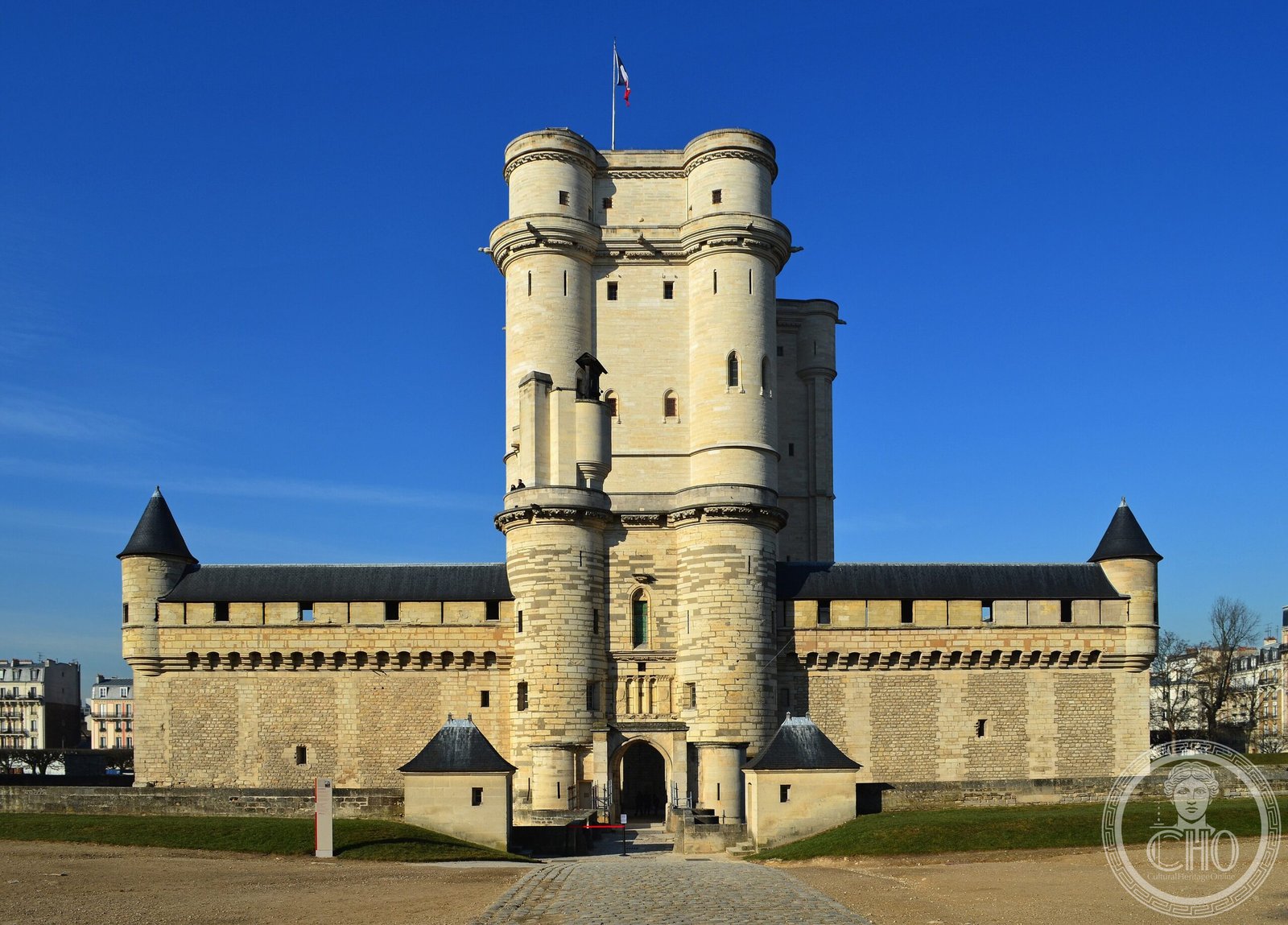
A former royal fortress on Paris’s eastern edge, Château de Vincennes commanded French court life for three centuries. Its soaring keep—once Europe’s tallest—and exquisite Flamboyant Gothic chapel remain monuments to royal power and artistic ambition.
At a glance
Château de Vincennes stands beside the Bois de Vincennes woodland, a short distance from central Paris. Built largely between 1361 and 1369, it served as a favoured royal residence after the Palais de la Cité, offering both grandeur and security through its formidable fortifications. Today, most of the complex opens to visitors.
History
Construction began in 1361 under royal patronage, establishing the château as a stronghold of medieval French kingship. The fortress became particularly valuable during turbulent periods, functioning as a royal sanctuary when Paris itself seemed unsafe. Its thick walls and strategic location made it equally suitable as a military headquarters and, at times, as a prison for high-profile detainees.
The Sainte-Chapelle de Vincennes was begun in 1379 but remained unfinished for over 170 years, finally completed in 1552—a testament to the building’s evolving ambitions across generations. Both chapel and keep received formal historic monument protection: the chapel in 1853, the keep in 1913.
What you see
The château’s defining feature is its “donjon,” a fortified central keep built in the 14th century and the tallest of its kind in Europe. This immense tower once dominated the Paris skyline and commanded views across the eastern approaches to the city.
The Sainte-Chapelle de Vincennes displays exceptional Flamboyant Gothic architecture, with intricate stonework and soaring proportions reflecting the refined tastes of late-medieval court patrons. The chapel’s prolonged construction allowed later generations to refine and embellish its design.
Cultural significance
Château de Vincennes represents a pivotal moment in French royal architecture—the transition from purely defensive military strongholds to residences that balanced security with courtly elegance. Its three-century prominence in royal life made it a cultural touchstone for French nobility, while the chapel’s Flamboyant Gothic style influenced ecclesiastical design across northern Europe.
Key facts
- Country: France
- City: Vincennes
- Coordinates: 48.8428°, 2.4358°
- Major construction: 1361–1369
- Keep: Built 14th century (tallest in Europe)
- Chapel begun: 1379; completed: 1552
- Chapel designated historic monument: 1853
- Keep designated historic monument: 1913
Practical information & getting there
Most of the château is open to the public. It lies on the eastern edge of Paris, adjacent to the Bois de Vincennes. Visitors can reach the site by public transport or car from central Paris.
Sources & resources
Find it on the map
See this place and what’s around it →📷 Become a Cultural Heritage Online photographer
Share your photos of places: they stay published under your name as the author. The more they're seen, the more you get noticed — and soon a contest will reward the most appreciated photos.
Log in or sign up free to add a photoIs this page about you?
This page is read by travellers and heritage enthusiasts who find it on Google. Tell us how you are connected to this place and we will take it from there.