
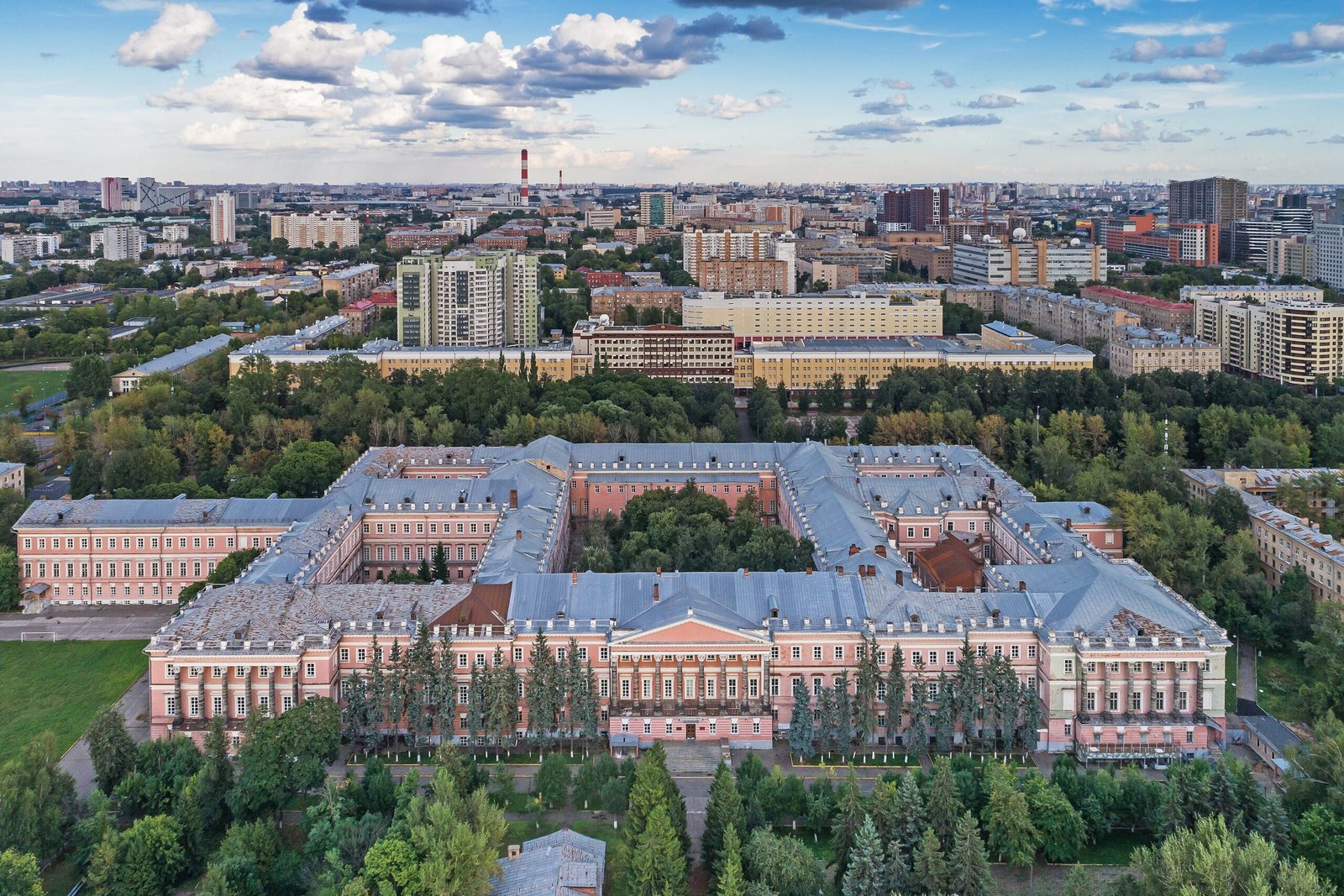
A Neoclassical residence on the Yauza River in Lefortovo, built for Catherine II over the ruins of two earlier palaces and long closed off behind military gates.
At a glance
Not to be confused with its far more photographed namesake at Tsarskoye Selo, this Catherine Palace stands in Moscow’s Lefortovo district. It replaced a Baroque residence that itself had replaced the mansion of Count Fyodor Golovin, the Russian Empire’s first Chancellor. The building bears Catherine II’s name but has spent most of its history serving soldiers, not sovereigns.
History
Golovin’s original house gave the site its early identity. After his death, Empress Anna commissioned Francesco Bartolomeo Rastrelli to build a Baroque complex called Annenhof, her favored residence, made up of two wooden Summer and Winter Palaces. A fire gutted Annenhof in 1746. Catherine II considered what remained old-fashioned and crumbling. She ordered demolition in the 1760s. From 1773 Karl Blank, Giacomo Quarenghi and Francesco Camporesi directed construction of a new Neoclassical residence, completed by 1797. Her son, Emperor Paul, disliked his mother’s palaces intensely. He turned this one into barracks. After Napoleon’s army occupied Moscow in 1812, architect Osip Bove oversaw the palace’s restoration. Military institutions followed one after another, including the Moscow Cadet Corps and later the Malinovsky Tank Academy. In October 1917 cadets stationed here mounted stiff resistance against Bolshevik forces. The surrounding Annenhof Park, already reduced, was further wrecked by a violent tornado that struck Moscow in 1904.
What you see
The palace presents a restrained Neoclassical façade, the work of Blank, Quarenghi and Camporesi under Catherine’s patronage. Wikidata records also credit Antonio Rinaldi among its architects. Little survives to evoke Rastrelli’s vanished Baroque Annenhof. What remains instead is a disciplined, later-century order layered atop demolished timber and fire. The building’s long military occupation has kept its interiors off limits, so its story is read mostly from the outside.
Cultural significance
The site traces nearly the whole arc of imperial Russian taste in one plot of ground. Golovin’s mansion, Rastrelli’s Baroque Annenhof, and Catherine’s Neoclassical rebuilding sit stacked in memory if not in stone. The 1917 cadet stand adds a sharp, later chapter, when the palace briefly became a front line in revolution. Lefortovo Park around it preserves the regular alleys Peter the Great’s era first laid out, a rare surviving planning scheme from that period.
Key facts
- Location: Lefortovo, Moscow, on the Yauza River
- Architects: Karl Blank, Giacomo Quarenghi, Francesco Camporesi; Antonio Rinaldi also credited
- Style: Neoclassical architecture
- Inception: 1797
- Also known as: Golovin Palace
- Heritage-listed site
- Manor grounds: 65.5 hectares
Practical information & getting there
You can walk freely through Lefortovo Park, laid out in 1703 around the Golovinsky and Cross Ponds. Look for the weathered 18th-century Grotto, a stone retaining wall with columns and niches, and the early 20th-century gazebo nearby. The palace itself, and the ground closest to it, remain under military jurisdiction and stay closed to visitors. Entrance to the park costs nothing.
Sources & resources
Find it on the map
See this place and what’s around it →📷 Become a Cultural Heritage Online photographer
Share your photos of places: they stay published under your name as the author. The more they're seen, the more you get noticed — and soon a contest will reward the most appreciated photos.
Log in or sign up free to add a photoIs this page about you?
This page is read by travellers and heritage enthusiasts who find it on Google. Tell us how you are connected to this place and we will take it from there.