

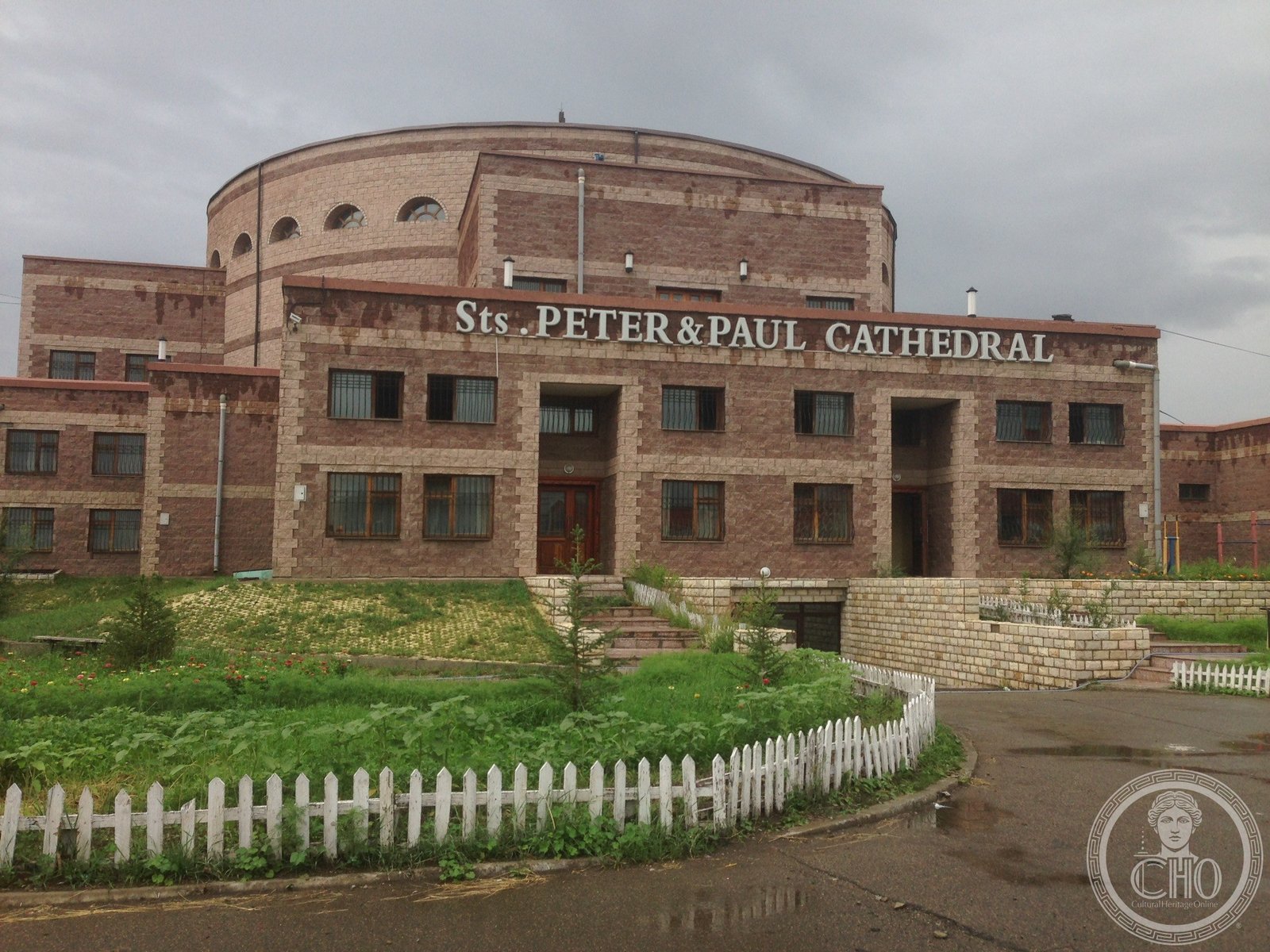
In Ulaanbaatar, the capital of Mongolia, a mission sui iuris of Outer Mongolia was established on 14 March 1922 and renamed the mission sui iuris of Urga in 1924, but all activity ceased almost at once with the arrival of the communist regime. After the democratisation of 1990 and the constitution of 1992, which guaranteed religious freedom, the Holy See established diplomatic relations with Mongolia on 4 April 1992. Three priests of the Congregation of the Immaculate Heart of Mary, the CICM, also known as the Scheut Fathers, came to rebuild the mission: Father Wenceslao Padilla, a Filipino, Father Gilbert Sales and Father Robert Goessens, with Padilla appointed ecclesiastical administrator on 19 April 1992. The Consolata Missionaries, the order of the present prefect, arrived only later, in July 2003. The first Catholic church of modern Mongolia was dedicated in 1996. The present cathedral, designed by the Serbian architect Predrag Stupar in an eclectic style deliberately modelled on the shape of a ger, the traditional Mongolian tent, was completed around 2002 and consecrated on 30 August 2003 by Cardinal Crescenzio Sepe, one day after the episcopal ordination of Padilla himself, which took place in the cathedral on 29 August 2003. Thirty-six semicircular windows and a skylight, added by 2005 to a design by Brother Mark of the Community of Taizé, show the four evangelists in a local reinterpretation: an eagle, an angel, a yak and a snow leopard, in place of the traditional winged bull and lion. The building also holds a statue of the Virgin found among rubbish in 2013 and venerated ever since. Neither the funder nor the exact seating capacity of the cathedral is documented. Mongolia has no diocese in the proper sense: the only Catholic jurisdiction in the country is the apostolic prefecture of Ulaanbaatar, established on 8 July 2002, with this cathedral as its seat. Padilla was its first apostolic prefect until his death on 25 September 2018, and was succeeded by Cardinal Giorgio Marengo, IMC, prefect since 2 April 2020, made a cardinal by Pope Francis in the consistory of 27 August 2022. He thereby became the youngest member of the college of cardinals at the time of his elevation, not, as is sometimes written, the youngest cardinal in the history of the Church. The Mongolian Catholic community remains among the smallest in the world, with figures that vary, by year and by source, between about 900 and 1,500 faithful in the period 2014-2023, against a national population of more than three million people. From 31 August to 4 September 2023 Pope Francis made the first apostolic journey in history to Mongolia. On 2 September he met bishops, priests, missionaries, religious and pastoral workers in this very cathedral, before celebrating a mass at the Steppe Arena and opening, on 4 September, the «House of Mercy», a clinic and shelter run by the Church for homeless people and victims of domestic violence.
About the Cathedral of Saints Peter and Paul
In Ulaanbaatar, the capital of Mongolia, a mission sui iuris of Outer Mongolia was established on 14 March 1922, renamed the mission sui iuris of Urga in 1924, but all activity ceased almost immediately once the communist regime took power. Following Mongolia’s 1990 democratization and its 1992 constitution guaranteeing religious freedom, the Holy See established diplomatic relations with Mongolia on 4 April 1992, and three priests of the Congregation of the Immaculate Heart of Mary (CICM, the Scheut Fathers) — Fr. Wenceslao Padilla, a Filipino, Fr. Gilbert Sales, and Fr. Robert Goessens — arrived to rebuild the mission; the Consolata Missionaries, the order of the current prefect, arrived only later, in July 2003. The current cathedral, designed by Serbian architect Predrag Stupar in an eclectic style deliberately modeled on a traditional ger, was completed around 2002 and consecrated on 30 August 2003 by Cardinal Crescenzio Sepe, one day after Padilla’s own episcopal ordination inside the cathedral on 29 August 2003.
Key facts
- 2002-2003: the cathedral built, shaped like a traditional Mongolian ger.
- 8 July 2002: the Apostolic Prefecture of Ulaanbaatar established, Mongolia’s only Catholic jurisdiction.
- 2005: 36 windows added depicting the four evangelists as an eagle, angel, yak, and snow leopard.
- 27 August 2022: Cardinal Giorgio Marengo becomes the youngest member of the College of Cardinals at his elevation.
- 2 September 2023: Pope Francis visits the cathedral during the first-ever papal journey to Mongolia.
- Mongolia’s Catholic community numbers roughly 900-1,500 faithful, among the smallest nationally in the world.
History
Built barely a decade after Catholic missionaries were allowed to return to a country where communist rule had extinguished the faith by the 1920s, this cathedral was deliberately shaped to look like a ger — a striking act of inculturation for one of the world’s tiniest national Catholic communities. Its own current prefect, Cardinal Giorgio Marengo, became the youngest member of the College of Cardinals in 2022, and the cathedral itself hosted Pope Francis in September 2023, during the first papal visit in Mongolia’s history.
What you see
An eclectic building consciously shaped like a traditional Mongolian ger houses 36 semicircular windows and a skylight, added in 2005, reinterpreting the four evangelists as an eagle, an angel, a yak, and a snow leopard in place of the usual winged bull and lion. Inside stands a statue of the Virgin Mary, found discarded in rubbish in 2013 and venerated ever since.
Practical information
- Opening hours: generally open daily outside services; check current hours before visiting.
- Address: 22 Volodarskovo St., Bayanzürkh district, Ulaanbaatar 690001, Mongolia.
Getting there
The cathedral stands in Ulaanbaatar’s Bayanzürkh district. GPS: 47°54′43″N, 106°58′33″E.
Nearby
- Bayanzürkh district — the central Ulaanbaatar district surrounding the cathedral.
Sources
- Wikipedia — “Saints Peter and Paul Cathedral (Ulaanbaatar),” “Apostolic Prefecture of Ulaanbaatar,” and “Catholic Church in Mongolia” (en.wikipedia.org).
- Vatican News — “Pope at Sts Peter and Paul Cathedral: Called to bring the Gospel to a new people,” 2 September 2023.
- Catholic World Report and Aleteia — coverage of Cardinal Giorgio Marengo’s 2022 elevation.
Find it on the map
See this place and what’s around it →📷 Become a Cultural Heritage Online photographer
Share your photos of places: they stay published under your name as the author. The more they're seen, the more you get noticed — and soon a contest will reward the most appreciated photos.
Log in or sign up free to add a photo