
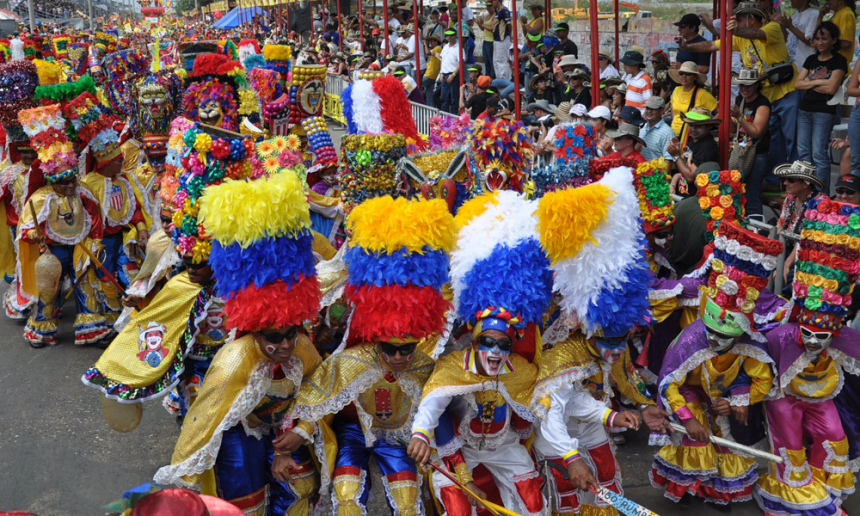
Four days of street dances, masquerade parades, and music that transform Colombia’s Caribbean port city into a stage for centuries-old traditions blending Spanish, African, and indigenous cultures.
In UNESCO’s words
Every year during the four days before Lent, the Carnival de Barranquilla offers a repertory of dances and musical expressions originating from different Colombian sub-cultures. Because of its geographical location situated on the Caribbean coast and the commercial development during the colonial period, the city of Barranquilla became one of the country’s busiest trading centres and a place where European, African, and indigenous peoples and cultures converged. The blending of various local traditions permeates numerous aspects of the carnival, particularly dances (as exemplified by the mico y micas from the Americas, the African congo and the paloteo of Spanish origin), musical genres (the predominant cumbia and variants such as the puya and porro) and folk instruments (tambora and allegre drums, maraca, claves, etc.). Carnival music is generally performed by drum ensembles or by groups playing a variety of wind instruments. The profuse material culture of handcrafted objects includes floats, costumes, head ornaments and animal masks. Groups of masqueraded dancers, actors, singers and instrumentalists delight crowds with theatrical and musical performances based on historical as well as current events. Contemporary political life and figures are satirized through mocking speeches and song lyrics that lend a burlesque atmosphere to the carnival. With its growing success in the twentieth century, Barranquilla’s carnival took on the trappings of a professional event, receiving wide media coverage. This development generates economic benefits for many low-income families, but the growing commercialisation may at the same time constitute a threat to the many traditional expressions.
Official description, UNESCO Intangible Cultural Heritage List — Carnival of Barranquilla
At a glance
The Carnival de Barranquilla takes place during the four days before Lent and brings together dances and musical styles rooted in European, African, and indigenous traditions. Performers and spectators experience cumbia and related musical genres played by drum ensembles and wind groups, alongside dances such as the Spanish paloteo, African Congo, and indigenous mico y micas. The event features elaborate handcrafted costumes, floats, masks, and animal ornaments that transform participants into theatrical performers who engage crowds with song, speech, and movement.
Origins & history
Barranquilla's position on the Caribbean coast made it a major trading center during the colonial period, drawing together European, African, and indigenous peoples. This convergence of populations allowed their distinct festive traditions to blend over time, creating the carnival's mixed character. The tradition emerged from this cultural interaction and grew into the prominent annual event of the present day.
The practice
Groups of masqueraded dancers, singers, actors, and instrumentalists perform throughout the four-day celebration. Drum ensembles and wind instrument groups provide music, while dancers move to cumbia, puya, and porro rhythms. Performers wear handcrafted costumes, head ornaments, and animal masks. The carnival includes theatrical and musical performances based on both historical and current events, with contemporary political figures and life often presented through mocking speeches and satirical song lyrics that create a burlesque atmosphere.
Cultural significance
The carnival represents the blending of European, African, and indigenous American cultures and serves as an expression of community identity. Its growing twentieth-century success brought economic benefits to many low-income families through the carnival's professional development and media attention. However, this commercialisation poses a threat to the preservation of traditional musical and dance expressions that form the foundation of the celebration.
Key facts
- Country: Colombia
- Inscribed: 2008
- UNESCO list: Representative List of the Intangible Cultural Heritage of Humanity
- UNESCO reference: 00051
- UNESCO vocabulary: Carnival; Dance; Procession
- Map: Barranquilla — the locality named in UNESCO’s official description of this element
Where to experience it
During the four days before Lent, Barranquilla transforms into a sprawling celebration where visitors encounter the Carnival's full repertory of dances, music, and theatre. The streets fill with masqueraded dancers, drum ensembles, and groups performing cumbia, puya, and porro—genres born from the city's convergence of European, African, and indigenous cultures. Handcrafted floats, costumes, and animal masks parade through crowds, while performers satirize contemporary political figures and events through song and mocking speeches. Professional productions now accompany traditional expressions, making the carnival both a living cultural practice and a major media event that draws participants and observers from across the region.
Sources & resources
- UNESCO — official element page: Carnival of Barranquilla
- UNESCO — open data record: Intangible Heritage List, reference 00051
- UNESCO — official video: UNESCO film on this element — embedded on this page
- UNESCO — official photograph: Photograph of this element — Vivien Saad
- Reference — Wikipedia (secondary): Barranquilla Carnival — consulted as a secondary reference, not as confirmation
- Cultural Heritage Online: Our archive and city guides

Find it on the map
See this place and what’s around it →📷 Become a Cultural Heritage Online photographer
Share your photos of places: they stay published under your name as the author. The more they're seen, the more you get noticed — and soon a contest will reward the most appreciated photos.
Log in or sign up free to add a photo