

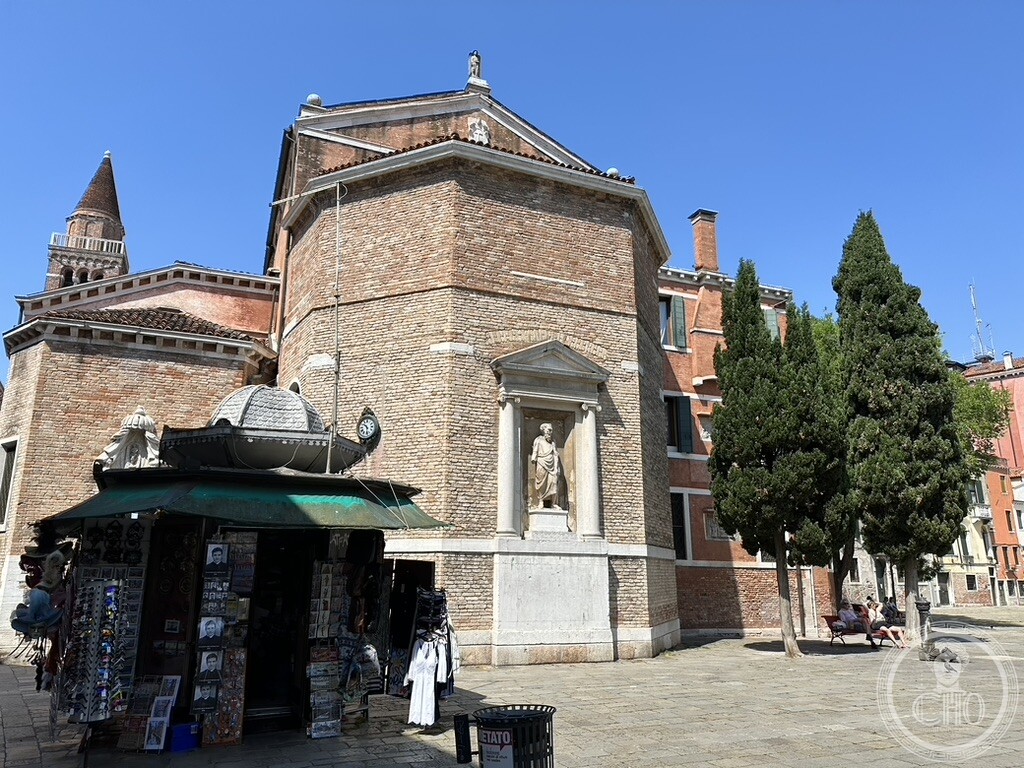
Second in size only to Piazza San Marco, Campo San Polo was for centuries the raucous civic stage of Venice—hosting bull-baiting spectacles, carnival masquerades, and military drills—watched over by an ancient church whose brick flank still preserves a severe 1611 magistracy decree threatening blasphemers with the galleys.
At a glance
Spanning an immense open expanse in the heart of the San Polo district, Campo San Polo is the largest civic square in Venice after the Piazza. Originally an unpaved pasture and horse-trading market crossed by a canal, the square was paved in herringbone brick in 1493 and fitted with a central public cistern. It quickly became Venice’s premier outdoor arena for popular entertainment, bull runs (cacce ai tori), masked balls, and public preachings. Anchoring its eastern perimeter stands the Chiesa di San Polo, a parish church founded in the 9th century that pairs 15th-century Gothic brickwork with a fascinating treasury of civic inscriptions.
Key facts
- Square scale: Largest open campo in Venice after Piazza San Marco; paved in 1493
- Church foundation: Founded c. 837 under Doge Pietro Tradonico; rebuilt in Gothic style in the 15th century and modified by David Rossi in 1804
- Famous events: The assassination of Lorenzino de’ Medici in 1548 took place on this square as he exited the church
- Artistic treasures inside: Giandomenico Tiepolo’s 14 Via Crucis (Stations of the Cross, 1747–1749) in the Oratorio del Crocifisso, Tintoretto’s Last Supper, and works by Paolo Veronese
- Exterior relief: A sculpted 17th-century marble tabernacle carrying a 1611 bando issued by the Esecutori contro la Bestemmia
- GPS: 45.43722, 12.33006 · Open in Google Maps
History
Until the late 15th century, San Polo was an uneven meadow where livestock grazed and horses were bought and sold. When the Republic paved the campo in 1493 and sealed the surrounding Rio Sant’Antonin, it created a vast communal forum that offered a secular counterpart to the ducal dignity of Piazza San Marco. Here the Venetian state allowed unrestrained public spectacle: annual bull-baitings where mastiffs fought bulls in front of tiered wooden bleachers, acrobatic tightrope walkers, and clandestine political intrigues.
On 26 February 1548, one of the Renaissance’s most infamous political assassinations was carried out on Campo San Polo: Lorenzino de’ Medici, who had murdered Duke Alessandro de’ Medici in Florence eleven years earlier, was tracked down and stabbed to death by assassins in the pay of Emperor Charles V as he stepped out into the square.
What you see
Entering the square, one is struck by its sheer openness—a rare luxury in a city of claustrophobic calli. The perimeter is lined by prestigious patrician palaces, including Palazzo Tiepolo, Palazzo Soranzo with its Gothic polyphora windows, and Palazzo Donà. Shady hackberry trees shade benches on the northern rim where local children play football and residents read newspapers.
Projecting into the square from the south is the brick polygonal apse of the Church of San Polo, flanked by a classical aedicule niche housing a statue of Saint Paul. Set high on the church’s exposed brick wall facing the square is one of the most expressive public legal monuments in the city: a carved Istrian stone tabernacle framed by draped curtains, angels, and the Holy Sacrament.
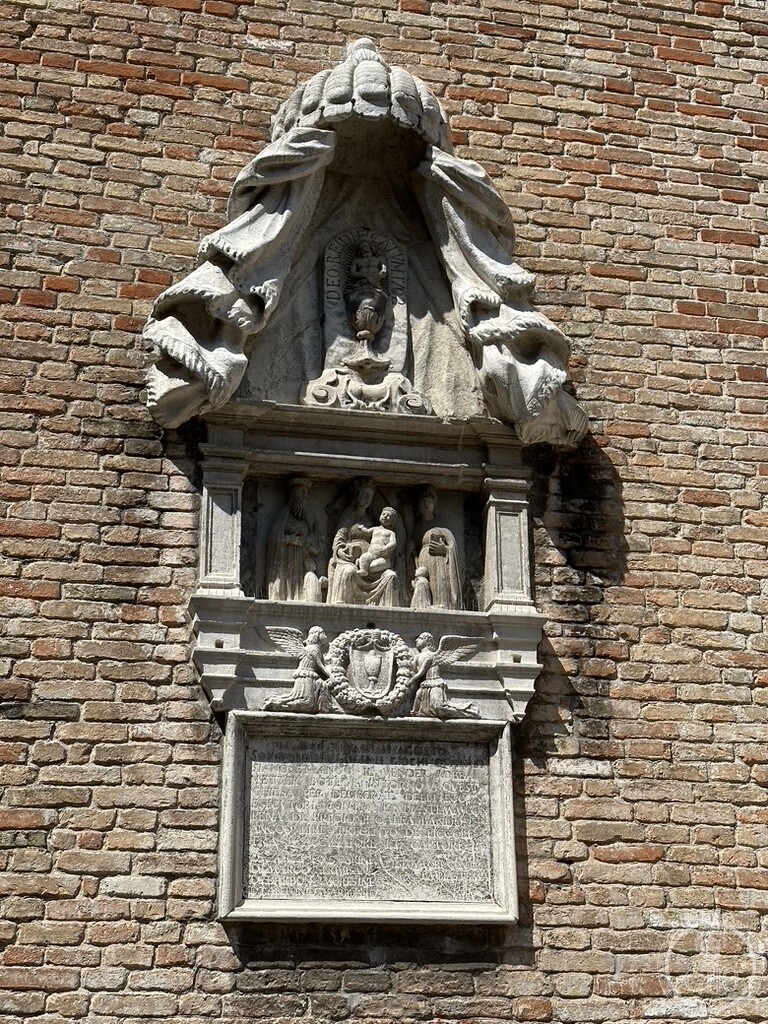
Beneath the sculptured Virgin and Child sits a stone plaque dated 11 August 1611, carved with an authoritative decree from the Esecutori contro la Bestemmia—the Venetian magistracy tasked with suppressing blasphemy, gambling, and public disorder. The inscription warns that anyone playing games, setting up illicit stalls, or uttering foul language around the sacred perimeter faces immediate imprisonment, heavy fines, or forced labor on the Venetian galleys.
Practical information
- The Campo: Open public square, accessible 24/7 at no cost
- Church visits: The Chiesa di San Polo belongs to the Chorus Circuit; open Monday to Saturday (typically 10:30 to 17:00), Chorus pass or single entry ticket required for interior access
- Summer outdoor cinema: During July and August, Campo San Polo hosts Venice’s beloved open-air film festival (Cinema sotto le stelle) with a giant screen erected under the night sky
- Recommended duration: 20 minutes for the square, historic palaces, and exterior plaques; 45 minutes if visiting the church interior and Tiepolo frescoes
Getting there
Situated in the center of the San Polo district, halfway between the Rialto and the Frari. It is a five-minute walk from the San Silvestro vaporetto stop on the Grand Canal (Line 1) or eight minutes from the Rialto Bridge via Ruga Vecchia San Giovanni.
Nearby
- The Bell Tower of San Polo and Its Two Lions — directly around the corner of the church on Salizada San Polo
- Scuola Grande di San Rocco — six minutes west across Rio de San Polo
- Santa Maria Gloriosa dei Frari — six minutes west
Sources
- Chorus Association — Church of San Polo historical dossier and art inventory (chorusvenezia.org)
- Tassini, Giuseppe. Curiosità Veneziane. Notes on Campo San Polo, Lorenzino de’ Medici, and the bull hunts.
- Magistrato agli Esecutori contro la Bestemmia — State Archives of Venice (ASVe), decrees and legal tablets on public morality.
- Geographical coordinates: 45.43722, 12.33006.
Find it on the map
See this place and what’s around it →Record researched and written by Carla Szathvary for Cultural Heritage Online, 2026.
📷 Become a Cultural Heritage Online photographer
Share your photos of places: they stay published under your name as the author. The more they're seen, the more you get noticed — and soon a contest will reward the most appreciated photos.
Log in or sign up free to add a photoIs this page about you?
This page is read by travellers and heritage enthusiasts who find it on Google. Tell us how you are connected to this place and we will take it from there.