

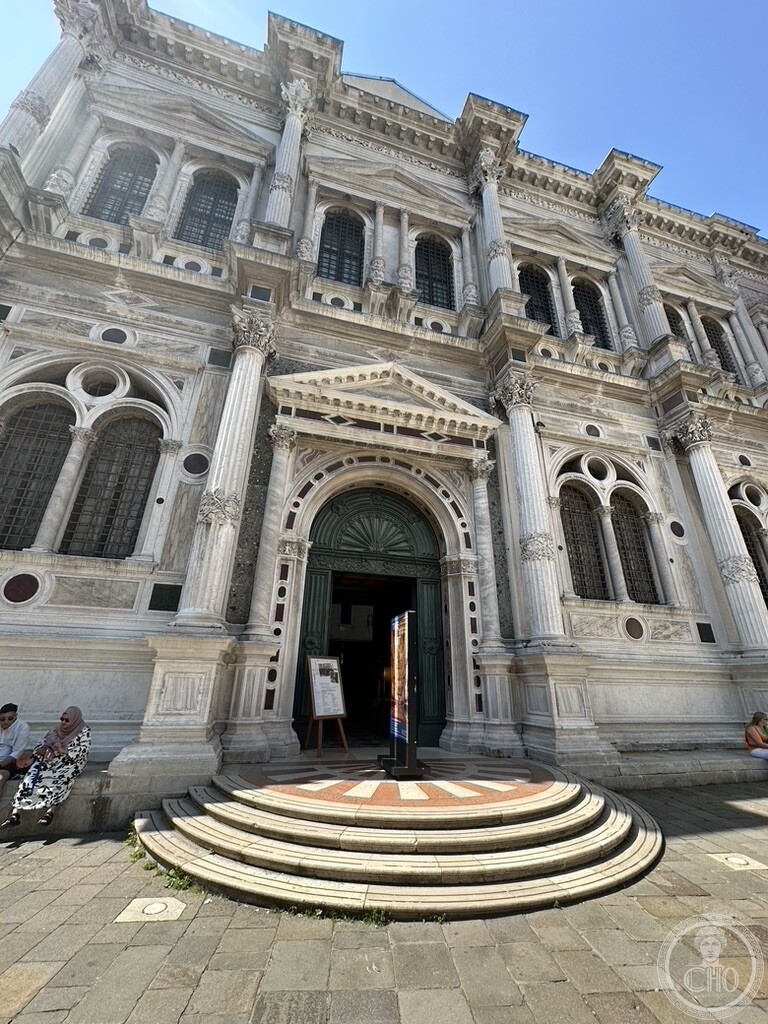
A lay brotherhood founded against the plague grew rich enough to build one of the finest Renaissance fronts in Venice, then spent twenty-four years filling it with Tintoretto. More than sixty of his canvases still hang where they were painted to hang.
At a glance
The Scuola Grande di San Rocco stands on Campo San Rocco, a small stone square behind the apse of the Frari, facing the church of the same name. Founded in 1478 as a charitable lay confraternity during an outbreak of plague, it became one of the wealthiest institutions of the Republic and spent that wealth on a single, unbroken commission. It is the one Venetian scuola grande that came through the fall of the Republic without being dissolved, and it still works as a charitable body today.
Key facts
- Founded: 1478 by Venetian citizens after a severe outbreak of plague; raised to Scuola Grande by the Council of Ten in 1489
- Architects: Bartolomeo Bon, Sante Lombardo, Antonio Abbondi (called Scarpagnino) and Gian Giacomo de’ Grigi; completed 1560
- The Tintoretto cycle: more than 60 canvases painted over 24 years (1564–1588) by Jacopo Tintoretto, still in the places they were made for
- Relics: the body of Saint Roch, patron against the plague, acquired in 1485
- Survival: spared the wholesale suppression that ended the other confraternities under Napoleon
- Address: Campo San Rocco, San Polo 3052, 30125 Venice
- GPS: 45.43654, 12.32527 · Open in Google Maps
History
Venetian scuole grandi were civic brotherhoods that worked apart from both the parish clergy and the ducal government, pooling patrician and merchant money for mutual aid, funerals and charity. In 1485 this one obtained what it held to be the relics of Saint Roch from Montpellier, and the San Polo site became a place of pilgrimage with a following across Europe.
Money followed: gifts, legacies, and thanksgiving offerings from citizens who had survived one epidemic after another. In 1564 the confraternity held a competition to decorate the ceiling of the Sala dell’Albergo. While Paolo Veronese, Giuseppe Salviati and Federico Zuccari worked up their preparatory sketches, Jacopo Tintoretto measured the ceiling in secret, painted a finished canvas of Saint Roch in Glory, and had it fixed in the frame before the judges sat down. He won by giving the painting away, and stayed twenty-four years.
What you see
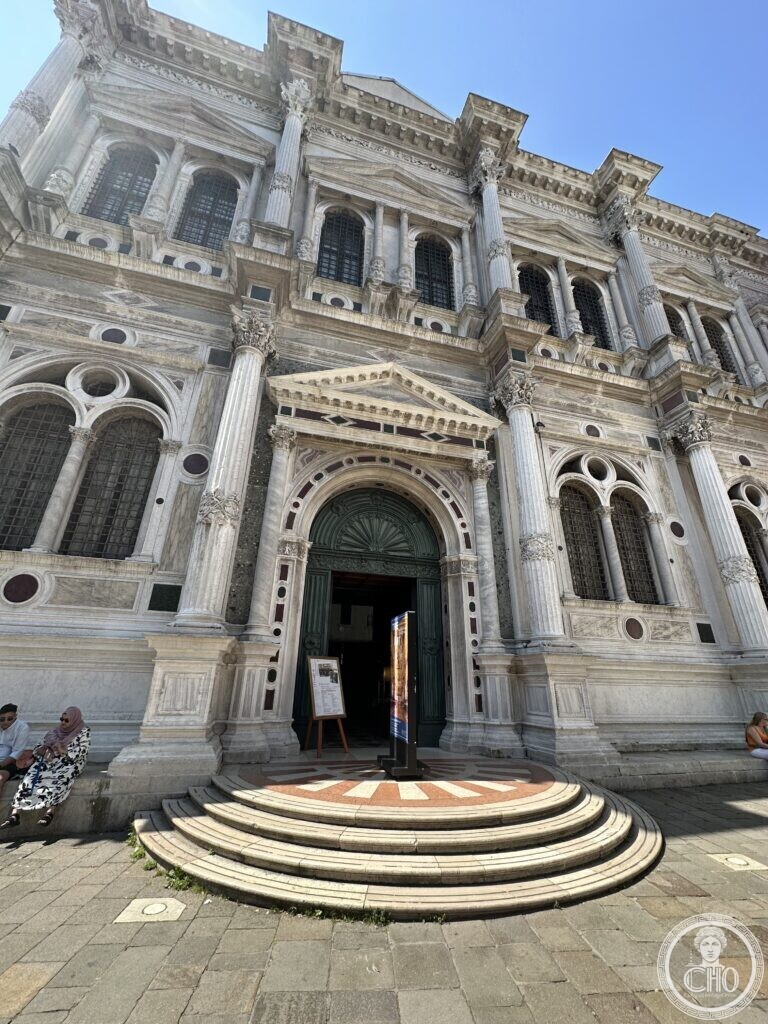
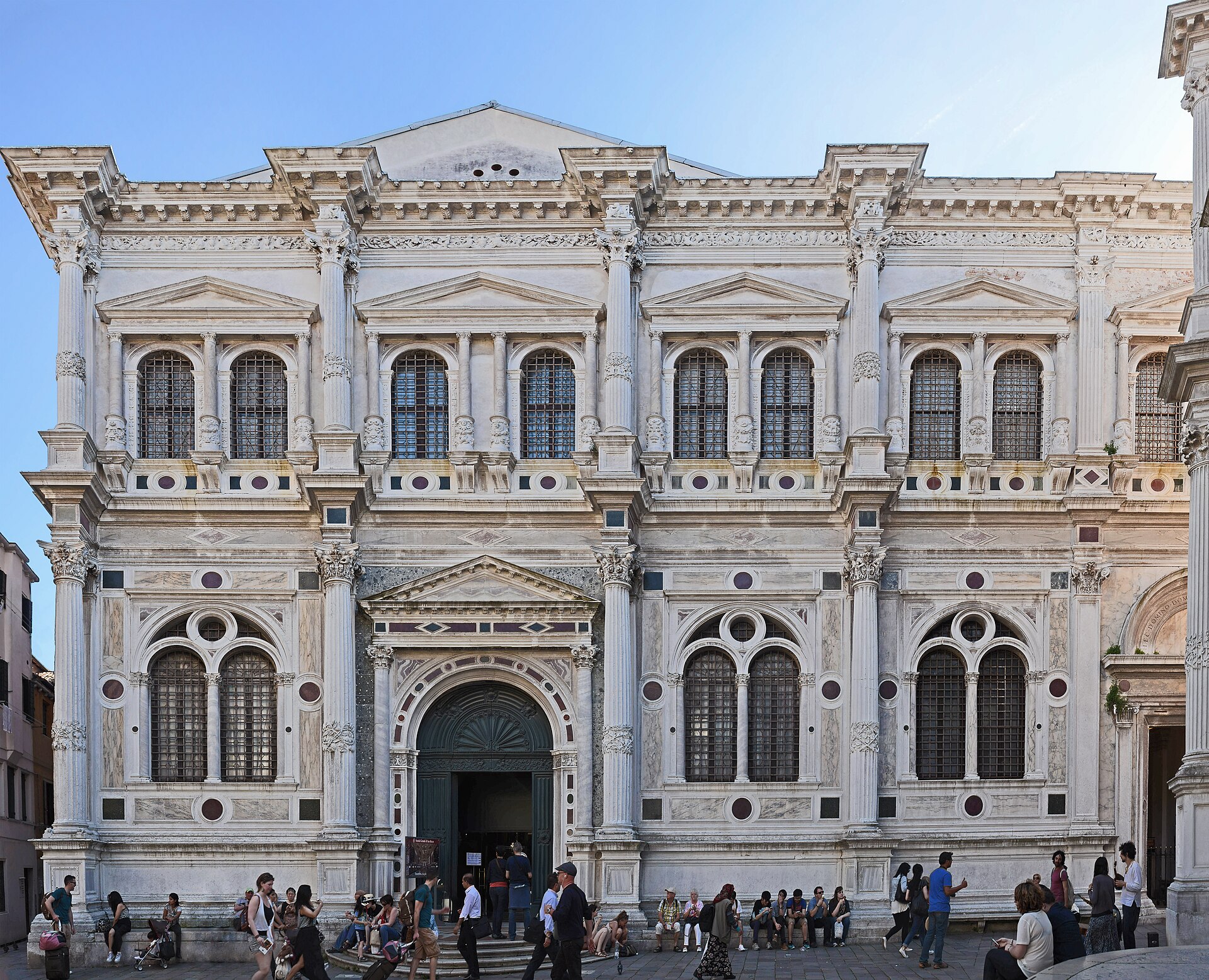
Two storeys of fluted Corinthian columns, deep friezes, roundels of coloured marble and a rhythm of arched windows, all in Istrian stone that holds the light. At the portal the pavement rises in a semicircular flight of shallow steps, drawing you into the ground-floor hall, the Sala Terrena. The building went up over some seventy years and under four architects.
Across the campo stands the church of San Rocco, whose front was rebuilt between 1765 and 1771 by Bernardino Maccaruzzi. The two faces of stone, a few metres apart, are separated by two and a half centuries.
Practical information
- Open daily as a museum; tickets on site or through the confraternity’s own site, scuolagrandesanrocco.org
- Hand mirrors are lent in the upper hall, the Sala Superiore, so that the ceiling can be looked at without craning
- Allow an hour and a half to two hours inside
- Telephone 041 523 4864
Getting there
San Polo, immediately behind the Frari. The nearest waterbus stop is San Tomà (lines 1 and 2), five minutes on foot; from Ferrovia or Piazzale Roma it is ten to twelve minutes across the Rio Marìn and Campo San Stin.
Nearby
- Campo San Rocco — the square the building stands on
- The Church of San Rocco — facing it across the campo, with the saint’s body at the high altar
- Santa Maria Gloriosa dei Frari — adjoining to the northeast, with Titian’s Assumption and his tomb
- Scuola Grande di San Giovanni Evangelista — five minutes north along Calle dell’Olio
Sources
- Scuola Grande Arciconfraternita di San Rocco, official site and archive — scuolagrandesanrocco.org
- Giulio Lorenzetti, Venezia e il suo estuario — on the building and the confraternity
- Tom Nichols, Tintoretto: Tradition and Identity — on the San Rocco commission and the 1564 competition
- Coordinates checked against OSM Nominatim, 23 September 2026: 45.4365420, 12.3252684
Gallery
Find it on the map
See this place and what’s around it →

📷 Become a Cultural Heritage Online photographer
Share your photos of places: they stay published under your name as the author. The more they're seen, the more you get noticed — and soon a contest will reward the most appreciated photos.
Log in or sign up free to add a photoIs this page about you?
This page is read by travellers and heritage enthusiasts who find it on Google. Tell us how you are connected to this place and we will take it from there.