
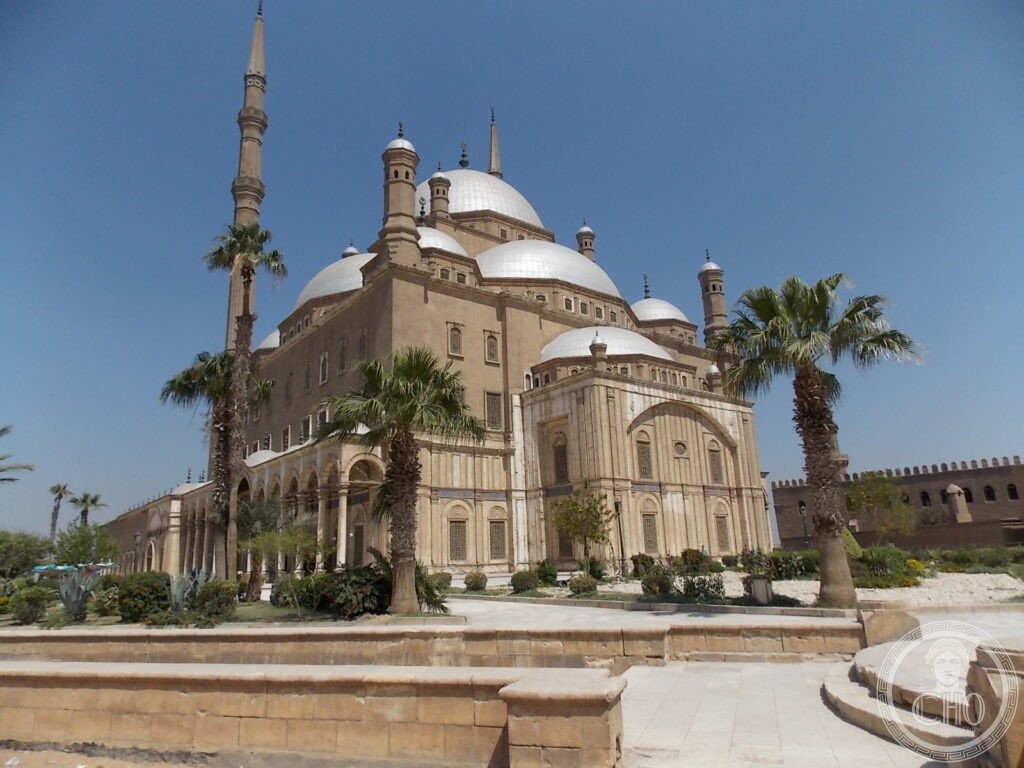
Raised on the Mokattam Hills above Cairo, the Citadel founded by Saladin in 1176 served as the seat of Egypt’s rulers for seven centuries. Its skyline is defined by the alabaster-clad Muhammad Ali Mosque and its vast Ottoman dome, while the northern walls give one of the widest views over the old city, reaching as far as the Pyramids of Giza on a clear day.
At a glance
The Cairo Citadel was begun in 1176 by Saladin, who needed a stronghold on the eastern edge of the city capable of resisting the Crusader threat. Built on the Mokattam Hills, it is enclosed by walls running for roughly two kilometres and reinforced by more than thirty towers. Within the enclosure, Joseph’s Well was cut through solid rock to a depth of 87 metres to secure a water supply; despite its name it commemorates the Biblical Joseph rather than Saladin, whose full name was Yusuf ibn Ayyub.
For seven hundred years the Citadel remained the residence of Egypt’s rulers, from Saladin’s Ayyubid successors through the Mamluk sultans to the Ottoman viceroys and, finally, Muhammad Ali Pasha.
Key facts
- Founded: 1176 by Saladin, on the Mokattam Hills at Cairo’s eastern edge
- Muhammad Ali Mosque: built 1830–1848 by the Istanbul architect Yusuf Bushnak for Muhammad Ali Pasha; the lower interior is clad in Ottoman alabaster
- Dome: 52 metres high and 21 metres in diameter, the largest Ottoman dome in North Africa
- Mosque of al-Nasir Muhammad: the principal Mamluk monument in the Citadel, built 1318–1335
- UNESCO status: part of Historic Cairo, inscribed as a World Heritage Site in 1979
- Coordinates: 30.0285° N, 31.2604° E
History
Saladin, a Kurd who founded the Ayyubid dynasty and recaptured Jerusalem from the Crusaders in 1187, began the Citadel in 1176 as a defensive stronghold for Cairo. Power passed in 1250 to the Mamluks, a warrior caste of former slaves who had seized control from the Ayyubids; their most significant addition to the Citadel is the Mosque of al-Nasir Muhammad, built between 1318 and 1335, whose entrance portal incorporates Gothic columns taken from Crusader buildings.
The Ottoman sultan Selim I conquered Egypt in 1517 and installed a Janissary garrison in place of the Mamluk administration. Mamluk influence endured until 1811, when Muhammad Ali Pasha lured the surviving Mamluk leaders to a banquet at the Citadel and had them massacred, consolidating his own rule. Muhammad Ali, who reigned from 1805 to 1848 and is regarded as the founder of modern Egypt, built factories, sent students to study in Europe and laid Africa’s first railway. His successors took the title of Khedive; under Khedive Ismail the Suez Canal opened in 1869. Britain occupied Egypt from 1882 until independence in 1922. The Citadel and the surrounding old quarters were inscribed by UNESCO as Historic Cairo in 1979.
What you see
The Citadel divides into two main enclosures. The Southern Enclosure holds the Muhammad Ali Mosque, Joseph’s Well and the former royal harem, now converted into museum space. The Northern Enclosure contains two further museums and the Mosque of al-Nasir Muhammad, and its walls offer the best panoramic views over Cairo. The Muhammad Ali Mosque itself combines Ottoman alabaster cladding with a marble ablutions fountain sheltered by an ornate portico, and its courtyard holds two clock towers: the mosque’s own working Ottoman clock, and an ornamental clock presented by King Louis-Philippe of France in 1845 in exchange for the obelisk now standing in the Place de la Concorde in Paris, which has never worked.
From the northern walls, visitors look out over a city nicknamed the City of a Thousand Minarets; on clear days, usually in winter or after rain when Cairo’s habitual haze lifts, the Pyramids of Giza are visible to the south-west.
At the foot of the Citadel hill, in Fustat, stands the National Museum of Egyptian Civilisation, with eleven galleries covering Egyptian history from prehistory to the modern era. In April 2021 the museum received twenty-two royal mummies, transferred from the Egyptian Museum in a procession using horse-drawn carriages in historical style.
Practical information
- Time on site: the Citadel rewards an unhurried visit; many people leave the Muhammad Ali Mosque for last to see the sunset light through its alabaster windows
- Military Museum: housed in the former Harem Palace within the Citadel
- Carriage Museum: displays carriages used by Egyptian royalty from Muhammad Ali to Farouk I
- Tickets and hours: check the current arrangements through the site’s official tourism channels before visiting
Getting there
Cairo International Airport serves the city. The Citadel stands in Islamic Cairo, a few kilometres from downtown Cairo and Tahrir Square. The nearest metro stop is Mar Girgis, meaning Saint George, on Line 1, from where a short taxi or tuk-tuk ride covers the remaining distance to the Citadel. Many visitors combine a morning at the Citadel with a walk down to the Khan el-Khalili bazaar and on to the Ibn Tulun Mosque, built in 879.
Nearby
- Pyramids of Giza — around 17 kilometres west, visible from the Citadel on clear days; site of the Great Pyramid of Khufu, standing 138 metres and the only surviving ancient Wonder of the World, alongside the Sphinx and the Solar Boat Museum
- Egyptian Museum, Tahrir Square — about 4 kilometres north; opened in 1902 and home to the Royal Mummies Hall and the solid gold mask of Tutankhamun, weighing 10.23 kilograms; the Grand Egyptian Museum at Giza has since opened as a further home for the collection
- Khan el-Khalili — roughly 1.5 kilometres north of the Citadel; the bazaar dates from 1382 and trades in gold, silver, spices, papyrus and alabaster; the Café el-Fishawi nearby has operated continuously since 1773 and is associated with the Nobel laureate Naguib Mahfouz, who set many novels in these streets
- Al-Azhar University and the City of the Dead — both within the wider Historic Cairo district; Al-Azhar is one of the world’s oldest continuously operating universities, while the City of the Dead is a Mamluk and Fatimid necropolis where a large resident population still lives among the mausolea
Sources
- Wikipedia, Cairo Citadel
- Wikipedia, Muhammad Ali Mosque
- Wikipedia, Mosque of al-Nasir Muhammad
- Wikipedia, Saladin
- UNESCO, Historic Cairo
- Max Rodenbeck, Cairo: The City Victorious, Knopf, 1999
Find it on the map
See this place and what’s around it →📷 Become a Cultural Heritage Online photographer
Share your photos of places: they stay published under your name as the author. The more they're seen, the more you get noticed — and soon a contest will reward the most appreciated photos.
Log in or sign up free to add a photoIs this page about you?
This page is read by travellers and heritage enthusiasts who find it on Google. Tell us how you are connected to this place and we will take it from there.