
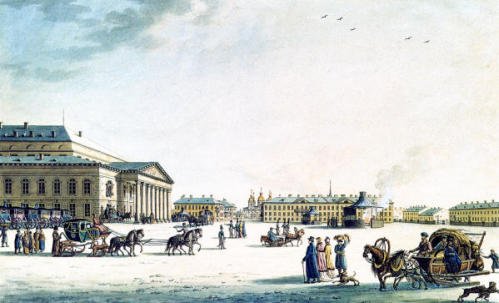
For over a century a Neoclassical theatre stood at the heart of Russian opera and ballet, its stage hosting Glinka, Verdi and Petipa before it vanished under the walls of the Saint Petersburg Conservatory.
At a glance
The Bolshoi Kamenny Theatre opened in 1783 as the Kamenny, or Stone, Theatre, designed by Antonio Rinaldi. It was rebuilt, renamed, burned, restored, and eventually demolished. Nothing of the structure remains today; the site is now occupied by the Conservatory.
History
Construction finished in 1783. Giovanni Paisiello’s opera Il mondo della luna opened the house on 24 September that year. In 1802 the architect Thomas de Thomon rebuilt the theatre and gave it its Bolshoi name. Fire destroyed the building in 1811. It rose again in 1818, then between 1826 and 1836 Alberto Cavos reworked the interior to fit newer stage machinery. For decades it served as the principal home of both the Imperial Ballet and the Imperial Russian Opera. In 1886 officials judged the building unsafe. Director Ivan Vsevolozhsky moved both companies to the Mariinsky Theatre, where they remain. The old theatre was demolished to make room for the Saint Petersburg Conservatory.
What you see
Nothing survives above ground. Rinaldi’s original design followed Neoclassical convention, later reshaped twice by de Thomon and Cavos to answer fire, fashion and the demands of a growing repertoire. The Conservatory now stands on the footprint, leaving only archival plans and prints to suggest the theatre’s scale and stagecraft.
Cultural significance
Few vanished buildings carry so dense a premiere history. Glinka’s A Life for the Tsar reached the stage here in 1836, followed by Ruslan and Lyudmila in 1842. Verdi’s La forza del destino had its first performance in this house in 1862. Marius Petipa staged The Pharaoh’s Daughter the same year, and later The Little Humpbacked Horse and La Bayadère. These works shaped Russian opera and classical ballet for generations. The theatre’s closure in 1886 marks the moment the Mariinsky assumed the role it still holds today.
Key facts
- Original architect: Antonio Rinaldi (1783)
- Rebuilt by: Thomas de Thomon (1802)
- Later modified by: Alberto Cavos (1826–1836)
- Style: Neoclassical
- Fate: demolished; site now occupied by the Saint Petersburg Conservatory
- Location: Saint Petersburg, Russia
Practical information & getting there
The theatre no longer exists, so there is nothing to visit on site. You can instead see the Saint Petersburg Conservatory, built where the Bolshoi Kamenny once stood, and the Mariinsky Theatre, which inherited its companies and much of its repertoire. Both sit within central Saint Petersburg and are easily reached on foot from the historic theatre district.
Sources & resources
Find it on the map
See this place and what’s around it →📷 Become a Cultural Heritage Online photographer
Share your photos of places: they stay published under your name as the author. The more they're seen, the more you get noticed — and soon a contest will reward the most appreciated photos.
Log in or sign up free to add a photoIs this page about you?
This page is read by travellers and heritage enthusiasts who find it on Google. Tell us how you are connected to this place and we will take it from there.