
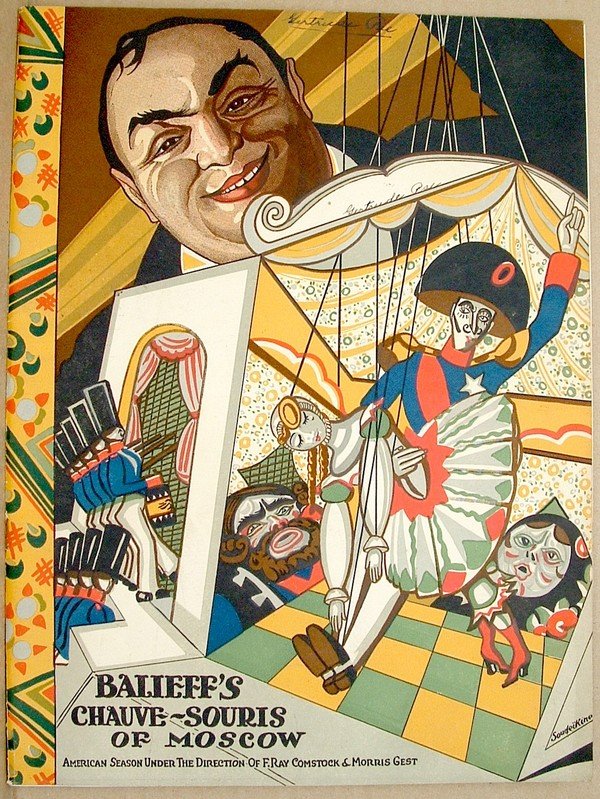
A basement cabaret in Moscow grew into one of the most travelled stage sensations of the 1920s, carrying Russian song and sly comedy from a private theatre club to Broadway and back again.
At a glance
La Chauve-Souris (“The Bat”) began as a Moscow theatre troupe founded around 1906–1908 by actor Nikita Balieff and Nikolai Tarasov. It later became a touring revue of songs, dances, and short sketches, most drawn from Russian sources. After the 1917 Revolution it re-formed in exile, played Paris and London, then crossed to America, where it ran on Broadway across several seasons through 1931.
History
Balieff worked without speaking parts for years at the Moscow Art Theatre under Stanislavski. Frustrated, he and Tarasov started a comic cabaret in a basement near the theatre, naming it after Vienna’s Fledermaus. The troupe thrived in Moscow until war and revolution scattered its audience. Balieff went into exile. La Chauve-Souris reopened in Paris in December 1920. British producer Charles B. Cochran saw it and brought Balieff’s company to London. Producer Morris Gest then arranged an American tour. The revue opened on Broadway in February 1922 and returned five more times through 1929, plus a final run billed New Chauve-Souris in 1931. Balieff appeared on the cover of Time in 1927. He staged one last production in 1934, his final theatrical venture.
What you see
There is no building to visit. The show itself was the architecture, a sequence of songs, dances, and sketches stitched together by Balieff as master of ceremonies. He performed a feigned lack of English, mixing Russian, French, and slang with heavy gesticulation, though offstage his English was fluent. The best-known number, The Parade of the Wooden Soldiers, set toy troops marching to Leon Jessel’s tune, spinning a legend about Tsar Paul I forgetting to call a halt. It became a fixture of the revue and, decades later, entered the Rockettes’ Radio City Christmas Spectacular.
Cultural significance
La Chauve-Souris helped popularize Russian émigré performance style in Western capitals during the interwar years. Its success was substantial enough to spawn a same-season parody: No Sirree!, staged for one night in April 1922 by the Algonquin Round Table, with Dorothy Parker, Robert Benchley, Tallulah Bankhead, and Jascha Heifetz among the contributors. The Parade of the Wooden Soldiers segment was also captured on film by Lee DeForest using his Phonofilm sound process, premiering in April 1923 at New York’s Rivoli Theater. That print survives in the Library of Congress. Several recordings of numbers from the revue, in Russian, French, and German, likewise preserve fragments of the touring repertoire.
Key facts
- Founded in Moscow by Nikita Balieff with Nikolai Tarasov, around 1906–1908
- Paris premiere as La Chauve-Souris: December 1920
- Broadway runs: 1922, 1923, 1925, 1927, 1929, and 1931 (as New Chauve-Souris)
- Balieff featured on the cover of Time magazine, 1927
- Signature act: The Parade of the Wooden Soldiers, music by Leon Jessel
- Filmed segment premiered 15 April 1923 at the Rivoli Theater, New York
Practical information & getting there
You cannot visit La Chauve-Souris as a site; it existed as a travelling production, not a fixed venue. Its traces survive instead in archives. The 1923 Phonofilm of Parade of the Wooden Soldiers is held in the Library of Congress’s Maurice Zouary collection. Period 78 rpm recordings of numbers from the revue, sung in Russian, French, and German, can be sought through discographical and archival listings. Readers curious about the Moscow origins can start from the coordinates linked to the troupe’s founding city, though no original venue is known to remain open to the public.
Sources & resources
Find it on the map
See this place and what’s around it →📷 Become a Cultural Heritage Online photographer
Share your photos of places: they stay published under your name as the author. The more they're seen, the more you get noticed — and soon a contest will reward the most appreciated photos.
Log in or sign up free to add a photoIs this page about you?
This page is read by travellers and heritage enthusiasts who find it on Google. Tell us how you are connected to this place and we will take it from there.