
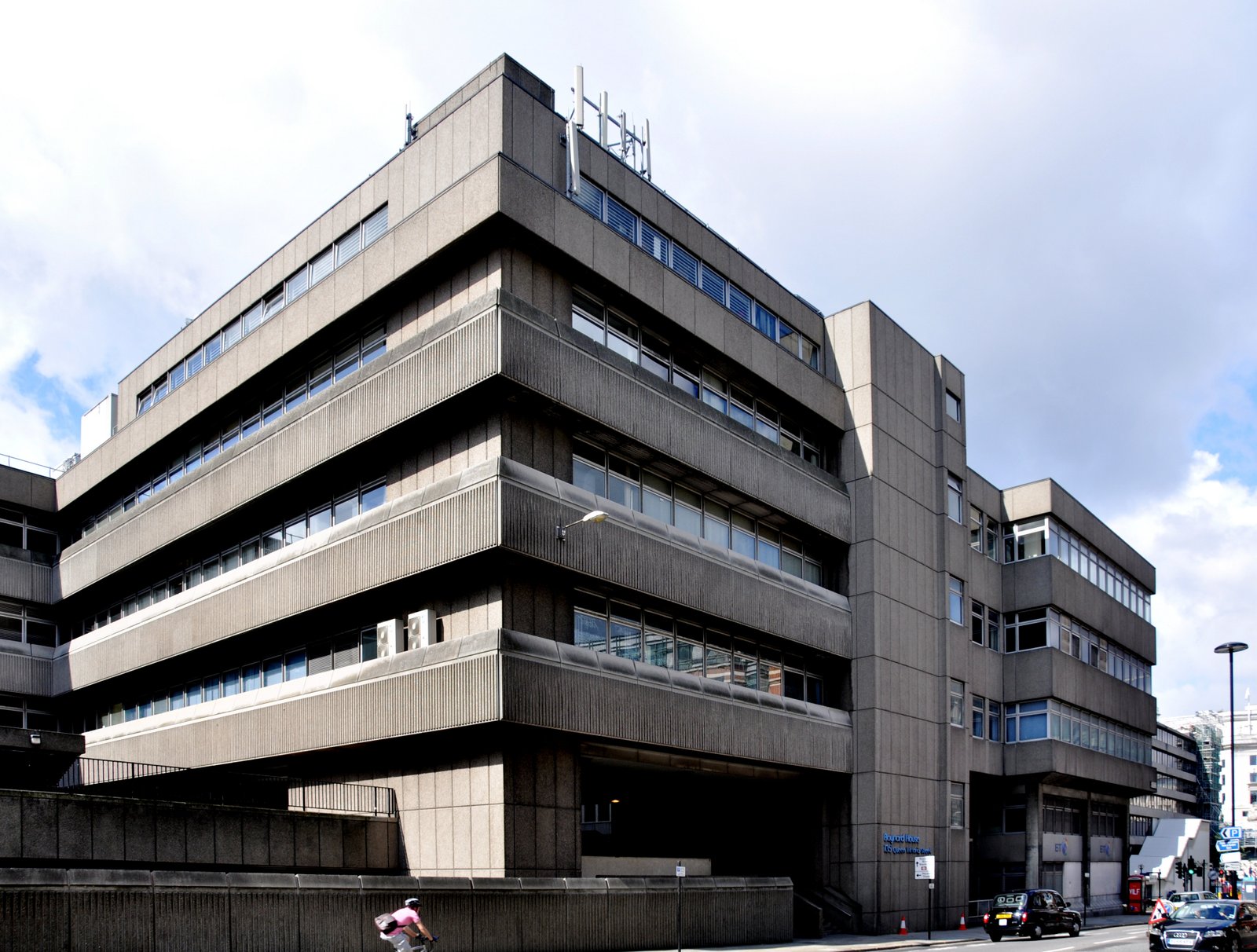
A modernist office tower on Queen Victoria Street, Baynard House stands on the site of a medieval castle and carries forward centuries of history beneath its concrete facade.
At a glance
Baynard House is a brutalist office block in the Blackfriars ward of the City of London, currently occupied by BT Group. Built on the remains of Baynard’s Castle, the second and final iteration of a fortress that once stood near the Thames, much of the land beneath the building holds scheduled monument status.
History
The site witnessed centuries of occupation before the modern era. Baynard’s Castle, the medieval fortress that preceded this building, gave way to the contemporary office structure. From 1982 to 1997, Baynard House housed the BT Museum, making it a repository of telecommunications history before that collection relocated.
What you see
The structure exemplifies brutalism, the mid-twentieth-century architectural style that emphasizes raw concrete, geometric form, and functional design. Its presence on Queen Victoria Street contributes to the layered urban landscape of the City of London, where historic ground meets modern skyline.
Cultural significance
Baynard House bridges London’s medieval past and its industrial future. The scheduled monument designation recognizes the archaeological importance of the ground beneath, preserving traces of Baynard’s Castle. The building itself marks an era when British corporate architecture embraced bold modernist expression.
Key facts
- Location: Queen Victoria Street, Blackfriars, City of London, United Kingdom
- Coordinates: 51.51191833, −0.10122333
- Current occupant: BT Group
- Former use: BT Museum (1982–1997)
- Architectural style: Brutalism
- Status: Built on scheduled monument land
Practical information & getting there
Baynard House is located in the City of London on Queen Victoria Street, accessible via public transport and walking routes through central London. The building remains in active commercial use; public access may be limited. For current information about visiting or specific details, consult local London tourism resources.
Sources & resources
Find it on the map
See this place and what’s around it →📷 Become a Cultural Heritage Online photographer
Share your photos of places: they stay published under your name as the author. The more they're seen, the more you get noticed — and soon a contest will reward the most appreciated photos.
Log in or sign up free to add a photoIs this page about you?
This page is read by travellers and heritage enthusiasts who find it on Google. Tell us how you are connected to this place and we will take it from there.