

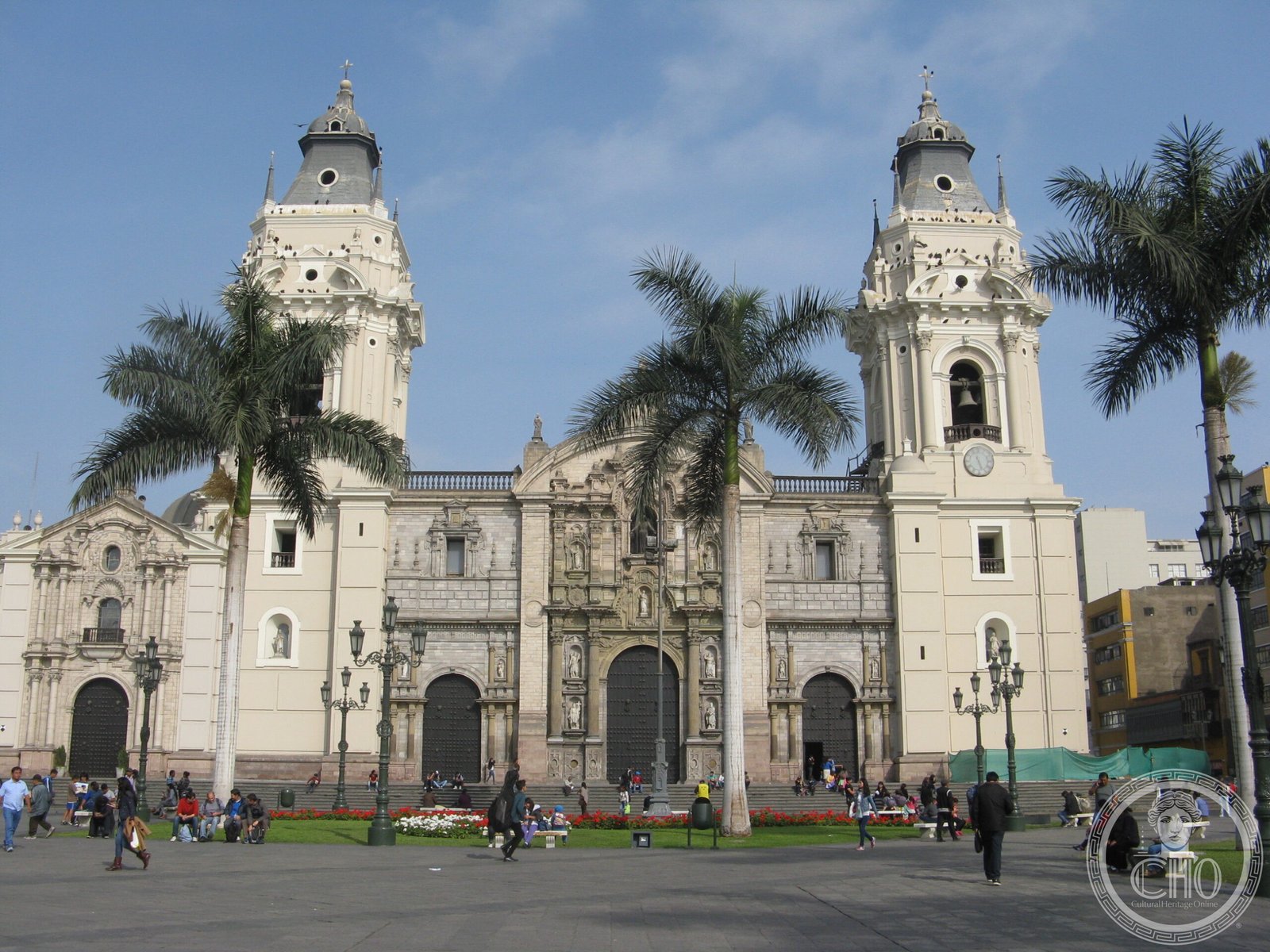
On the Plaza Mayor of Lima, the basilica cathedral is the seat of the Catholic archdiocese of Lima. Francisco Pizarro laid the first stone himself and carried the first timber in 1535 for the first church, completed in 1538 and opened on 11 March 1540. With the bull of Pope Paul III of 14 May 1541 the diocese of Lima was erected and the church raised to a cathedral. A second cathedral was opened in 1552 under Governor Cristóbal Vaca de Castro, and the present, third building, begun in 1585 to a design by the architect Francisco Becerra, had its naves consecrated in October 1625. The earthquake of 28 October 1746, one of the most devastating in the history of Lima, brought down both bell towers and much of the nave, and left standing only twenty-five of the city’s roughly three thousand houses. The viceroy José Antonio Manso de Velasco directed the rebuilding in three phases, between 1755 and 1778, completed in its present form in 1797. The archdiocese of Lima, raised to a metropolitan see on 12 February 1546, is among the oldest in the Americas. The present archbishop is Cardinal Carlos Gustavo Castillo Mattasoglio, in office since 2019. Francisco Pizarro, murdered on 26 June 1541, is buried in the cathedral. In 1891, for the three hundred and fiftieth anniversary of his death, remains believed to be his were put on public display in a glass coffin, where they stayed for decades. In 1977, during restoration work, workmen found a separate and forgotten crypt holding a lead box inscribed «Here is the skull of the Marquis Don Francisco Pizarro who discovered and conquered Peru and placed it under the crown of Castile», together with mixed skeletal remains of a woman, two children and an adult man. It was that man, identified by forensic anthropologists from multiple sword wounds to skull and neck consistent with contemporary accounts of his murder, who proved to be the real Pizarro, unlike the remains displayed from 1891, which in fact belonged to someone else. The authenticated remains were laid in the present public crypt in January 1985, four hundred and forty-four years after his death. Pope Francis visited this cathedral on 21 January 2018, praying before the relics of the Peruvian saints and addressing the sixty-eight bishops of the country, then appearing the following day from the cathedral balcony over the Plaza Mayor. According to one source, John Paul II also visited it on his journeys to Peru of 1985 and 1988, though that particular detail has not been cross-checked against a second, independent source. Lima was home to one of only three tribunals of the Spanish Inquisition in the Americas, set up in 1569 and active from 1570 until 1820, with about forty public autos-da-fé held on the Plaza Mayor in front of the cathedral. The tribunal, however, had its seat in a separate building, near the church of La Merced, and not in the cathedral itself.
About the Cathedral
The Basilica Cathedral of Lima, on the city’s Plaza Mayor, is the seat of the Archdiocese of Lima. Francisco Pizarro personally laid its first stone in 1535; the current, third building on the site was begun in 1585 and rebuilt after the catastrophic 1746 earthquake, reaching its present form by 1797.
Key facts
- 1535: Francisco Pizarro lays the cathedral site’s first stone.
- 14 May 1541: Diocese of Lima erected; church becomes a cathedral.
- 28 October 1746: catastrophic earthquake collapses both bell towers and much of the nave.
- 1891–1977: the wrong skeleton is publicly displayed as Francisco Pizarro’s remains.
- January 1985: authenticated Pizarro remains reburied in the cathedral’s current crypt.
- 21 January 2018: Pope Francis visits the cathedral, addressing Peru’s 68 bishops.
History
Founded by conquistador Francisco Pizarro himself and rebuilt after the devastating 1746 earthquake leveled all but a fraction of colonial Lima, the cathedral holds one of Peruvian history’s stranger footnotes: for nearly a century, the skeleton displayed in a glass casket as Pizarro’s own was not actually his. A 1977 restoration discovery — a lead box bearing his name, buried alongside mixed skeletal remains including an adult male bearing sword wounds matching contemporary accounts of his 1541 assassination — corrected the record, and the authenticated remains were reburied here in 1985.
What you see
A cream-colored facade blending Renaissance, Gothic, Baroque and Neoclassical elements — the legacy of repeated earthquake reconstruction — rises between twin bell towers rebuilt by 1797, with three main doors facing the Plaza Mayor.
Practical information
- Opening hours: generally open daily outside services; check current hours before visiting.
- Address: Plaza Mayor, Lima, Peru.
Getting there
The cathedral fronts Lima’s Plaza Mayor, alongside the Government Palace and Archbishop’s Palace. GPS: 12°02′49″S, 77°01′47″W.
Nearby
- Government Palace of Peru — the seat of the presidency, on the same Plaza Mayor.
Sources
- Wikipedia — “Basilica Cathedral of Lima,” “Roman Catholic Archdiocese of Lima,” “1746 Lima–Callao earthquake,” “Spanish Inquisition in Peru”
- Catholic-Hierarchy.org and GCatholic.org — Archdiocese of Lima records.
- Ancient Origins and Atlas Obscura — coverage of the Pizarro remains misidentification and 1977 discovery.
- Vatican.va — official record of Pope Francis’s 21–22 January 2018 visit to Lima Cathedral.
Find it on the map
See this place and what’s around it →📷 Become a Cultural Heritage Online photographer
Share your photos of places: they stay published under your name as the author. The more they're seen, the more you get noticed — and soon a contest will reward the most appreciated photos.
Log in or sign up free to add a photo