
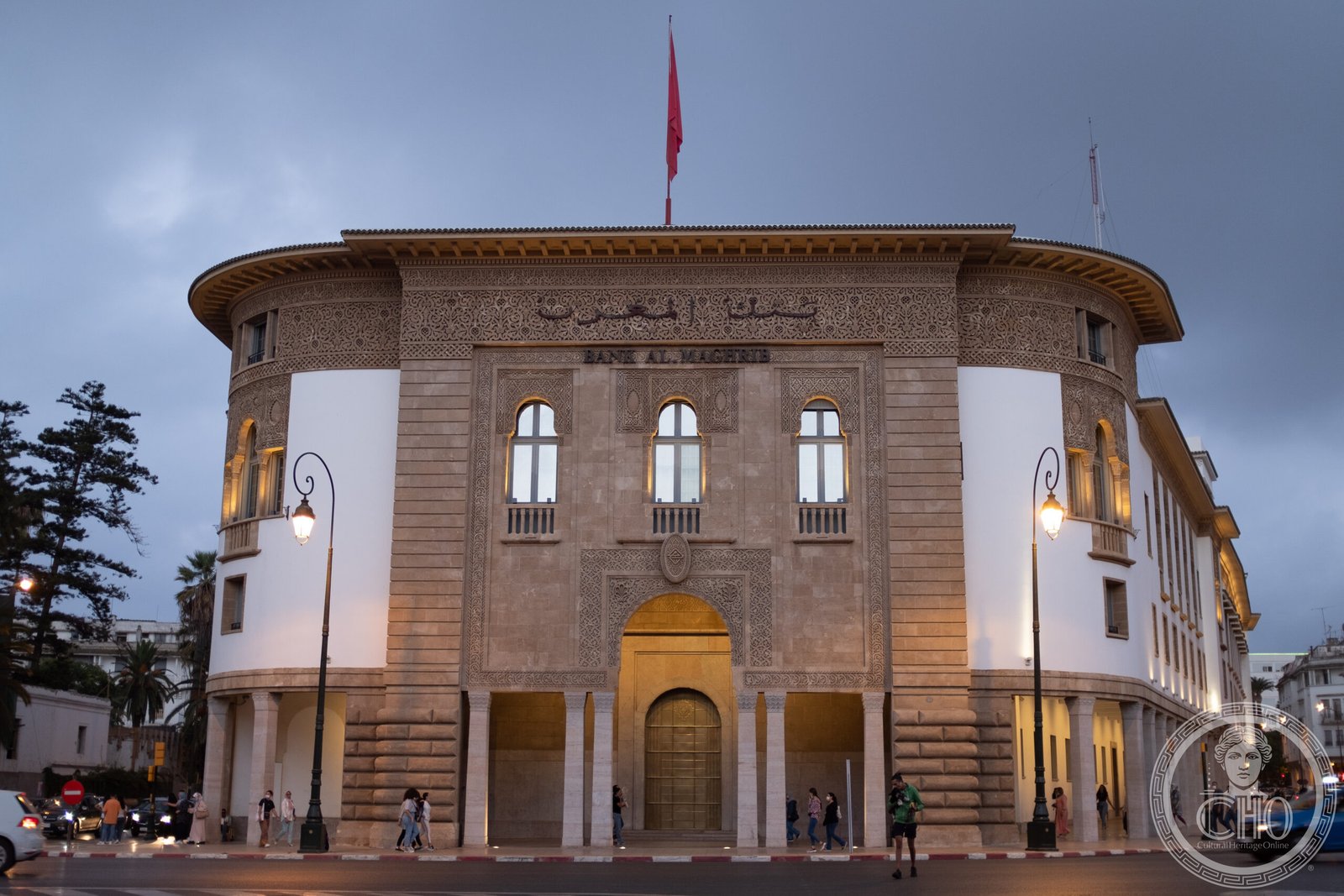
The Bank Al-Maghrib headquarters on Avenue Mohammed V is one of Rabat’s most distinguished examples of colonial-era Art Deco institutional architecture. Built during the French Protectorate period, the building’s symmetrical facade and restrained monumental character reflect the ambitions of the French urban planning vision for the Moroccan capital, and the structure remains the operational centre of Morocco’s central bank today.
At a glance
- Type
- Bank headquarters building
- Period
- French Protectorate era, c. 1930s
- Style
- Art Deco Colonial
- Location
- Avenue Mohammed V, Rabat, Morocco
- Coordinates
- 34.0194° N, 6.8358° W
- Architect(s)
- French Protectorate administration (architect unattributed)
Overview
Situated on the prestigious Avenue Mohammed V — Rabat’s ceremonial spine — the Bank Al-Maghrib headquarters occupies a commanding corner position that signals its institutional authority. The building’s composition follows the logic of French colonial civic architecture: a symmetrical facade with classical proportions updated through Art Deco detailing, projecting permanence and financial solidity. Avenue Mohammed V itself is a showcase of French Protectorate planning, lined with administrative buildings, cultural institutions, and gardens that together give Rabat the character of an ordered, monumental capital city.
History
The building dates from the French Protectorate period (1912–1956), during which Rabat was established as the administrative capital of Morocco under Resident-General Hubert Lyautey’s urban planning vision. The bank itself traces its institutional origins to the State Bank of Morocco, founded in 1907, which was reorganised into Bank Al-Maghrib in 1959 following Moroccan independence. The Avenue Mohammed V headquarters predates the bank’s post-independence relaunch and has served continuously as the nerve centre of Moroccan monetary policy through the transition from French rule to sovereignty and into the modern era.
Architecture & Design
The building exemplifies the Art Deco Colonial style that French architects deployed across the Protectorate’s major institutional commissions during the 1920s and 1930s. In contrast to Western Art Déco’s fascination with ornamental excess and jazz-age dynamism, the colonial variant applied the movement’s geometric vocabulary to a more restrained, authoritative language suited to government and finance. The facade is organised around a central bay with flanking wings, using rusticated stonework at street level, large rectangular windows, and discreet sculptural relief to articulate the building’s hierarchy without ostentation. The relationship between the building and the wide boulevard in front of it is part of the architectural intention — the setback and scale create an urban tableau of power and order.
Cultural significance
The Bank Al-Maghrib headquarters is a landmark of Rabat’s UNESCO-listed historic centre, which was inscribed on the World Heritage List in 2012 as a “Modern Capital and Historic City.” The avenue on which it stands represents Rabat’s dual identity: an ancient medina and a planned modern capital, both present within the same urban fabric. The building embodies the ambivalent legacy of the French Protectorate — a period of modernisation and architectural creation that also involved the suppression of Moroccan political sovereignty.
Visiting today
The headquarters is an active bank and not open for public interior visits. The exterior, however, is freely observable from Avenue Mohammed V and is part of the standard walking itinerary through Rabat’s modern heritage centre. The Bank Al-Maghrib also operates a Museum of Money (Musée de Bank Al-Maghrib) in Rabat, which is open to the public and documents the history of Moroccan currency and the institution itself.
Getting there
The building is located on Avenue Mohammed V, easily reachable on foot from Rabat’s main train station (Rabat-Ville) in approximately 10 minutes. The Rabat-Salé Tramway stops close by. Avenue Mohammed V runs through the heart of the modern city centre and is well signposted from all main transport nodes.
Sources & resources
Find it on the map
See this place and what’s around it →Record researched and written by Luigi De Marchi for Cultural Heritage Online, 2026.
📷 Become a Cultural Heritage Online photographer
Share your photos of places: they stay published under your name as the author. The more they're seen, the more you get noticed — and soon a contest will reward the most appreciated photos.
Log in or sign up free to add a photoIs this page about you?
This page is read by travellers and heritage enthusiasts who find it on Google. Tell us how you are connected to this place and we will take it from there.