
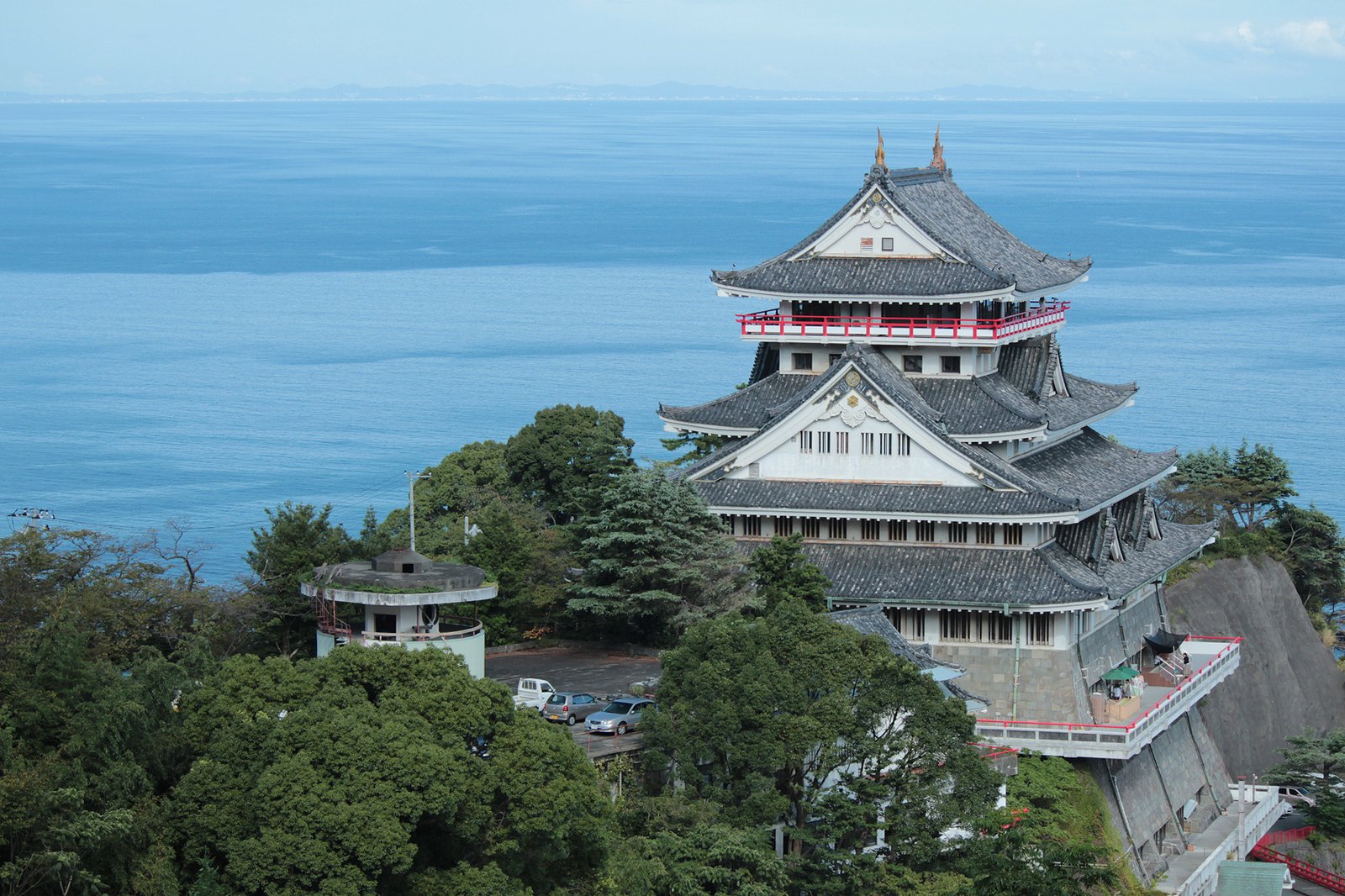
A concrete tenshu built for tourists, not warlords, crowning Nishikigaura Mountain above Sagami Bay.
At a glance
Atami Castle sits 120 meters above sea level on the summit of Nishikigaura Mountain, overlooking the resort city of Atami in Shizuoka Prefecture. Built in 1959, it is a reinforced concrete replica modeled on the tenshu of Azuchi–Momoyama period castles, though no fortress ever stood on this exact spot. Five exterior floors conceal nine interior levels of museums, an observation deck and a foot bath. It was never a defensive structure. It was, from the start, an attraction.
History
During the Sengoku period, the Odawara Hōjō clan reportedly weighed building a hilltop stronghold here for its navy. The plan went nowhere. Centuries later, in the postwar 1950s, Atami boomed as a domestic tourism destination, and civic ambition filled the gap left by the abandoned Hōjō scheme. Atami Castle rose in 1959, an invented castle built for a very real tourist boom rather than any siege or lord. It has since become a fixture of the local skyline, appearing in the 1962 film King Kong vs. Godzilla and the 1967 film Gappa: The Triphibian Monster.
What you see
The exterior evokes the tiered form and white walls of a Momoyama-era keep, its roofline capped by two golden shachihoko sculpted by Asano Shoun. Inside, the arrangement has nothing to do with historical castle planning. The sixth floor holds a panoramic observation deck; on clear days a telescope there brings Tokyo Skytree and the Yokohama Landmark Tower into view across the bay. Lower floors house a Japanese Castle Museum, a Samurai Culture Museum with armor, swords and matchlock guns, an Edo-period rebus gallery, and a Ukiyo-e erotic art (shunga) exhibition. A basement level offers table tennis, bouldering and a ball pool, an odd but telling reminder of the building’s entertainment-first purpose. Around 200 sakura trees fill the surrounding gardens.
Cultural significance
Atami Castle occupies an unusual place in Japan’s heritage landscape: a monument to castle imagery rather than castle history. Its frank artificiality has not stopped it from becoming a genuine local landmark, tied to the city’s cherry blossom festival each spring and to its Sea Fireworks Festival, for which the hill is a favored viewing point. Its cameo appearances in kaiju cinema of the 1960s cemented its place in pop-culture memory alongside its role as a family attraction.
Key facts
- Location: Nishikigaura Mountain, Atami, Shizuoka Prefecture, Japan
- Built: 1959
- Structure: reinforced concrete, five exterior floors, nine interior floors
- Elevation: 120 meters above sea level
- Model: Azuchi–Momoyama period tenshu (castle keep)
- Roof ornaments: two golden shachihoko by Asano Shoun
- Onsite: Japanese Castle Museum, Samurai Culture Museum, Ukiyo-e Erotic Art Museum, Edo rebus gallery
Practical information & getting there
You will find Atami Castle a short trip from Atami’s coastal center, reached by road up Nishikigaura Mountain. Adult admission is 1,200 yen, with reduced rates for children; a combined ticket with the neighboring Atami Trick Art Museum costs 2,000 yen for adults. Spring visits coincide with the sakura festival from late March to early April, while summer evenings suit the fireworks views. An open-air foot bath on the viewing platform offers a place to rest between floors. The underground hot spring and former lodging annex have both closed.
Sources & resources
Find it on the map
See this place and what’s around it →📷 Become a Cultural Heritage Online photographer
Share your photos of places: they stay published under your name as the author. The more they're seen, the more you get noticed — and soon a contest will reward the most appreciated photos.
Log in or sign up free to add a photoIs this page about you?
This page is read by travellers and heritage enthusiasts who find it on Google. Tell us how you are connected to this place and we will take it from there.