
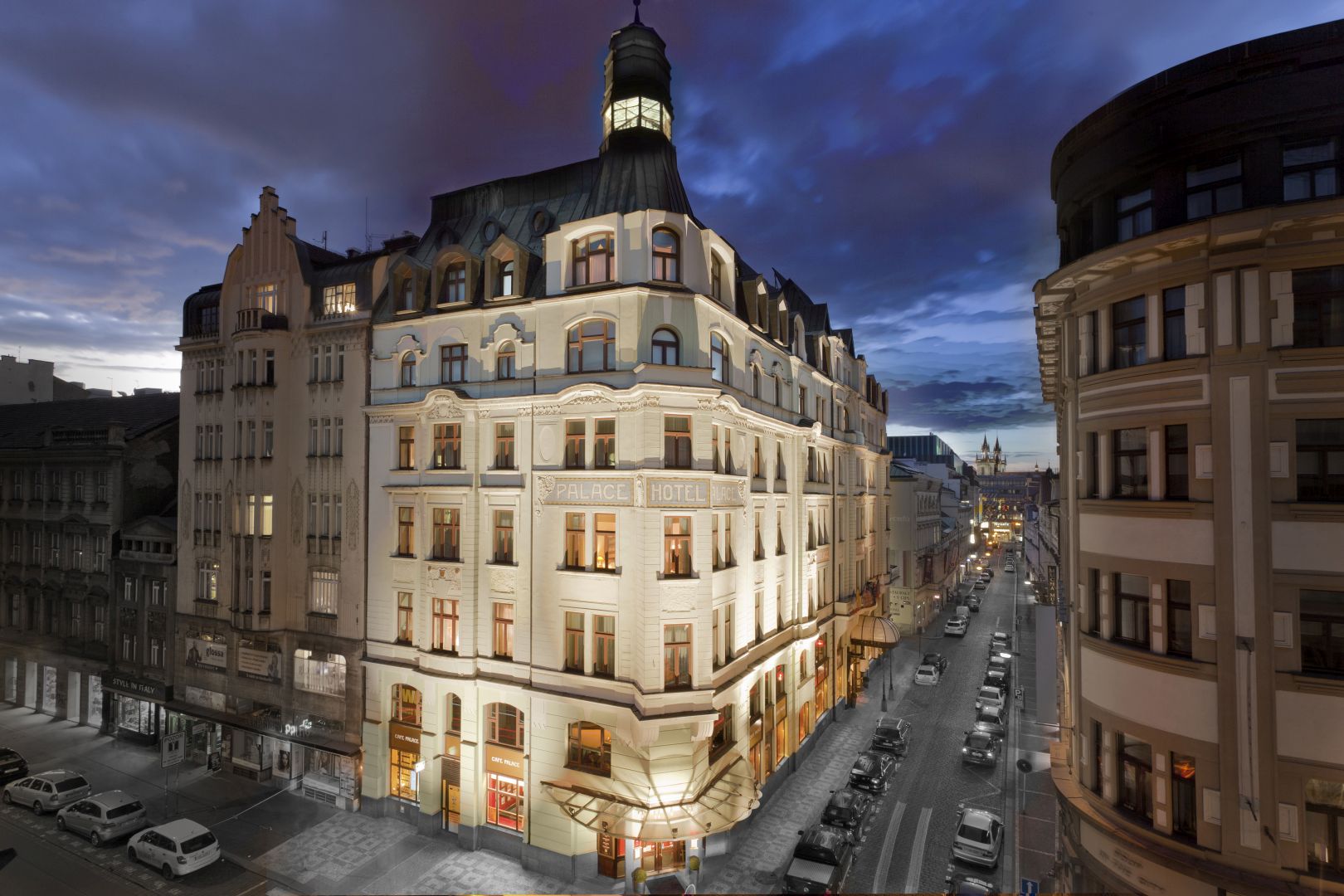
A five-star corner hotel opened in 1909 — a late Historicist building with Art Nouveau elements, traditionally described as an example of restrained Viennese Art Nouveau — on a plot that, by the hotel’s own records, had carried an aristocratic house since the fourteenth century. It closed for renovation in 1986 and came back in 1989.
At a glance
- Type
- Late Historicist building with Art Nouveau elements; a five-star hotel, in continuous use apart from the closure of 1986–1989
- Architect
- Jiří Justich (named George Justich in the hotel’s English materials)
- Builder and first proprietor
- František Buldra, Prague builder and hotelier
- Built
- Project initiated 1903; constructed 1907–1909; opened 21 April 1909
- Address
- Panská 897/12, 110 00 Prague 1 (Nové Město)
- Coordinates
- 50.08394° N, 14.42773° E
Overview
Prague is where Art Nouveau went ornamental. The Municipal House and the buildings along Pařížská carry mosaic, sculpture and wrought iron in quantity, and that is the version of the style most visitors come to see. The Palace Hotel is the other version. It is a late Historicist building with Art Nouveau elements, traditionally described as an example of restrained Viennese Art Nouveau — flatter, quieter, ornament held back to the lettering, the window surrounds and the roofline.
The result is a building that reads as a whole rather than as a collection of decorated parts. It stands on the corner of Panská and Jindřišská in the New Town, a few minutes from Wenceslas Square, close to the historic boundary with the Old Town.
History
The site was built on long before the hotel. According to the hotel’s historical records, a residence stood on the plot from 1378; it was assigned to a prince of the Kaunic family in 1776, and later served as a second Prague palace of the Auersperg family, before passing in the nineteenth century to a middle-class owner.
What is firmly dated is the hotel. In 1903 František Buldra, a Prague builder and hotelier, initiated the project with the architect Jiří Justich, working on the medieval footprint. The hotel itself was constructed between 1907 and 1909, and officially opened on 21 April 1909.
Its reputation was made under the next owner. Emanuel Oppel took over in 1924 and set out to run it as a luxury house, and the Palace became a fixture of the city’s social life between the wars. Josephine Baker stayed here. So did the soprano Ema Destinnová, and Enrico Caruso, who sang with her.
The long first era ended in 1986, when the hotel closed for renovation. It reopened in 1989 — the year the country changed — and has run since.
Distinguished guests
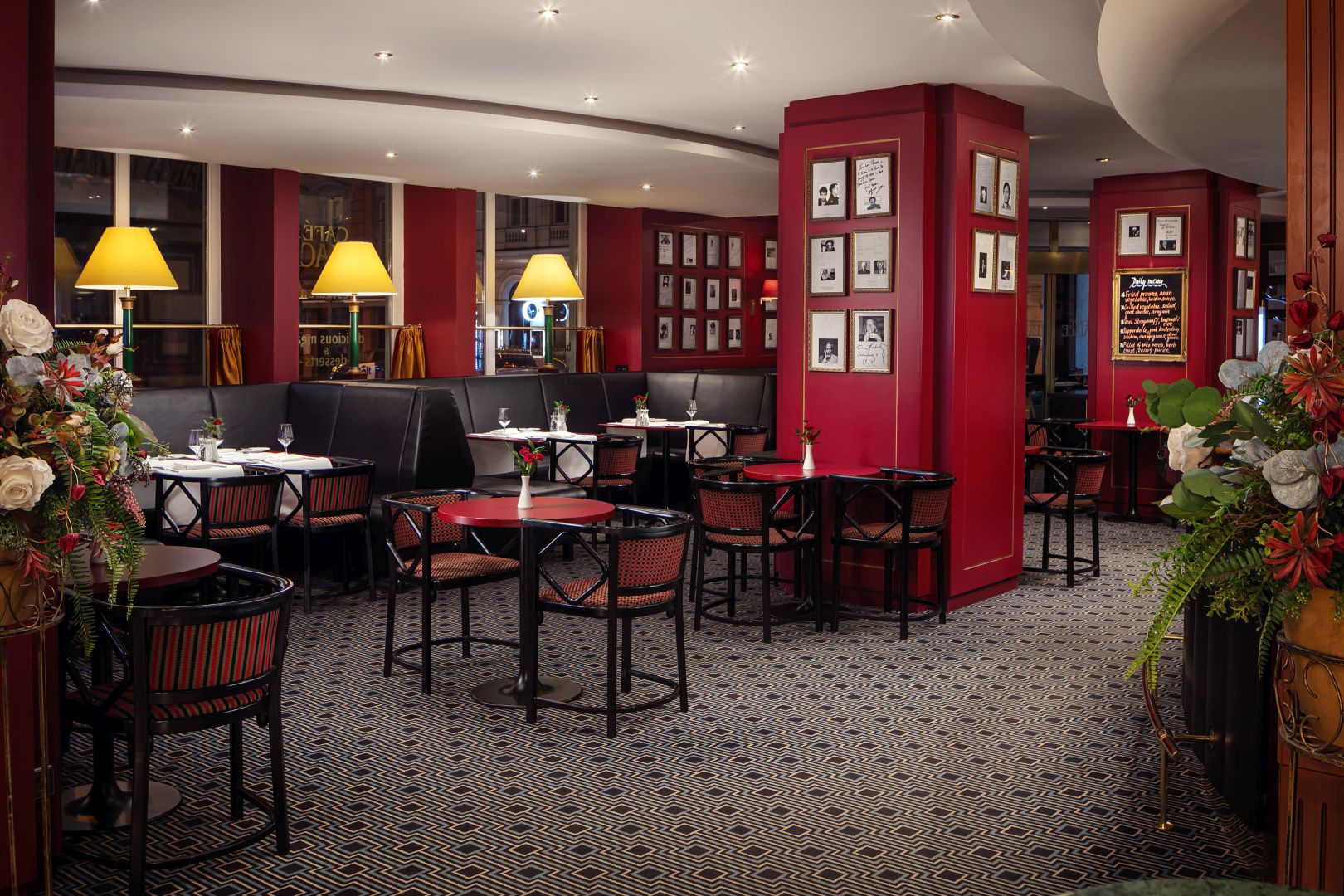
Throughout its history, the Palace has welcomed an extraordinary range of internationally renowned guests. Among them were Josephine Baker, Ema Destinnová, Enrico Caruso, Jacqueline Kennedy Onassis, Alain Delon, Miloš Forman, Steven Spielberg, Whoopi Goldberg, Cher, Mick Jagger, Lenny Kravitz, Pelé and Sir Bobby Charlton. The hotel preserves a gallery documenting many of these memorable visits.
What you see
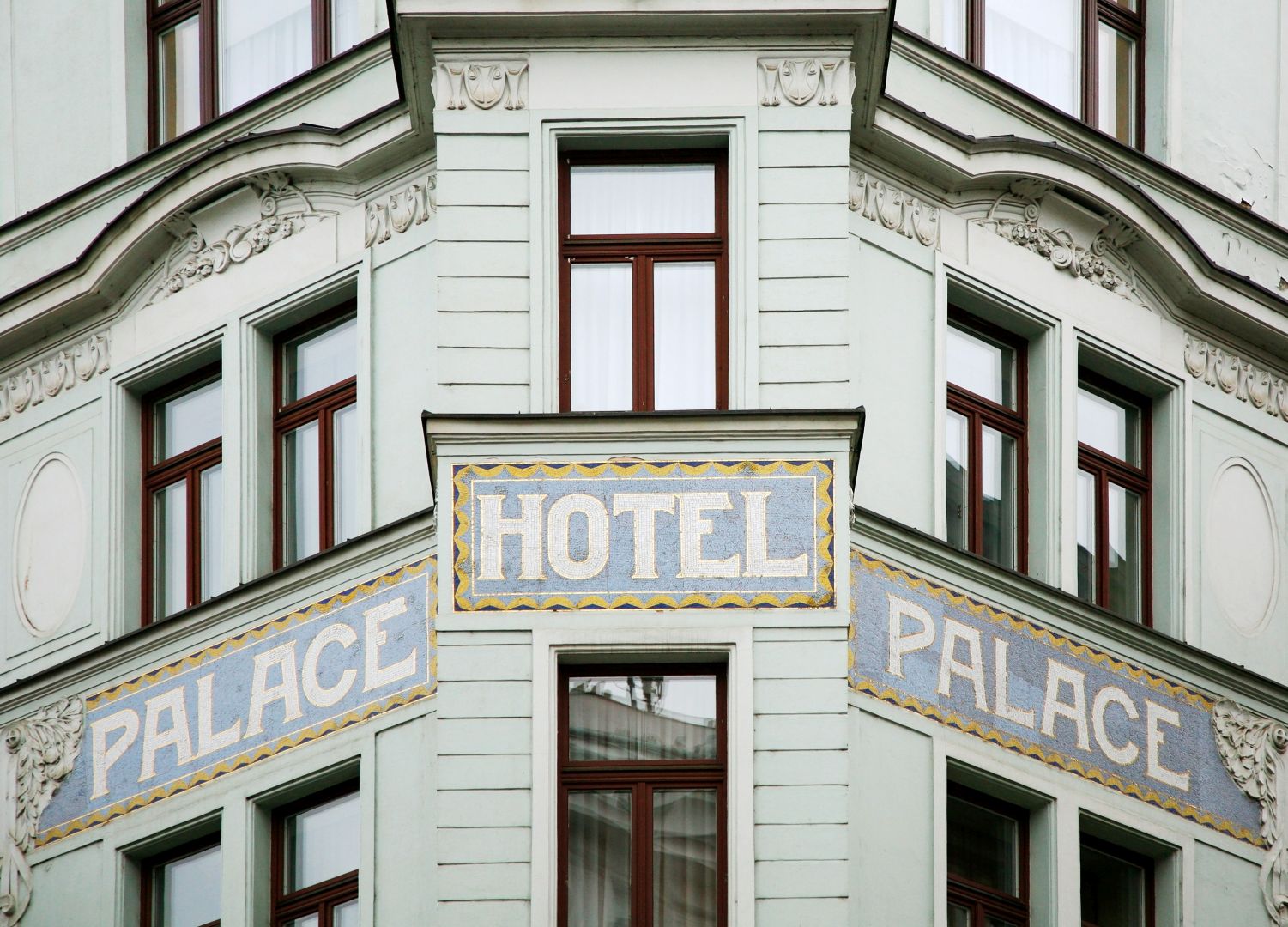
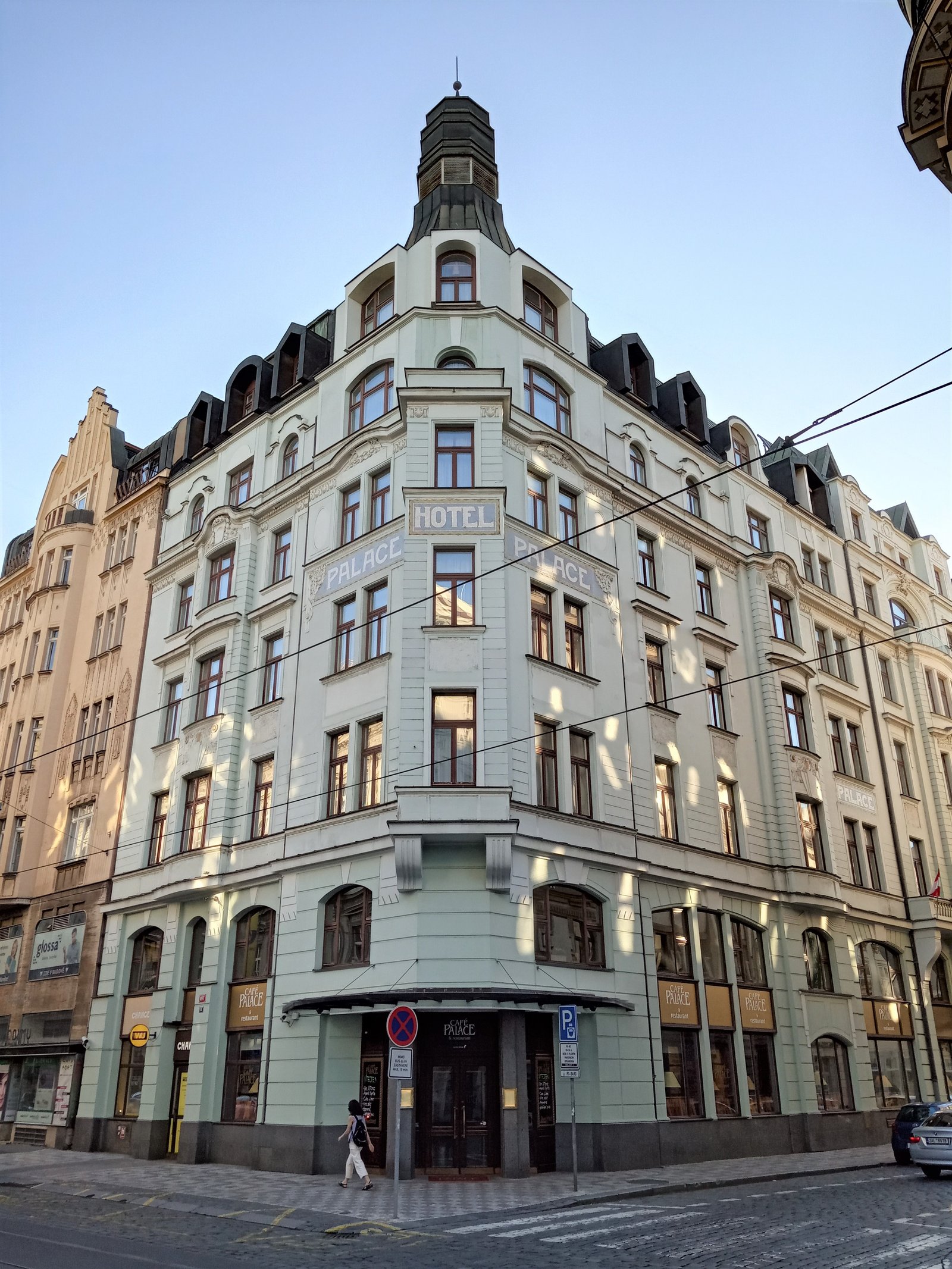
The corner is the whole design. A shallow bay rises through the upper floors and resolves into a tower whose roof steps inward in stages before a slim spire. Below it, set into flat panels in the render, the words HOTEL and PALACE are spelled out in relief — the ornament doing the work that a cartouche or a sculpted figure would do on a showier facade.
Everything else is deliberately level. The walls are a pale green-grey, the pilaster strips flat, the window surrounds carrying low-relief bands rather than modelled foliage. The mansard roof runs a long rank of hooded dormers along both streets. At street level the shopfronts are arched, and a metal canopy reaches over the corner door, where the café still trades under the hotel’s name.
Cultural significance
Prague’s Art Nouveau is usually told through its most decorated buildings, which makes the style look like a matter of surface. A building like this one complicates that. The same years, the same city, and a facade that argues for restraint — closer to what was being built in Vienna than to what was going up along the river — showing that the movement arrived here as a set of choices rather than a single look.
Practical information
- Access
- A working five-star hotel. Café Palace, on the corner, is open to hotel residents and non-hotel guests alike
- Exterior
- Visible from the street at any hour; the corner reads best from the Jindřišská side, where the tower is not foreshortened
Getting there
The hotel is a short walk from the foot of Wenceslas Square. Můstek station (metro lines A and B) is the nearest stop; the Jindřišská tram stop is closer still, and the Jindřišská bell tower stands at the end of the same street.
In pictures
Sources
- Art Nouveau Palace Hotel Prague — hotel history (official site) — dates, architect, builder, ownership, guests, closure and reopening
- VisitCzechia — Art Nouveau Palace Hotel Prague
- OpenStreetMap Nominatim — coordinates verified against Panská 897/12, Prague 1
- Biographical Dictionary of the Czech Lands — František Buldra (1851–1926)
- Corrections and photographs provided by the Art Nouveau Palace Hotel, September 2026
Find it on the map
See this place and what’s around it →📷 Become a Cultural Heritage Online photographer
Share your photos of places: they stay published under your name as the author. The more they're seen, the more you get noticed — and soon a contest will reward the most appreciated photos.
Log in or sign up free to add a photoIs this page about you?
This page is read by travellers and heritage enthusiasts who find it on Google. Tell us how you are connected to this place and we will take it from there.