

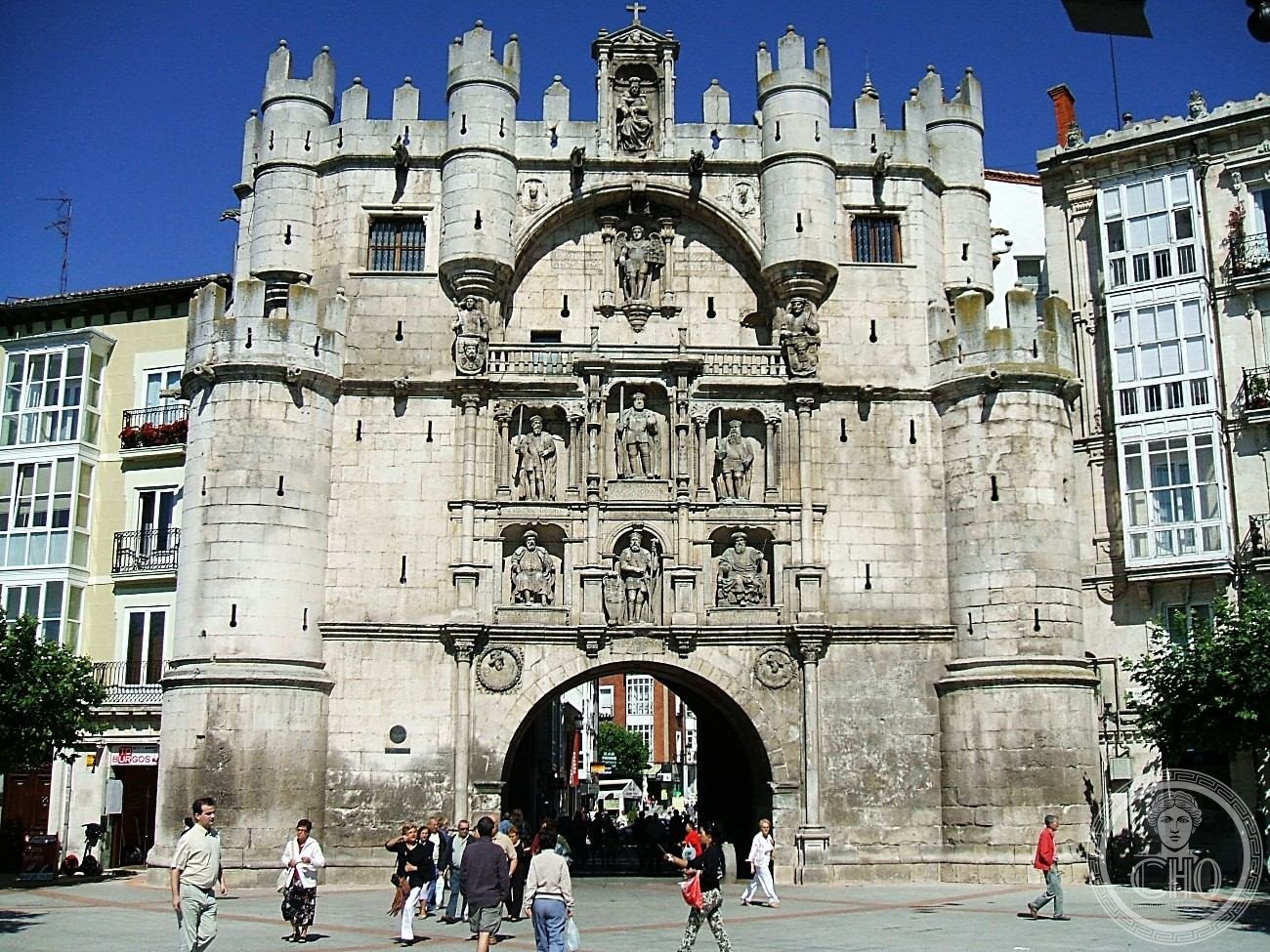
A monumental Renaissance gatehouse rebuilt under Charles V, crowned with statues of Castile’s legendary founders and greatest heroes.
At a glance
The Arco de Santa María is one of twelve medieval gates that once protected Burgos. Reconstructed in the 16th century as a symbol of royal favor and civic pride, it stands as a striking example of Renaissance transformation of a Gothic fortress.
History
The arch originated as a defensive gate during Burgos’s medieval expansion. Following the city’s rulers’ support for Charles V during the Revolt of the Comuneros, the Holy Roman Emperor commissioned its dramatic rebuilding in the 16th century. This reconstruction transformed the gate into a triumphal monument celebrating both imperial authority and local identity. The gatehouse was designated a National Monument in 1943.
What you see
The façade displays a carefully orchestrated hierarchy of statues. On the upper level, Charles V appears between Count Fernán González (c. 910–970) and El Cid, history’s most celebrated Castilian warrior. Below them stand the mythical 9th-century judges Laín Calvo and Nuño Rasura, traditionally regarded as forefathers of these two heroes, flanking Count Diego Rodríguez Porcelos, founder of Burgos in 884. This sculptural program reads as a genealogy of greatness.
Cultural significance
The arch encodes a political statement. By surrounding himself with Castile’s legendary figures, Charles V claimed continuity with a mythic past and rewarded the city’s loyalty. The monument testifies to Renaissance principles of fame, lineage, and visual propaganda while honoring the deep medieval roots that defined Castilian identity.
Key facts
- Location: Burgos, Spain
- Coordinates: 42.33983, −3.70394
- Rebuilt: 16th century under Charles V
- Designated National Monument: 1943
- Original function: Medieval city gate (one of twelve)
Practical information & getting there
The interior is open to the public and features temporary art exhibitions, a large mural by Burgos artist José Vela Zanetti, and a display of historical pharmaceutical equipment. Specific opening hours and admission details are best confirmed locally.
Sources & resources
- Arco de Santa María – Wikipedia
- Cultural Heritage Online
Find it on the map
See this place and what’s around it →📷 Become a Cultural Heritage Online photographer
Share your photos of places: they stay published under your name as the author. The more they're seen, the more you get noticed — and soon a contest will reward the most appreciated photos.
Log in or sign up free to add a photoIs this page about you?
This page is read by travellers and heritage enthusiasts who find it on Google. Tell us how you are connected to this place and we will take it from there.