

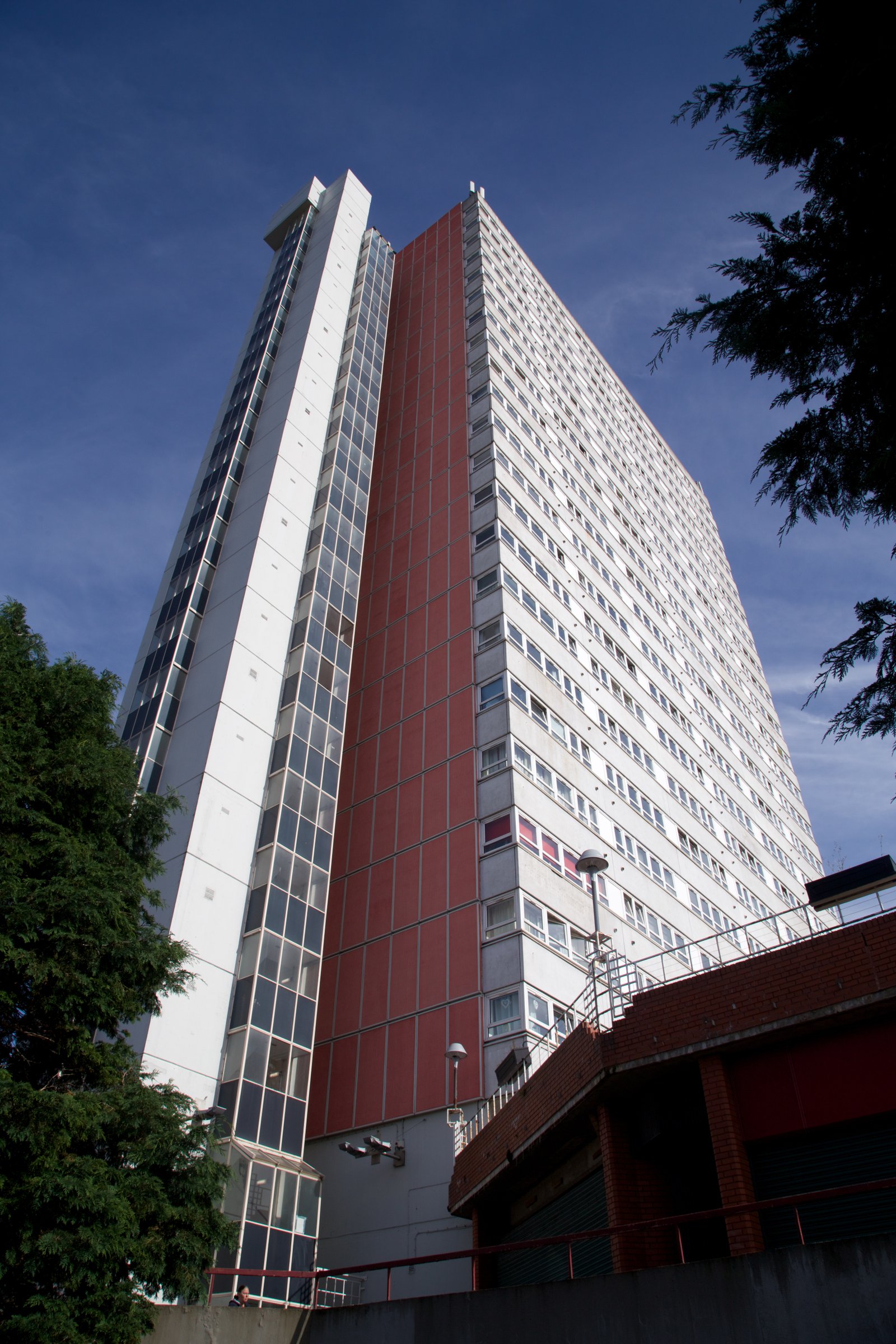
A 22-storey residential tower in Glasgow’s Anniesland district, this brutalist landmark holds Scotland’s distinction as the tallest listed building and the only Glasgow tower block awarded the highest category A heritage designation.
At a glance
Anniesland Court rises 22 storeys above Glasgow’s suburban landscape. Designed by J Holmes & Partners, it stands as a bold statement of post-war modernism and remains the city’s sole tower block to receive Category A listing status. Its architectural language echoes—and predates by several years—the celebrated Trellick Tower in London.
History
Completed in 1968, Anniesland Court emerged during the height of Britain’s tower-block era. The building was designed by J Holmes & Partners, a Glasgow-based practice responsive to the period’s faith in vertical residential living and modernist principles.
What you see
The tower exhibits the robust concrete forms characteristic of brutalism. Its design shares remarkable similarities with Ernő Goldfinger’s Trellick Tower—completed several years later—yet Anniesland Court established many of these aesthetic principles independently. The structure’s massing, fenestration, and structural expression define its visual presence within the city.
Cultural significance
Anniesland Court’s Category A listing recognizes both its architectural merit and its role in Glasgow’s twentieth-century urban development. As Scotland’s tallest listed building, it represents a deliberate shift in heritage conservation—acknowledging the cultural and design value of post-war modernism alongside earlier periods. The tower block stands as testimony to an ambitious, now-contested chapter in British urban planning.
Key facts
- Location: Anniesland, Glasgow City, United Kingdom
- Completed: 1968
- Architect: J Holmes & Partners
- Height: 22 storeys
- Coordinates: 55.8911°N, 4.3250°W
- Heritage status: Category A listed building (Scotland’s tallest)
Practical information & getting there
Anniesland Court is located in the Anniesland district of Glasgow, accessible by public transport. The building remains in residential use. As a listed structure, it is viewed from the public realm; interior access is restricted to residents. Visit in daylight to appreciate its sculptural concrete form against Glasgow’s sky.
Sources & resources
Find it on the map
See this place and what’s around it →📷 Become a Cultural Heritage Online photographer
Share your photos of places: they stay published under your name as the author. The more they're seen, the more you get noticed — and soon a contest will reward the most appreciated photos.
Log in or sign up free to add a photoIs this page about you?
This page is read by travellers and heritage enthusiasts who find it on Google. Tell us how you are connected to this place and we will take it from there.