

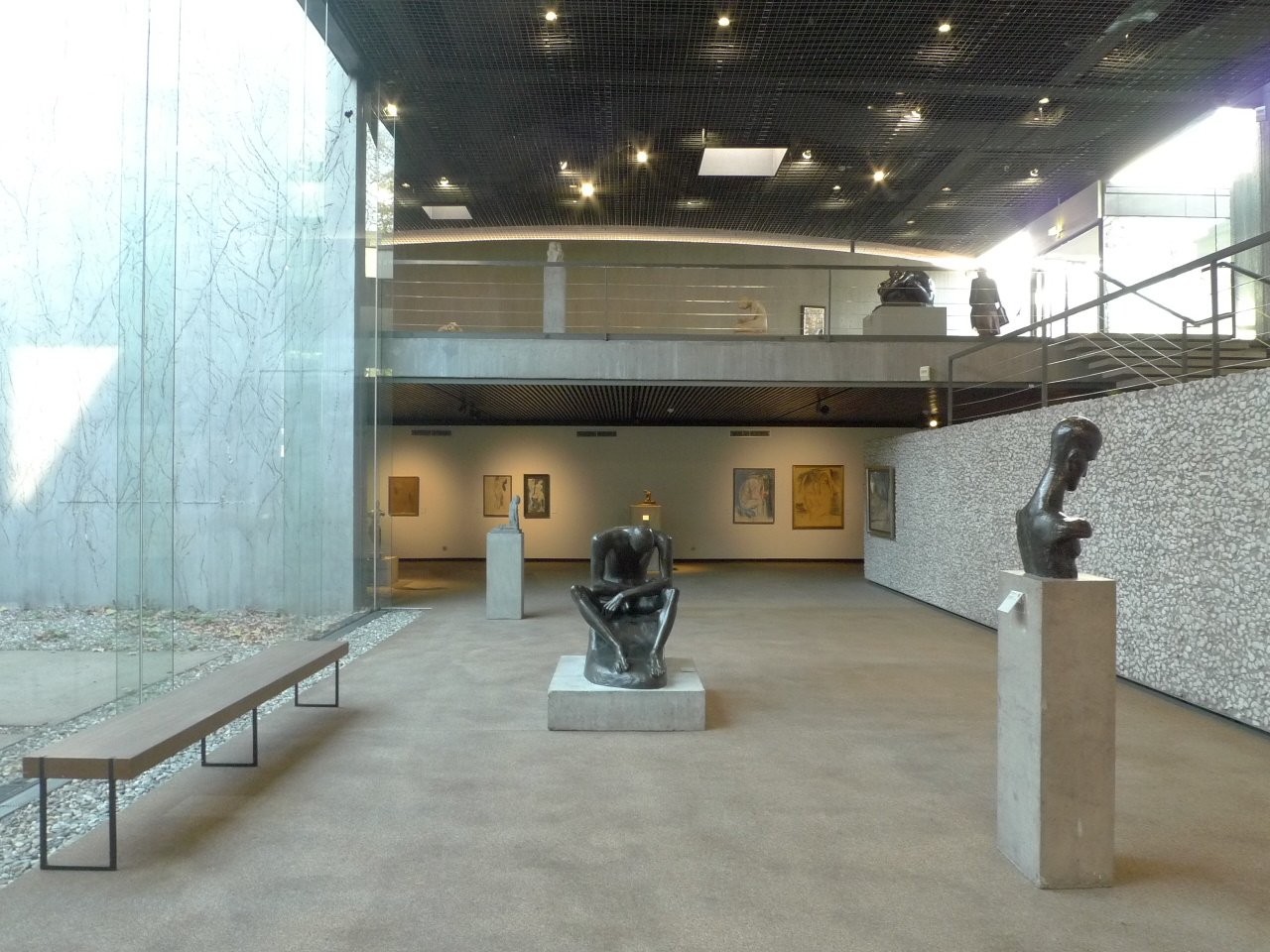
A modernist sculpture museum in the Rhineland, housing seminal works by Wilhelm Lehmbruck and an extraordinary international collection of 20th-century avant-garde art.
At a glance
The Lehmbruck Museum is dedicated to sculpture and painting across two centuries. Its core holdings centre on Wilhelm Lehmbruck, the German Expressionist sculptor, complemented by major works from across modernism’s vital decades.
History
Built between 1957 and 1967, the Lehmbruck Museum emerged as a postwar institution devoted to experimental sculpture. It takes its name from Wilhelm Lehmbruck (1881–1919), whose expressive bronze and stone figures remain central to its identity. The museum’s acquisition strategy expanded rapidly to encompass the full spectrum of modernist sculptural practice—from Constructivism and Cubism to Surrealism and abstraction.
What you see
The building itself reflects modernist design principles of its era. Inside, the permanent collection reveals an ambitious curatorial vision: monumental bronzes by Barlach and Kollwitz stand alongside Archipenko’s experiments in void and mass; Picasso’s sculptures converse with Dalí’s dreamscapes; works by Rodtschenko, Gabo, and Pevsner document the revolution in three-dimensional form. German paintings from the 19th and 20th centuries provide a supplementary dialogue with the sculpture.
Cultural significance
The Lehmbruck occupies a distinctive place in German museum history as a centre dedicated entirely to sculpture during the modernist epoch. Its annual reinstallation of works ensures the collection remains active and dialogical rather than fixed—a curatorial practice that honours the dynamism of the movements it documents.
Key facts
- Location: Duisburg-Mitte, Germany
- Coordinates: 51.43028°N, 6.76611°E
- Built: 1957–1967
- Focus: Sculpture and painting, primarily 20th-century modernism
- Collection strategy: Annual reinstallations of works
Practical information & getting there
The museum is located in Duisburg-Mitte, in Germany’s North Rhine-Westphalia region. Duisburg is accessible by rail and highway from across northern Europe. Check the official website for current opening hours, admission prices, and any special exhibitions before your visit.
Sources & resources
Find it on the map
See this place and what’s around it →📷 Become a Cultural Heritage Online photographer
Share your photos of places: they stay published under your name as the author. The more they're seen, the more you get noticed — and soon a contest will reward the most appreciated photos.
Log in or sign up free to add a photoIs this page about you?
This page is read by travellers and heritage enthusiasts who find it on Google. Tell us how you are connected to this place and we will take it from there.