

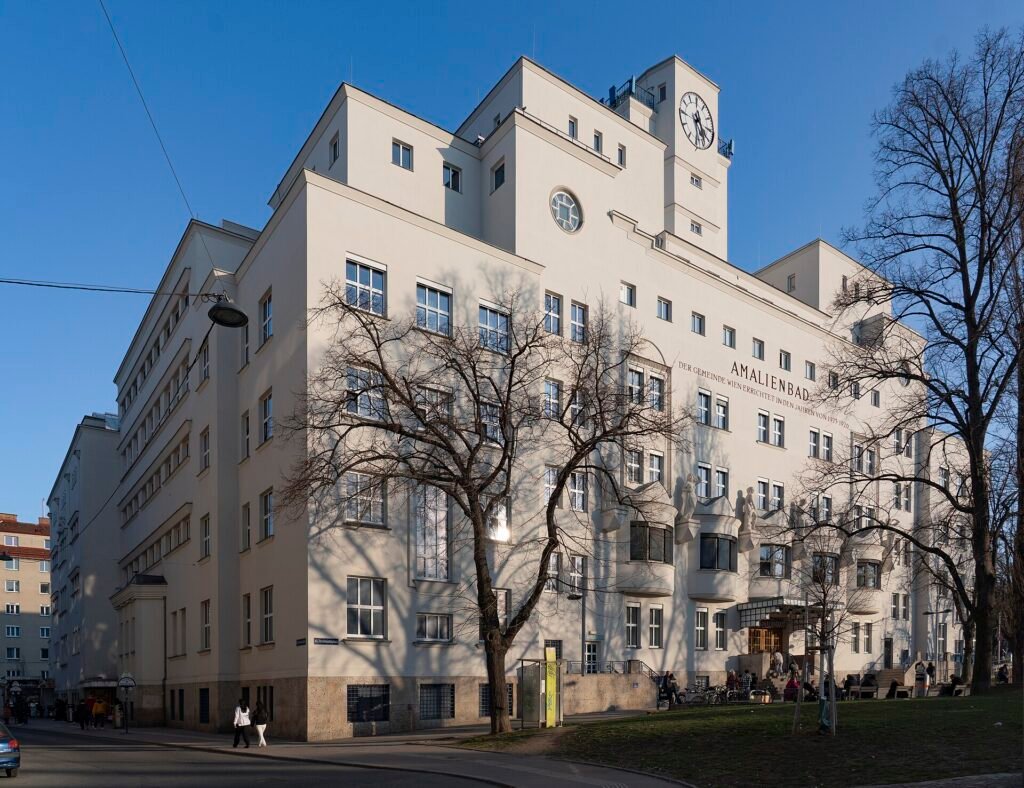
A swimming pool built like a palace for the people: glass roof, coloured tiles and a hall the size of a church.
At a glance
The Amalienbad in the Favoriten district was Vienna’s grandest public bath, built between 1923 and 1926 by the city architects Karl Schmalhofer and Otto Nadel. A project of “Red Vienna”, the socialist city government of the day, it gave working families a swimming hall under a glass roof, lined with coloured tile in confident Art Deco. When it opened it was among the largest indoor pools in Europe.
Key facts
- Location: Reumannplatz, Favoriten, Vienna
- Architects: Karl Schmalhofer and Otto Nadel
- Built: 1923–1926
- Style: Art Deco
- Origin: a public bath of “Red Vienna”
History
Between the wars, Vienna’s city government built housing, clinics and baths for its workers on a scale that drew the world’s attention. The Amalienbad was its showpiece pool, named after a local labour activist.
It offered swimming, steam baths and washing facilities to a district of cramped flats. Damaged in the Second World War and later restored, it still serves the neighbourhood as a public swimming bath.
What you see
The main hall is a tall room of glass and tile: a glazed roof over the pool, galleries on the sides, and patterns of blue, gold and black tile in the geometric taste of the 1920s. It feels less like a municipal pool than a temple to bathing, exactly the dignity its builders intended.
Practical information
- Open: a working public bath; check swimming hours
- Cost: admission for swimming
- Best for: the Art Deco pool hall and tilework
- Time needed: 30–45 minutes
Getting there
The Amalienbad is on Reumannplatz in Favoriten, directly above the U1 metro terminus, a short ride south of the city centre.
Nearby
- Reumannplatz — the square and its famous ice-cream parlour
- Favoriten — the working district of Red Vienna housing
Sources
- Wikipedia (German) — Amalienbad
- Stadt Wien / Wiener Bäder — official baths information
- Wikimedia Commons — image source and licence
Find it on the map
See this place and what’s around it →Record researched and written by Luigi De Marchi for Cultural Heritage Online, 2026.
📷 Become a Cultural Heritage Online photographer
Share your photos of places: they stay published under your name as the author. The more they're seen, the more you get noticed — and soon a contest will reward the most appreciated photos.
Log in or sign up free to add a photoIs this page about you?
This page is read by travellers and heritage enthusiasts who find it on Google. Tell us how you are connected to this place and we will take it from there.