
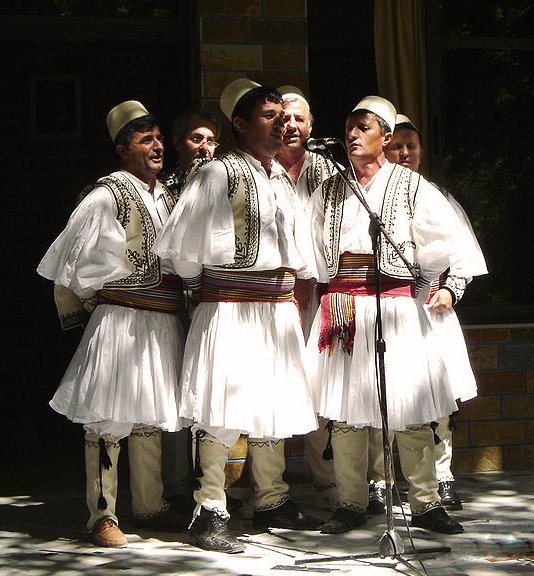
A living tradition of multipart singing rooted in ancient lamentation, Albanian iso-polyphony weaves two, three, or four independent melodic lines into complex vocal harmonies that define the soundscape of southern Albania.
At a glance
Albanian iso-polyphony is a vocal music practice in which singers perform simultaneous, independent melodic lines—sometimes two parts, sometimes four. The tradition is strongest in the southern regions of Lalëria (Myzeqe), Toskëria, Çamëria, and Labëria, where it remains an integral part of daily and ceremonial life. Related polyphonic forms also appear in northern Albania, North Macedonia, and Montenegro.
Origins & history
Iso-polyphony is thought to have its roots in vajtim, the many-voiced traditional lamentation of the dead practiced across southern Albania. Over time, this funerary vocal practice evolved into secular polyphonic song forms that persist today. The instrumental expression of iso-polyphony developed into the Albanian kaba.
The practice
Singers perform without instrumental accompaniment, their voices creating interlocking melodic patterns. Two-part songs are traditionally sung by women alone. Three-part songs may be performed by men and women together. Four-part songs—a Labërian specialty—represent the most complex form and are thought to have developed after three-part singing became established.
Research indicates that four-part polyphony demands precise coordination and deep knowledge of melodic relationships. Each singer maintains an independent line while listening intently to the others, creating a unified whole from distinct voices.
Cultural significance
Iso-polyphony expresses the identity and continuity of southern Albanian communities. The practice carries memory—both of the dead through its lamentation heritage and of community bonds through collective performance. It remains a marker of regional pride and cultural belonging in Labëria, Toskëria, and neighboring areas.
Key facts
- UNESCO Intangible Cultural Heritage, reference 00155
- Anchor region: Gjirokastër and surrounding southern Albania
- Forms: two-part (women), three-part (men and women), four-part (most complex)
- Related practices in northern Albania, North Macedonia, and Montenegro
Where to experience it
The Gjirokastër National Folklore Festival, held every five years in October since 1968, typically features many performances of polyphonic songs. The practice continues in communities throughout the Labëria, Toskëria, Çamëria, and Lalëria regions, where it remains woven into daily life and celebration.
Sources & resources
- Albanian iso-polyphony — Wikipedia
- Albanian Folk Iso-Polyphony — UNESCO Intangible Cultural Heritage
- Cultural Heritage Online
Find it on the map
See this place and what’s around it →📷 Become a Cultural Heritage Online photographer
Share your photos of places: they stay published under your name as the author. The more they're seen, the more you get noticed — and soon a contest will reward the most appreciated photos.
Log in or sign up free to add a photo