
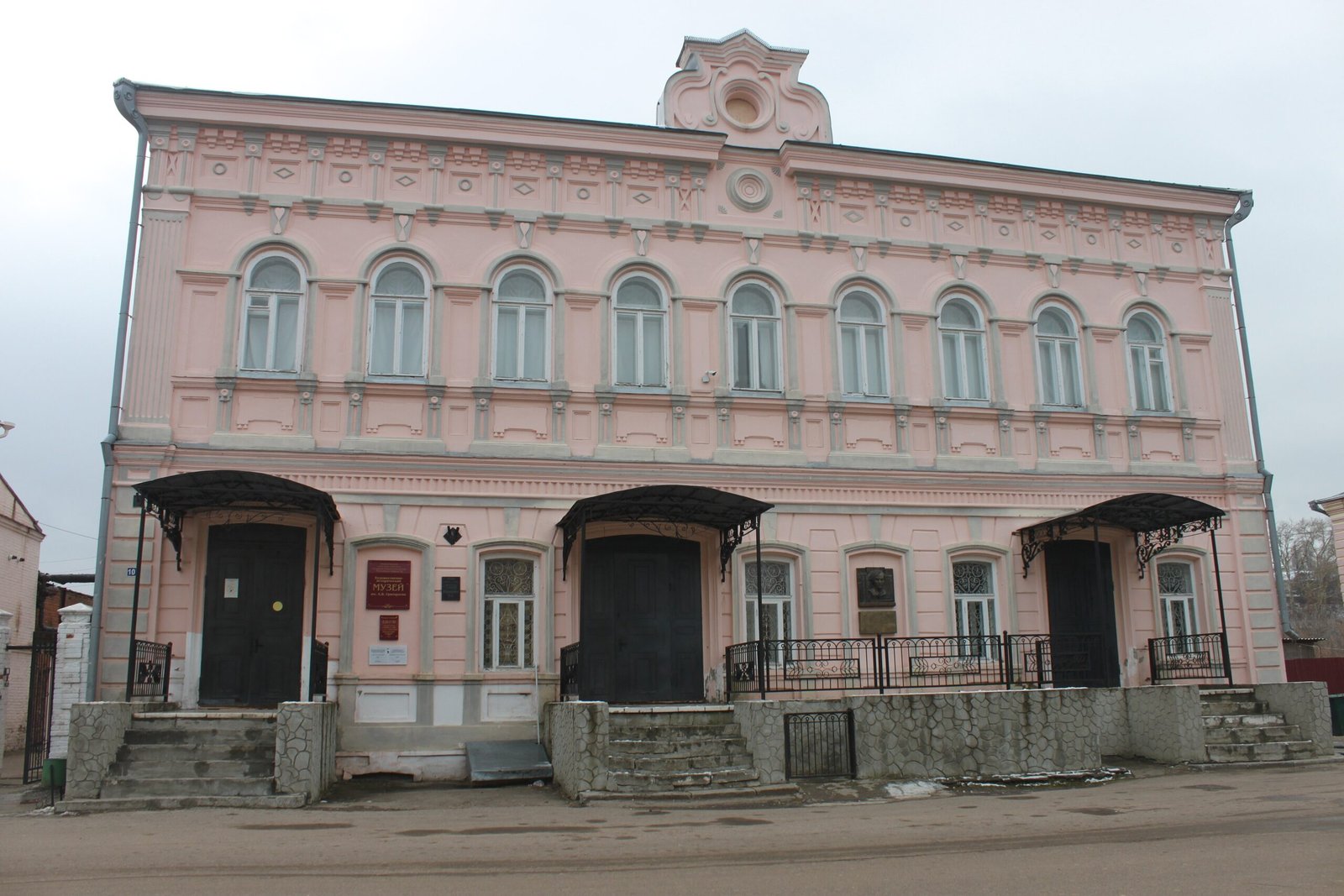
A provincial museum born from a stranded exhibition and a civil war, now housed in a merchant’s mansion on the Volga.
At a glance
Founded in 1919 in Kozmodemyansk, in the Mari El Republic, this is among the oldest art galleries of the Volga region. It holds over 43,000 items, including some 3,500 works of fine art. Since 1998 the collection has occupied the restored house of the merchant Ponomarev, built in 1883 and protected as an architectural monument.
History
The story begins with paintings, not a building. In 1918 Kazan artists organised a traveling Volga-Kama exhibition, drawing partly on the collection of Alexander Mantel, with works by Itinerant painters and Kazan contemporaries such as P. Radimov and N. Feshin. Civil war intervened. The White Guards took Kazan, and the touring paintings were left behind in Kozmodemyansk for safekeeping.
Arriving that autumn, the Mari artist Alexander Grigoriev saw the stranded canvases and decided a museum should hold them. It opened on 7 September 1919, first in the Torsuev merchant house, later in the Smolensk Cathedral from 1933. In 1920 the city named it after Grigoriev, its founder. He later moved to Moscow, buying dozens more paintings and receiving gifts from artists including Feshin, Byalynitsky-Birulia and Malyavin.
Then came 1938. Grigoriev was arrested in the Stalinist repressions and spent eight years in exile in Kazakhstan; the museum’s name was stripped from him. Released in 1946, he was not formally rehabilitated until 1954. His name returned to the museum only in 1966, two decades after his release.
What you see
Since 1998 the collection has lived in the Ponomarev house, dated to 1883 and specially restored for museum use. Locals regard it as the finest house in the city, prized for its layout as much as its facade. Inside, three thematic rooms form the historical department: regional nature and archaeology, a run of Russian, European and Oriental porcelain from the 18th to 20th centuries, and the town’s own past and present.
The art rooms carry the weight of the founding exhibition. Academic portraiture sits near Itinerant landscapes and genre scenes; a maritime run of works, including a moonlit Black Sea by Ivan Aivazovsky, adds another register entirely.
Cultural significance
Eleven works by Nikolai Feshin anchor the collection’s reputation, among them sketches for his “Cheremis Wedding,” gifted to Grigoriev before the painter left for the United States in 1923. In 2020 the museum was named among the ten best regional museums of Russian art. It stands as a rare provincial repository shaped almost entirely by one collector’s persistence, survival, and eventual vindication.
Key facts
- Founded 7 September 1919 in Kozmodemyansk, Mari El Republic
- Named for founder Alexander V. Grigoriev; name removed 1938–1966
- Housed since 1998 in the Ponomarev merchant house, built 1883
- Holds over 43,000 items, including roughly 3,500 fine art works
- Includes eleven works by Nikolai Feshin
- Ranked among Russia’s ten best regional art museums, 2020
Practical information & getting there
The museum sits in Kozmodemyansk, a river town on the Volga in the Mari El Republic. It operates as a branch of the Kozmodemyansky cultural and historical museum complex. Check current opening hours locally before visiting, as the article does not specify them.
Sources & resources
Find it on the map
See this place and what’s around it →📷 Become a Cultural Heritage Online photographer
Share your photos of places: they stay published under your name as the author. The more they're seen, the more you get noticed — and soon a contest will reward the most appreciated photos.
Log in or sign up free to add a photoDo you manage this place?
This page is read by travellers and heritage enthusiasts who find it on Google. Keep it accurate — and make it work for you. Free for non-profit heritage institutions.