
Mogliano Veneto, Veneto · early twentieth century · Villa
At a glance
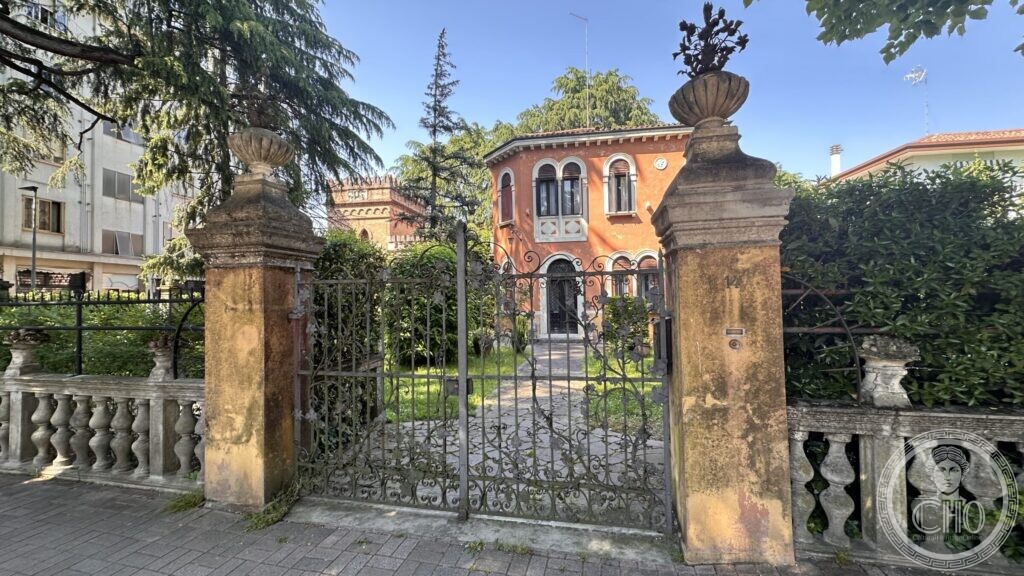
A villa of the early twentieth century behind a wrought-iron gate, on via Roma in Mogliano Veneto. We publish it without a name: we could not find a source that says who built it, for whom, or in what year. What the building itself says is a good deal, and this page is an invitation — if you know more, tell us.
What you see
The house is rendered in a warm orange-red, two storeys over a raised ground floor, under a hipped roof with wide eaves carried on brackets. Its centre is a loggia of three round arches at first-floor level, set in a slightly projecting bay — the feature that gives the front its whole character, and a motif with a long Venetian pedigree, the three-light window of the lagoon house brought inland and simplified.
Around it the detailing is restrained and of its moment: a string course marking the floors, shallow stucco panels, a round medallion set into the wall above the loggia, and moulded frames to the windows. Nothing is carved in stone; everything is modelled in render, which is what distinguishes a villa of this kind from the sixteenth-century houses it is descended from.
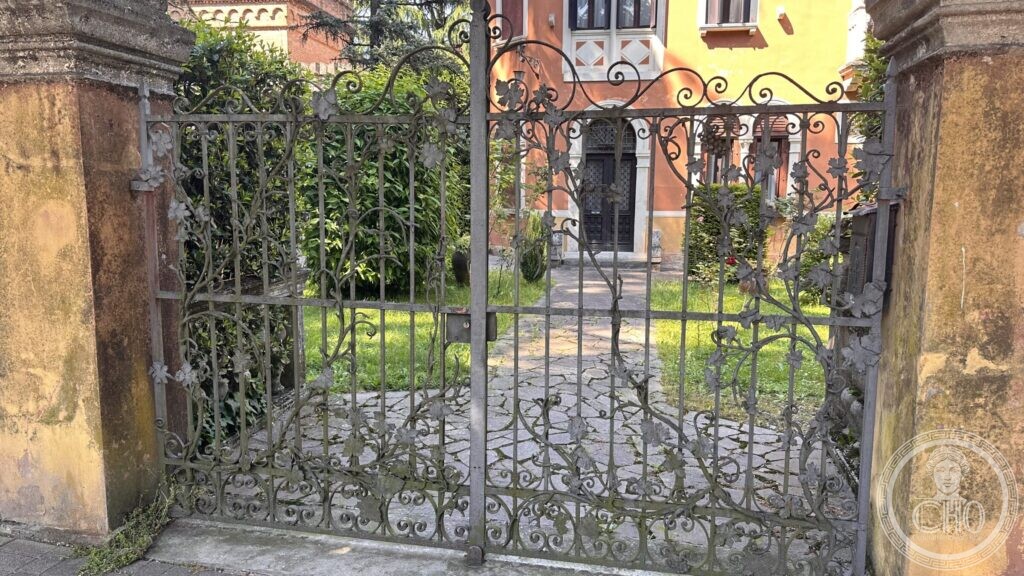
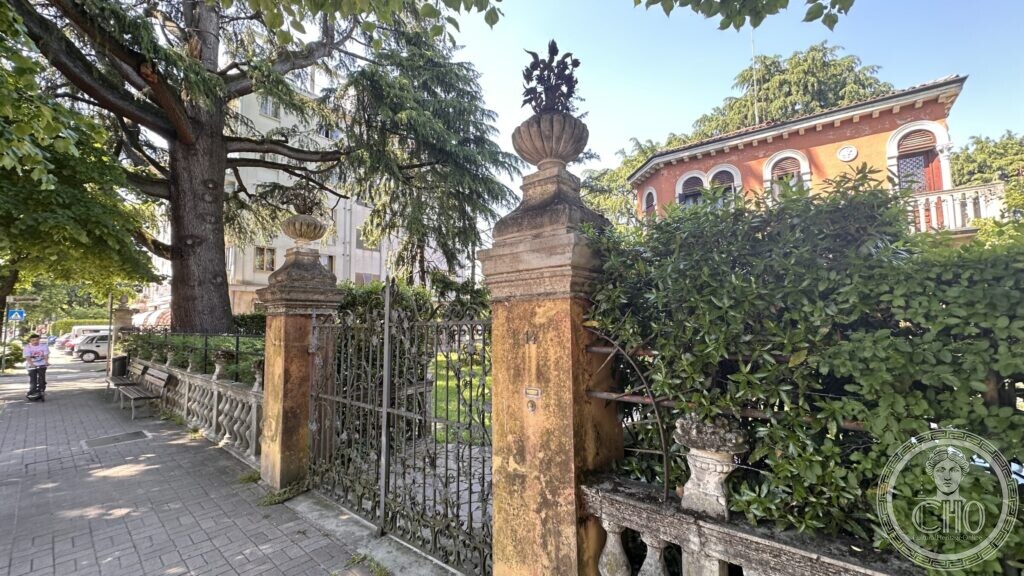
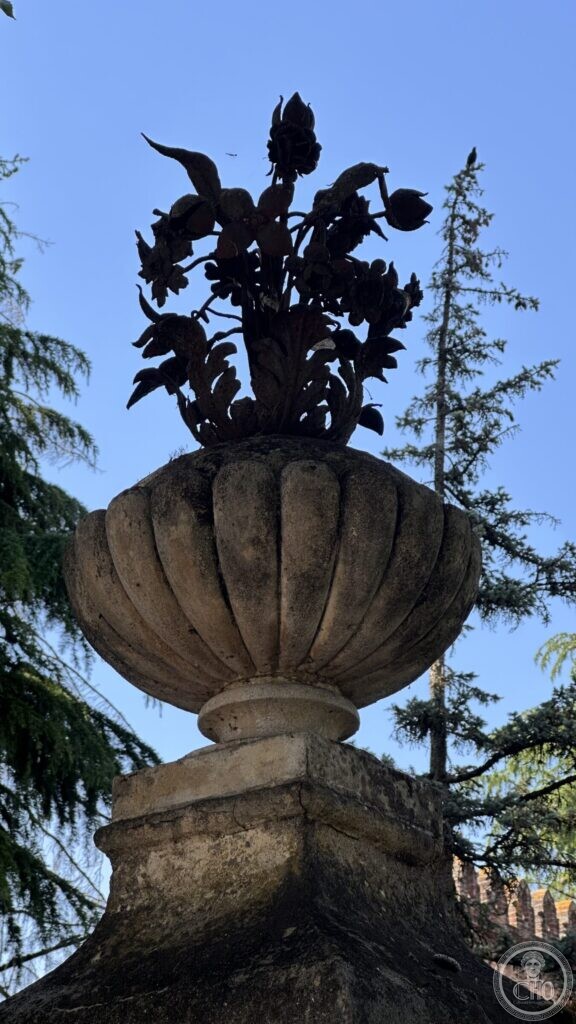
The gate is the piece that dates the building most confidently. It is wrought iron worked into stems, leaves and open flowers, with tendrils curling across the uprights — the vocabulary of the Liberty style, the Italian Art Nouveau, which in the Veneto ran from the very last years of the nineteenth century into the 1920s. Above the brick piers sit two carved stone urns, each with a bouquet of stone flowers rising out of it. The boundary wall carries a balustrade of small turned columns, and a cedar shades the garden.
Put together, these are the marks of a suburban villa built for a professional or merchant family in the first quarter of the twentieth century: eclectic in its plan and its proportions, Liberty in its ironwork and its ornament. That is as far as the building can be read without documents.
Where it stands
Mogliano Veneto lies on the Terraglio, the road that runs from Mestre to Treviso, and that road is the reason the town looks the way it does. From the sixteenth century onwards the Venetian families built their country houses along it, close enough to the city to be reached in a morning; the result is a corridor of Venetian villas that is still, today, the identity of the place.
Between the nineteenth and the early twentieth century many of those houses changed hands, passing from the old families to bourgeois owners and to institutions. New villas were built alongside the old ones in the taste of the day — which is where a house like this one belongs: not one of the historic Venetian villas, but a later arrival on the same road, built by people who wanted what the Terraglio had always offered.
During the First World War the villas of Mogliano were requisitioned as military hospitals and as command posts for the troops on the lower Piave, a few kilometres away. Whoever owned this house in 1917 would have lived through that.
The villa today

Practical information
- Private property, seen from the public street. The garden is not open.
- Via Roma, Mogliano Veneto, in the Olme district.
- Coordinates: 45.561303, 12.230844
Do you know more?
On this page we have published what can be seen and what we were able to verify. About this villa we could not find a reliable source. If you know something — a name, a date, the architect, the family who lived there, an old photograph, a document, a book that mentions it — write to Sofia, who looks after these pages.
Write to Sofia
or send a message on WhatsApp
Please start your message with the title of this page, so it reaches the right file. Every contribution is checked against independent sources before it goes on the page, and we always say where a piece of information came from.
Sources
- Comune di Mogliano Veneto and general literature on the villas of the Terraglio, for the context of the road and the town — not for this building, which we could not document
- Photographs: Luigi De Marchi, 11 September 2026
Record researched and written by Luigi De Marchi for Cultural Heritage Online, 2026.
Find it on the map
See this place and what’s around it →📷 Become a Cultural Heritage Online photographer
Share your photos of places: they stay published under your name as the author. The more they're seen, the more you get noticed — and soon a contest will reward the most appreciated photos.
Log in or sign up free to add a photo