
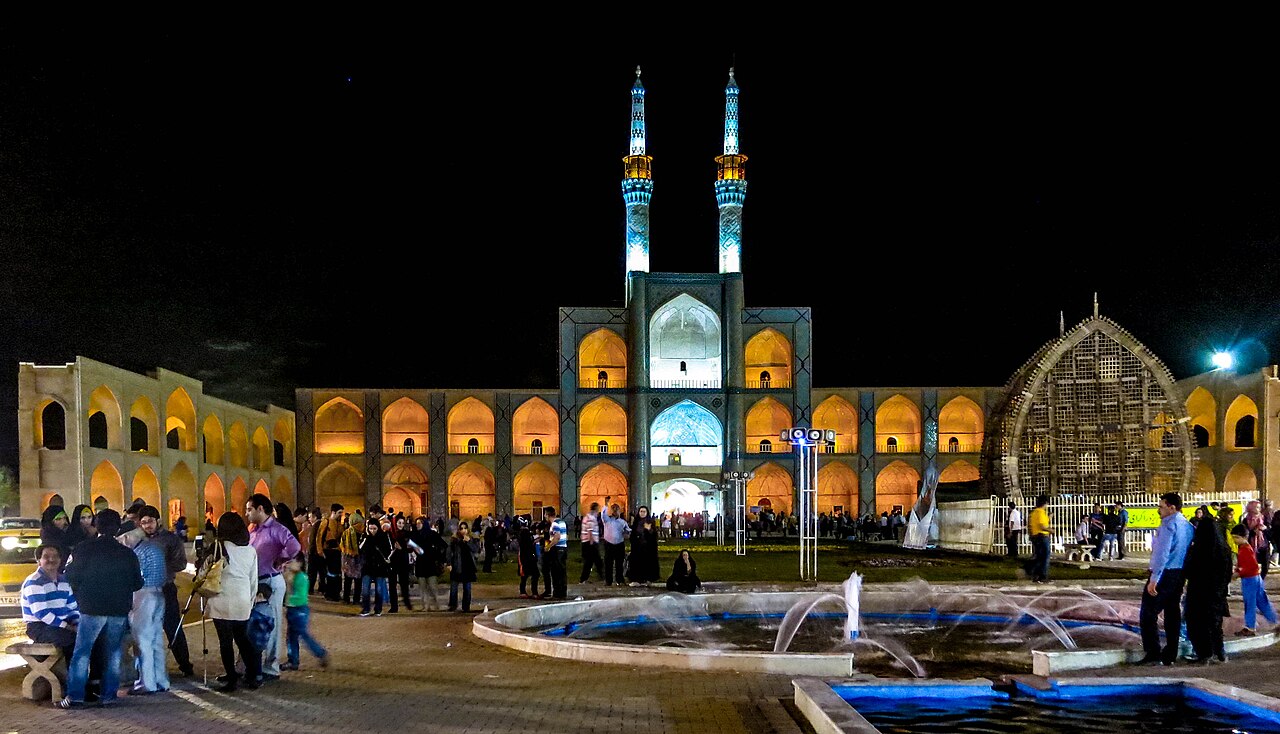
The Historic City of Yazd — inscribed in 2017 as Iran’s first inscribed living historic city — is the best-preserved earthen architecture city in the world and the global capital of Zoroastrianism, the religion of ancient Persia. Isfahan’s Safavid palaces are 3 hours northwest; Persepolis’s Achaemenid ruins are 4 hours south — a central Iranian heritage itinerary spanning from the Bronze Age to the seventeenth century.
Historic City of Yazd: The Living Earthen City City centre
The Historic City of Yazd, inscribed in 2017 under criteria (ii) and (v), is the oldest continuously inhabited earthen-architecture city in the world — a desert city in the Iranian plateau whose mud-brick buildings, dating from the early Islamic period (seventh century CE) to the nineteenth century, document 1,300 years of adaptation to an extreme environment without stone or timber. The city’s badgirs (wind towers) — structures of 10 to 20 metres that capture prevailing breezes and channel cooled air down into the buildings below — are the most sophisticated natural ventilation system in pre-industrial architecture; Yazd has more badgirs per square kilometre than any other city, giving its skyline a distinctive silhouette of asymmetric towers. The qanat system (underground irrigation channels carrying water from the Shirkuh mountain snowfields to the desert city over 70 kilometres) is the infrastructure that made the city possible; more than 130 qanats feed Yazd and its gardens. The Jameh Mosque of Yazd (begun 1324 CE, twin minarets completed c. 1375 CE, at 48 metres the tallest minarets in Iran) and the Amir Chakhmaq complex (1437 CE) represent the Timurid and Ilkhanid architectural heritage within the earthen city.
Zoroastrian Heritage: Fire Temples and Towers of Silence 🚕 5–15 km from Yazd centre
Yazd is the world centre of Zoroastrianism — the pre-Islamic monotheistic religion of ancient Persia, founded by the prophet Zarathustra (c. 1500–1000 BCE), which held that creation is the battleground between the forces of Ahura Mazda (the Wise Lord) and Angra Mainyu (the Destructive Spirit). The Yazd Atash Behram (Fire Temple), built in 1934 but housing a sacred fire that has burned continuously since 470 CE, is the holiest Zoroastrian site in Iran; the roughly 25,000 Iranian Zoroastrians (Zartoshtis) and the Parsi Zoroastrian community of India make pilgrimage to the flame. The Towers of Silence (Dakhma) — two circular stone platforms on a hill 15 km south of Yazd where Zoroastrian dead were exposed to birds of prey rather than buried (to avoid polluting the sacred elements of earth, water, and fire) — were last used in the 1960s; the older tower dates from the seventeenth century and commands a panoramic view of the desert basin.
Meybod: Caravanserai and Narin Castle 🚗 45 mins northwest
Meybod, 45 kilometres northwest of Yazd, preserves a complete caravanserai complex around the Narin Castle (a Sasanian-period mud-brick fort of the third to seventh century CE, rebuilt multiple times) — a well-preserved example of the earthen architecture tradition in a satellite town of Yazd that was an important stop on the Silk Road. The Robat-e Zayn al-Din caravanserai (restored Safavid-period, sixteenth century), with its circular dome over the central court, is one of the best-preserved examples of Safavid period commercial infrastructure; travellers and their pack animals could shelter, water their beasts at the central tank, and continue to Yazd or Isfahan the following day. Meybod also holds an intact ice house (yakhchal) — a conical mud-brick dome structure designed to preserve winter ice through the summer, a refrigeration system without electricity that operated from antiquity until the 1960s.
Persepolis: From Yazd to the Achaemenid Capital 🚗 ~4 hrs south via Shiraz
Persepolis, 390 kilometres south of Yazd via Shiraz, is the ceremonial capital of the Achaemenid Persian Empire — the same civilisation whose Zoroastrian religion Yazd’s fire temples preserve. The Achaemenid rulers Darius I (522–486 BCE) and Xerxes (486–465 BCE) built the terrace complex on a rock platform above the Marvdasht plain; the Apadana audience hall and its relief procession of the 28 tribute-bringing peoples of the empire represent the first great centralised Persian state. A combined Yazd–Persepolis itinerary traces the continuity of Iranian civilisation from the Achaemenid Empire through the Islamic period to the present Zoroastrian community — a cultural thread 2,500 years long. The city of Shiraz, 60 kilometres from Persepolis, is the gateway for the Persepolis visit and holds the Nasir al-Mulk Mosque (the Pink Mosque) and the shrines of the poets Hafez and Saadi.
Practical information
Yazd Airport (AZD) connects to Tehran, Mashhad, and Isfahan. The historic city is partially pedestrianised; the Jameh Mosque, the Amir Chakhmaq complex, the Zoroastrian Fire Temple, and the Water Museum (documenting the qanat system) are all within 30 minutes’ walk of the main square. The Towers of Silence require a taxi (15 km south) and allow approximately 1 hour for the hill climb and site. Dress code for Iran applies throughout: women require hijab and modest clothing, men should avoid shorts. The best season for Yazd is October–April; summer temperatures in the desert city regularly exceed 40°C. The Persian New Year (Nowruz, March 21) and the fire-jumping festival of Chaharshanbe Suri (Wednesday before Nowruz) are the most atmospheric times to be in Yazd.
Frequently Asked Questions
Is Yazd a UNESCO World Heritage Site?
Yes. The Historic City of Yazd was inscribed in 2017 under criteria (ii) and (v), making it the first living historic city in Iran to receive UNESCO World Heritage status. The inscription covers the historic city fabric, its badgir wind towers, qanat water channels, and the earthen mud-brick architecture that has been continuously maintained and inhabited for over a thousand years.
What is a badgir and how does it work?
A badgir (wind tower) is a traditional Persian passive cooling device — a vertical tower 10–20 metres tall with openings on one or more sides that capture the prevailing desert wind and channel it down through shafts into the building below. The tower can also create a thermal chimney effect, drawing hot air up and out while pulling cooler underground air into the basement rooms. Yazd has more operational badgirs than any other city; the traditional architecture of the old town relies on them in combination with qanats to keep interior temperatures 10–15°C below the outdoor maximum.
Can non-Zoroastrians visit the Atash Behram Fire Temple?
Yes. The Yazd Atash Behram (Cathedral Fire Temple) is open to visitors of all faiths daily from 8 a.m. to 8 p.m.; admission requires a modest fee. Respectful dress is expected. The sacred fire, burning in a golden urn behind glass, is visible from the entrance room; photography is permitted. The adjacent museum documents the history of Zoroastrianism in Iran and the global Parsi diaspora.
.jpg)