
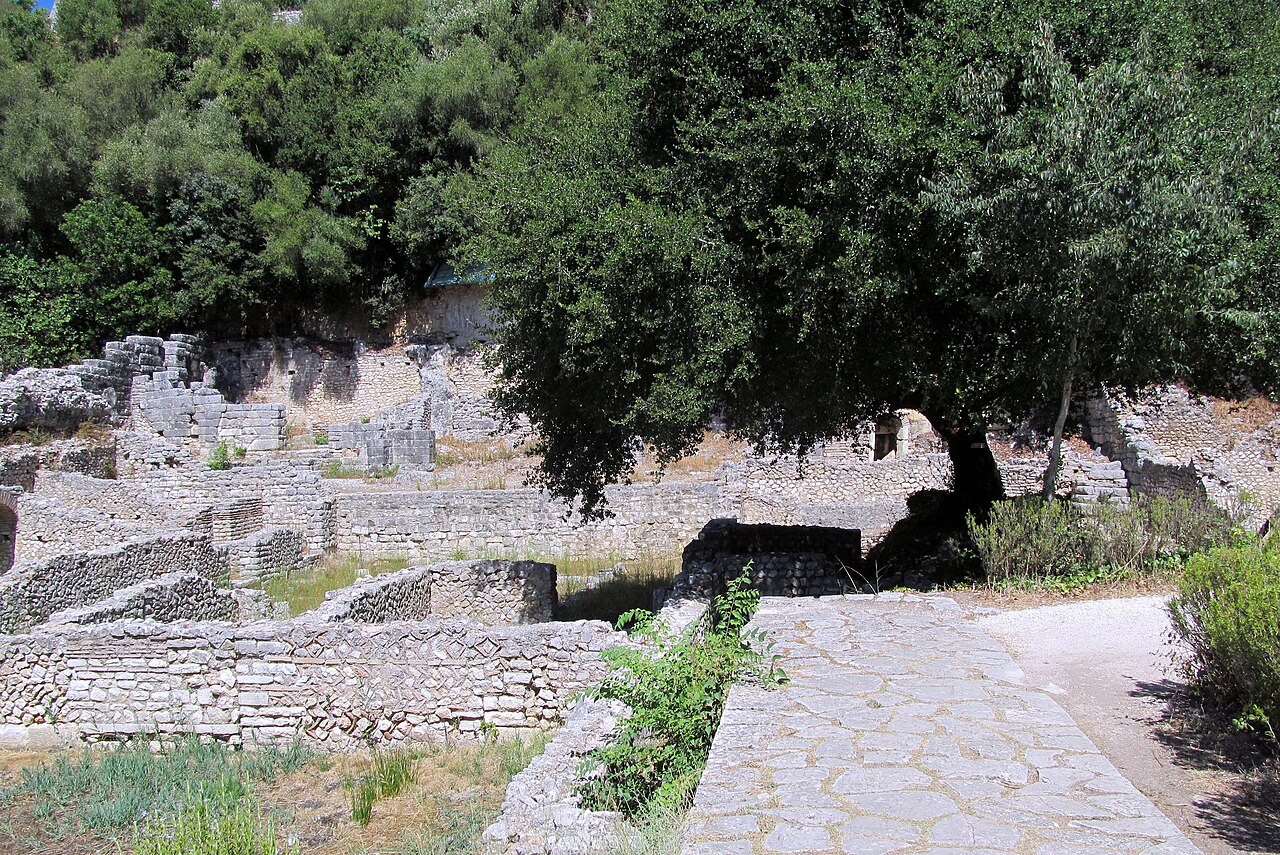
Albania holds three UNESCO World Heritage Sites, and all three are reachable from Tirana in a single day’s drive. Butrint in the deep south preserves one of the most complete stratigraphies of ancient urban life in the Mediterranean; Berat and Gjirokastra together form an ensemble of Ottoman-era townscapes without parallel in the Balkans. From Cultural Heritage Online.
Berat 90 km south — 1.5 hr by road
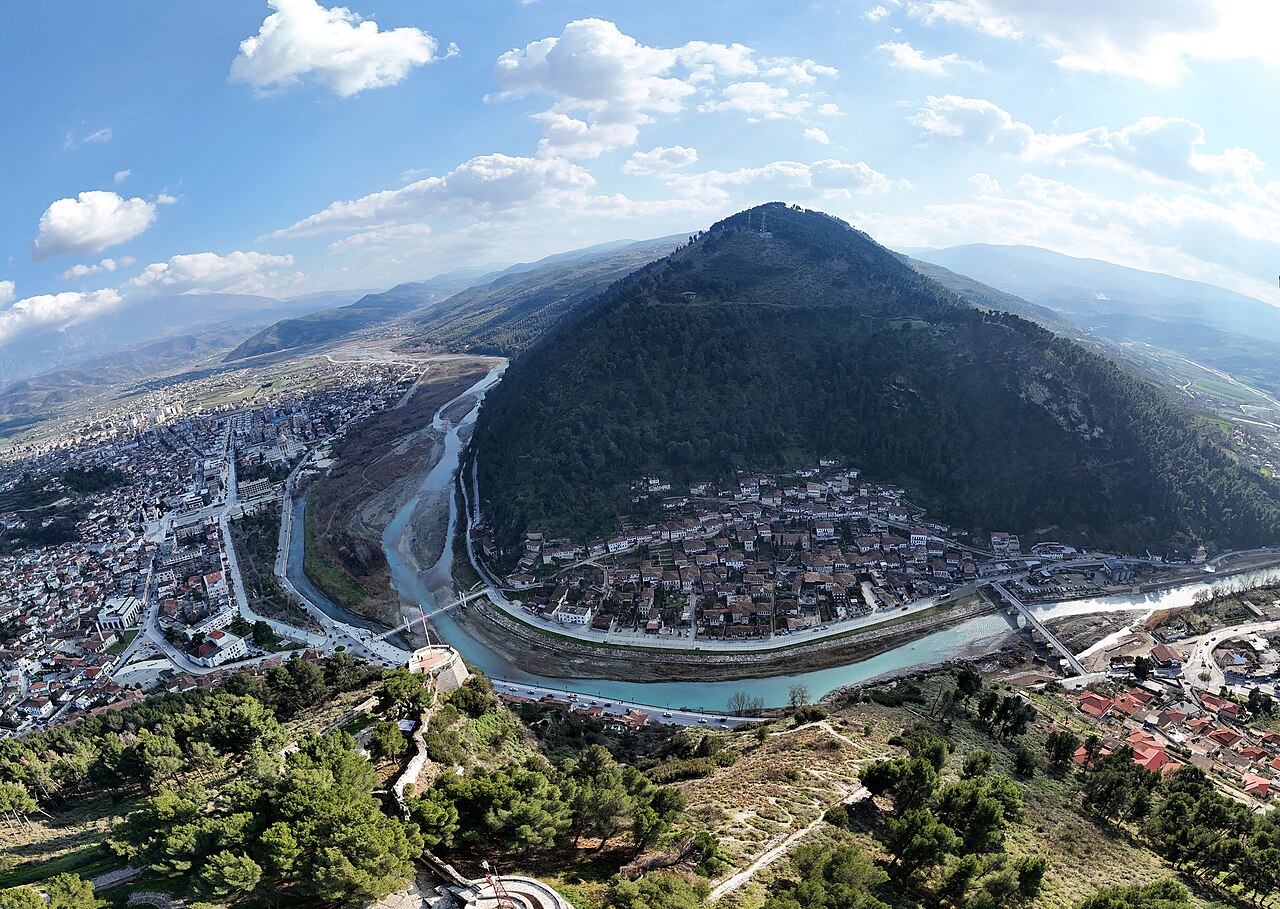
Berat earns its Albanian epithet — “the city of a thousand windows” — from the rows of large Ottoman-period casements that stack up the hillside above the Osum river. The town organises itself around three distinct zones: the walled castle district (Kalaja) on the summit, the 18th-century merchant quarter of Mangalem on the slope below it, and Gorica on the opposite bank, connected by a stone bridge. Each zone retains its own character, and the visual effect from a distance — tier upon tier of white facades and dark timber frames — reads almost as a single composition.
The Kalaja is a functioning neighbourhood, not an archaeological site. Churches and mosques share the ridge; residents hang laundry in the same courtyards where Byzantine foundations are exposed underfoot. Inside the Church of the Dormition of Saint Mary, frescoes dating from the 13th to the 16th century survive in remarkable condition, the work of the Onufri school of Albanian icon painters. Onufri himself — the most celebrated Albanian painter of the 16th century — worked here, and the castle church now houses a museum of his icons and those of his son Nikolla.
Berat was inscribed alongside Gjirokastra in 2005 as a rare surviving example of an Ottoman-era Balkan town where the full urban fabric — residential, religious, and commercial — remains largely intact. The extension of the inscription in 2008 recognised additional historic fabric beyond the castle walls.
Getting there: From Tirana, drive south on the SH4 toward Fier, then continue on the SH72 to Berat. Furgon (shared minibus) services depart from Tirana’s South Bus Terminal. Allow: A half day to walk all three zones; a full day if you intend to visit the Onufri Museum and climb both banks of the river. Best for: Travellers interested in Ottoman domestic architecture, Byzantine art, and living historic townscapes.
Gjirokastra 100 km south — 2 hr by road
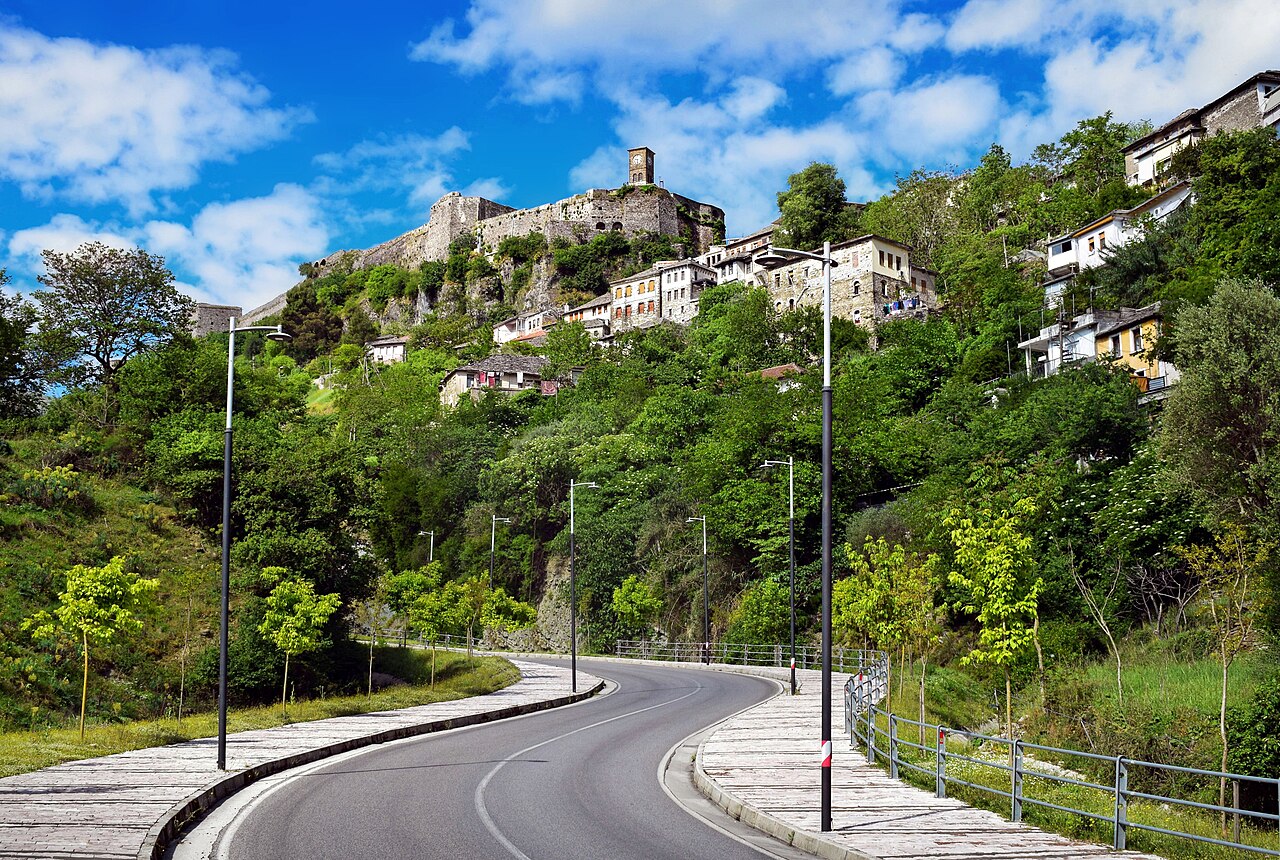
Gjirokastra is built on a gradient so steep that the rooftop of one house sits level with the foundation of the next. The characteristic dwelling type — the kule, or tower house — is a three- to four-storey structure of dressed grey limestone, with load-bearing stone walls on the lower floors and elaborate carved wooden interiors above. More than 200 kule survive, giving the town a density and coherence that has no equivalent in the region. The Zekate House, dating from the 1812, is the largest and best-preserved example, its twin towers and projecting upper floors unchanged since the early 19th century.
The fortress on the crest of the ridge has origins in the 12th century but reached its current extent largely through Byzantine, Ottoman, and later Albanian interventions up to the 19th century. It is also a biographical site of a peculiar kind: Gjirokastra was the birthplace of both the novelist Ismail Kadaré — whose early autobiographical novel “Chronicle in Stone” (1971) describes the town’s wartime years from a child’s perspective — and of Enver Hoxha, the communist dictator who ruled Albania from 1944 to 1985. The town’s inscription on the World Heritage List in 2005 stands largely independent of both legacies; it is the built fabric that justifies the designation.
Gjirokastra can be combined with Berat in a single two-day circuit from Tirana, driving south to Gjirokastra on the first day and returning via Berat on the second. The two towns lie roughly 80 km apart on the SH4 corridor.
Getting there: Drive south from Tirana on the SH4; Gjirokastra is approximately 2 hours by car. Direct furgon services also run from Tirana’s South Bus Terminal. Allow: At least 3–4 hours in the historic centre; a full day if you visit the Zekate House, the fortress, and the Ethnographic Museum. Best for: Travellers drawn to military and domestic architecture, literary history, and high-altitude Balkan townscapes.
Butrint National Park 210 km south — 3 hr by road
Butrint occupies a low promontory between a coastal lagoon and a channel connecting to the Ionian Sea — a site where the proximity of fresh water, shelter, and maritime access made continuous occupation across nearly four millennia not just possible but inevitable. Excavations have traced human presence here from around 2700 BC. By the 7th century BC a Greek sanctuary was established; by the 4th century BC a polis with defensive walls. The Romans under Augustus settled veterans here around 44 BC, raising the settlement to the status of a colonia and leaving the forum, baths, and street grid that still determine the site’s topography today. Byzantine administrators followed, then Venetian merchants, and finally Ottoman governors — each layer compressed into a remarkably small footprint.
The single most impressive structure is the Hellenistic theatre, built in the 4th century BC against a natural slope. Fifteen tiers of seating survive, carved from the bedrock and supplemented by cut stone, and the theatre remains legible as a building rather than as rubble. A few hundred metres away, the early Christian baptistery from the 6th century AD preserves its floor mosaic largely intact: a composition of fish, birds, deer, and geometric interlace that extends across the entire floor surface and represents one of the finest surviving examples of early Christian decorative work in the Balkans. The Venetian tower at the edge of the site and the Lion Gate at the city entrance are the latest major additions, dating from the medieval period.
Butrint was inscribed by UNESCO in 1992 and extended in 1999 to encompass the National Park. The surrounding wetland — the Butrint lagoon and its bordering forests — is one of the most ecologically significant habitats in the eastern Mediterranean, home to rare waterbirds and supporting a mosaic of saltwater and freshwater environments. The combination of archaeological depth and ecological integrity is what makes Butrint unusual even among World Heritage Sites.
Getting there: Drive south from Tirana on the SH4 through Gjirokastra, then continue through the Qafë Muzina Pass to Saranda and the Butrint road (approximately 3 hours). Alternatively, fly to Saranda Airport (approximately 1 hour; seasonal connections) and continue 20 minutes by road. Allow: 3–4 hours on site. Best for: Travellers interested in stratified urban archaeology, Roman colonial history, early Christian mosaics, and Mediterranean wetland habitats.
Frequently Asked Questions
How many UNESCO World Heritage Sites are near Tirana?
Albania has three UNESCO World Heritage Sites in total, and all three are accessible from Tirana by road. Berat lies 90 km to the south (about 1.5 hours), Gjirokastra 100 km to the south (about 2 hours), and Butrint 210 km to the south near Saranda (about 3 hours). All three can be visited over two or three days from Tirana as a base.
Can I visit Berat and Gjirokastra in the same trip?
Yes. The two towns are around 80 km apart and sit on the same SH4 road corridor south of Tirana, making a two-day circuit straightforward. A typical approach is to drive to Gjirokastra on day one and return via Berat on day two, or to combine both in a single long day if you keep site time to two to three hours each. Most travellers find a night in each town more rewarding.
What is the best season to visit these UNESCO sites in Albania?
April through June and September through October offer the most comfortable conditions across all three sites. Summer heat (July–August) can be intense at Butrint, where the lagoon amplifies humidity, and the mountain road to Gjirokastra is exposed. Butrint’s wetlands are particularly active with bird life in spring. Winter access to all three sites is possible but cold, and some smaller museums may reduce hours.
What makes Butrint historically significant beyond its Roman ruins?
Butrint’s UNESCO designation rests on the continuity and density of its occupational sequence rather than on any single period. The site contains substantive remains from at least six distinct cultural phases — Illyrian, Greek colonial, Roman, Byzantine, Venetian, and Ottoman — compressed onto one small peninsula. This overlap means that walking through the site is in effect walking through a compressed history of the eastern Mediterranean, with each phase visible in direct relationship to the others. The 6th-century baptistery floor mosaic alone, one of the most complete early Christian mosaics in existence, would justify the designation on its own terms.


.jpg)

