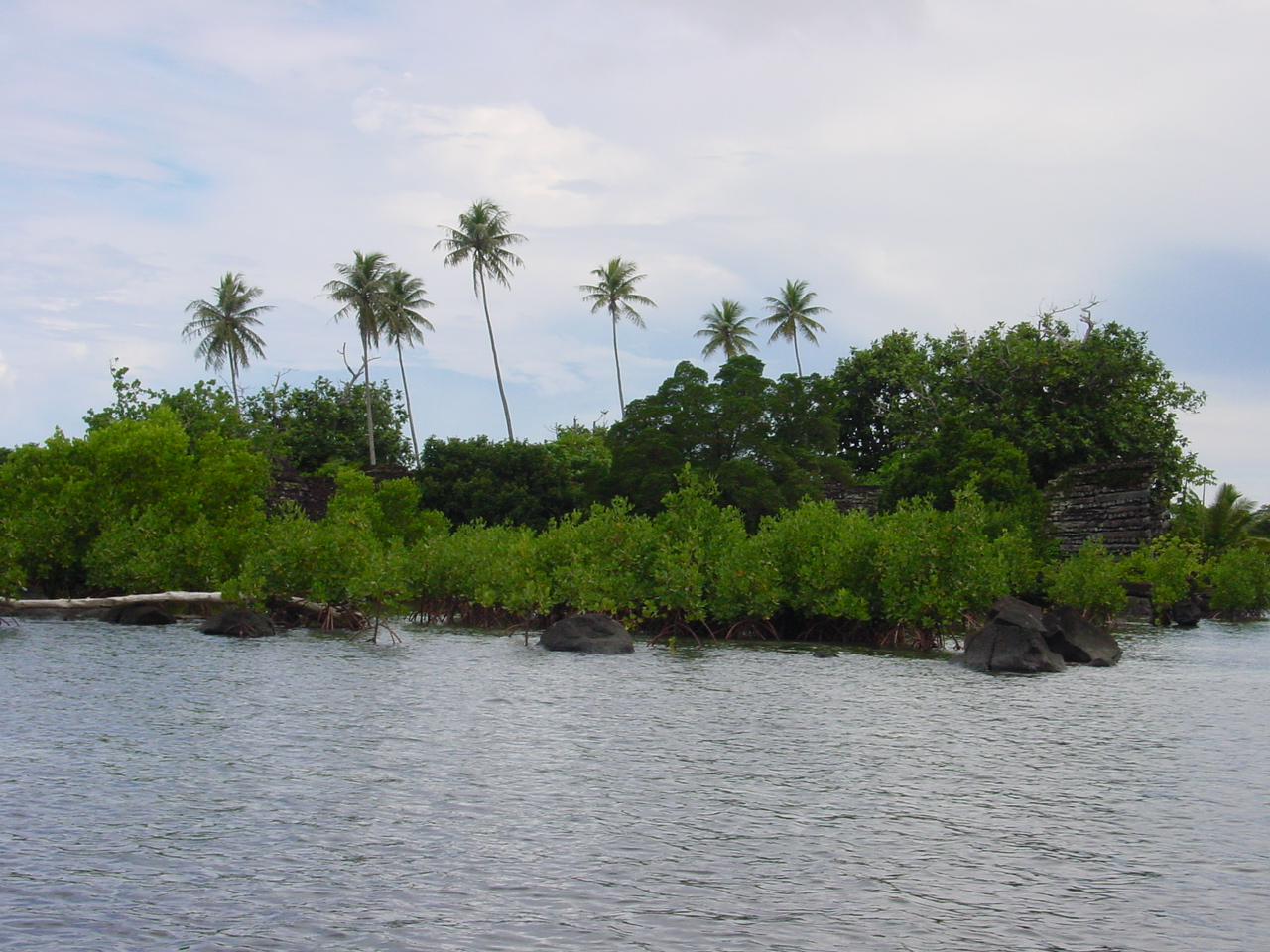
Palikir, the capital of the Federated States of Micronesia, shares its island — Pohnpei — with Nan Madol, a prehistoric city of 92 artificial islets built in a tidal lagoon that is UNESCO-inscribed and often called the “Venice of the Pacific”. From Cultural Heritage Online.
Nan Madol, Ceremonial Centre of Eastern Micronesia 20 km from Kolonia — 30 min by road and boat
Nan Madol was built on and around the tidal flats of Temwen Island on Pohnpei’s southeastern coast over a period of several centuries, reaching its peak between approximately 1200 and 1600 AD under the Saudeleur dynasty. The complex consists of 92 artificial islets constructed by stacking millions of prismatic basalt columns — some reaching 5–6 metres in length and weighing several tonnes — without mortar, in interlocking log-cabin patterns that have remained stable for centuries. The channels between the islets carry tidal water, allowing canoe navigation throughout the complex. No road access exists to most of the site: boats are required to reach most of the 92 islets.
The largest structure is Nan Douwas, a mortuary complex for the Saudeleur chiefs, surrounded by walls reaching 7–8 metres in height with a central tomb chamber. The basalt columns used throughout Nan Madol were quarried at specific locations on Pohnpei — the closest quarry is approximately 30 km away, and some columns were transported by sea from the southwestern tip of the island, a journey that required significant navigational and logistical organization given the size and weight of the material.
Nan Madol was inscribed as a UNESCO World Heritage Site in 2016 and simultaneously placed on the List of World Heritage in Danger due to inadequate management, invasive vegetation obscuring and damaging the basalt structures, and the advance of mangroves into the canals. An estimated 750 to 1,000 people once lived and worked on the islets at the height of Saudeleur power; the site has been uninhabited since the Saudeleur dynasty collapsed around 1628.
Getting there: Palikir is on Pohnpei island; Kolonia (the main town) is 20 km from Palikir. From Kolonia, guided boat tours reach Nan Madol in approximately 30 minutes by road to Madolenihmw and then by canoe into the site. Access requires a permit and guide. Allow: Half to full day. Best for: Pre-Columbian Pacific archaeology; island heritage visitors.
Frequently Asked Questions
How many UNESCO World Heritage Sites does the Federated States of Micronesia have?
One: Nan Madol, Ceremonial Centre of Eastern Micronesia, inscribed in 2016. It was simultaneously placed on the UNESCO List of World Heritage in Danger due to vegetation management issues and inadequate site management. It is the only UNESCO World Heritage Site in Micronesia.
What are the 92 islets of Nan Madol made of?
The islets were constructed by stacking prismatic basalt columns — a natural rock formation found on Pohnpei where basalt cools in hexagonal and irregular prisms — without mortar, in log-cabin interlocking patterns. The columns range from small pieces to monoliths several metres long and weighing several tonnes. The quarrying, transport by sea around the island, and placement of millions of basalt columns over several centuries represents one of the largest construction achievements in the ancient Pacific.
Why was Nan Madol placed on the Danger List when inscribed?
Because of pre-existing threats that the FSM government had not adequately addressed: invasive mangroves and other vegetation advancing into the canal system and over the basalt structures, causing physical damage; insufficient management and conservation infrastructure; and inadequate legal protection at the national level. UNESCO set specific milestones for the FSM to achieve removal from the Danger List, including vegetation clearance, legal protection, and a management plan.
Can you visit Nan Madol independently?
No. Access to Nan Madol requires a local guide and a permit issued through the Pohnpei State Historic Preservation Office. The site is also physically difficult to navigate independently — most of the 92 islets are accessible only by canoe, and the channel system is complex. Guided tours can be arranged through tour operators in Kolonia.
Sources
- S1 — Hanlon, David. Upon a Stone Altar: A History of the Island of Pohnpei to 1890. University of Hawaii Press, 1988. ISBN 978-0-8248-1124-2.
- S2 — Rainbird, Paul. The Archaeology of Micronesia. Cambridge University Press, 2004. ISBN 978-0-521-65630-6.
Spotted an error? Write to editorial@culturalheritageonline.com and we correct it the same day.