

Kandy anchors one of the densest concentrations of UNESCO World Heritage Sites in Asia: from the sacred tooth relic at its centre to the cave temples of Dambulla, the rock citadel of Sigiriya, the ancient capital of Polonnaruwa, and the Dutch colonial ramparts of Galle — all reachable within a day’s drive. From Cultural Heritage Online.
Sacred City of Kandy Within the city — no travel time
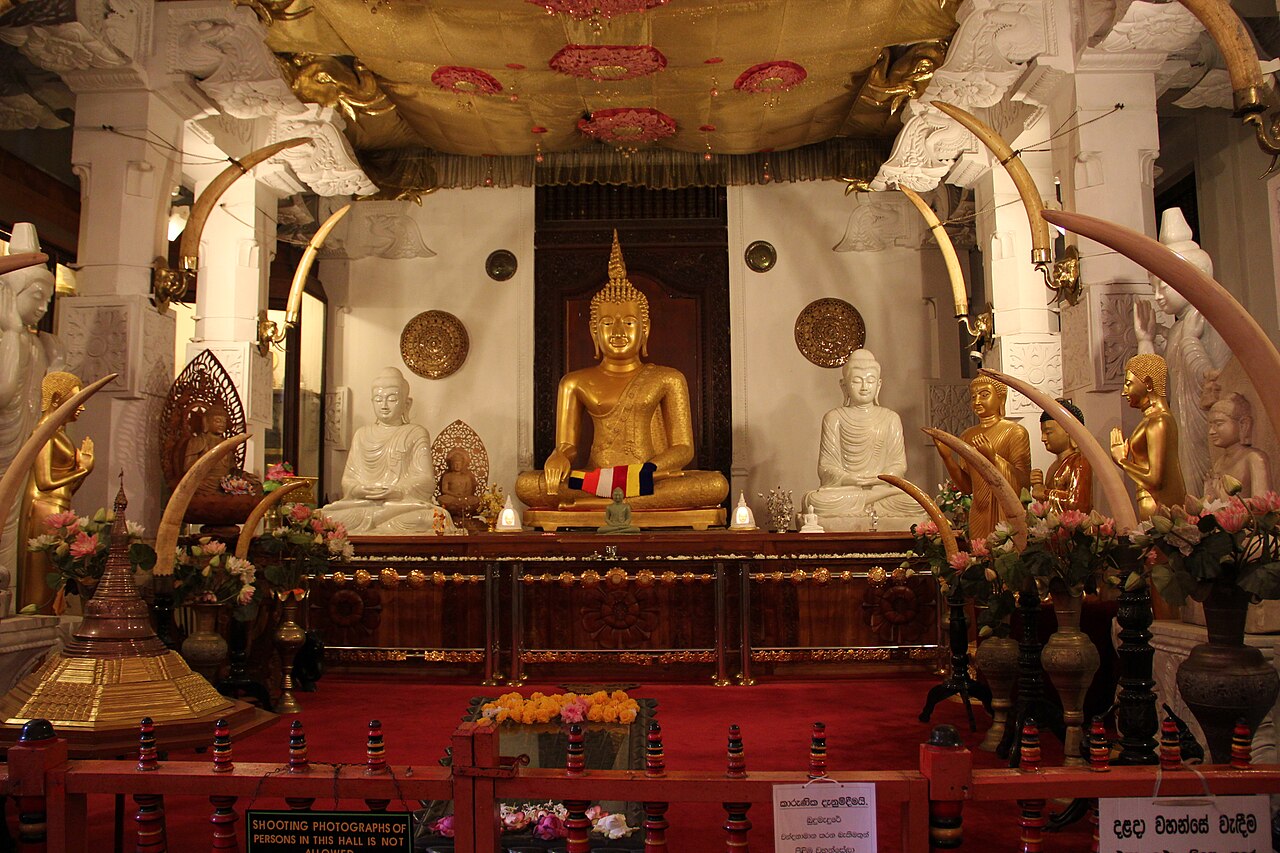
Kandy holds its centrepiece gently: a low, golden-roofed shrine set beside an artificial lake that King Kirti Sri Rajasinha ordered built in 1807. The Temple of the Tooth Relic — Sri Dalada Maligawa in Sinhala — houses a tooth of the historical Buddha, brought to Sri Lanka from India in the 4th century AD. For over fifteen hundred years the relic has been the political as much as the spiritual axis of the island: whoever held the tooth held the right to rule.
The temple compound is active from before dawn. The day opens with three puja ceremonies — the ceremonial unveiling of the inner casket — at roughly 5:30 am, 9:30 am and 6:30 pm, each announced by the low roll of Kandyan drums that carries across the lake. The UNESCO inscription in 1988 recognised not only the monuments but the living ceremonial tradition that surrounds them, including the Esala Perahera, a ten-day procession of costumed elephants, drummers and torch-bearers held each August.
The royal palace complex adjacent to the temple — audience halls, a court and the National Museum of Kandy — completes a site that functioned as the last independent capital of the Kandyan Kingdom until British annexation in 1815. The kingdom resisted Portuguese, Dutch and early British colonial pressure for over three centuries.
Getting there: Central Kandy; walkable from most accommodation. Allow: 2–3 hours, longer if attending a puja. Best for: Travellers interested in living Buddhist tradition, South Asian royal history.
Golden Temple of Dambulla 72 km north — approx. 1.5 hr by road
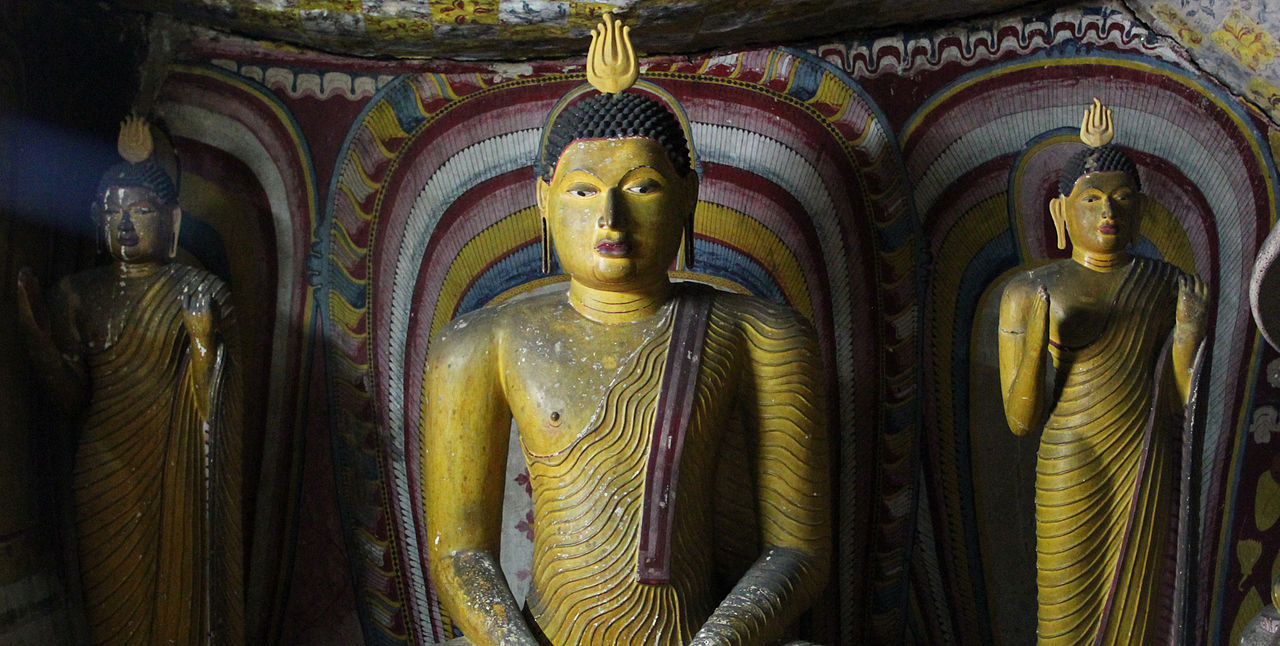
A granite massif rises abruptly from the dry-zone scrub north of Kandy, and carved into its flanks are five cave temples that have functioned as a place of worship since at least the 1st century BC. King Valagamba took refuge here after being driven from Anuradhapura by South Indian invaders; when he reclaimed his throne around 89 BC he converted the natural caves into a royal rock temple. The paintings and statues accumulated across twenty centuries of patronage.
Inside, 2,100 square metres of ceiling and wall paintings press close in the lamplight — ochre Jatakas, celestial figures, rows of lotus buds. The 153 Buddha images range from small votive figurines to the 15-metre reclining statue in Cave 1. Three Kandyan kings are represented in sculpture alongside four Hindu deities, which reflects the syncretic character of royal patronage in medieval Sri Lanka. UNESCO inscribed the site in 1991.
Getting there: Bus or taxi via the A9 highway north from Kandy toward Dambulla town; the cave entrance requires a short steep climb. Allow: 2–3 hours on site. Best for: Those interested in Buddhist art, cave archaeology, and the continuity of pilgrimage across two millennia.
Ancient City of Sigiriya 93 km north via Dambulla — approx. 2 hr by road
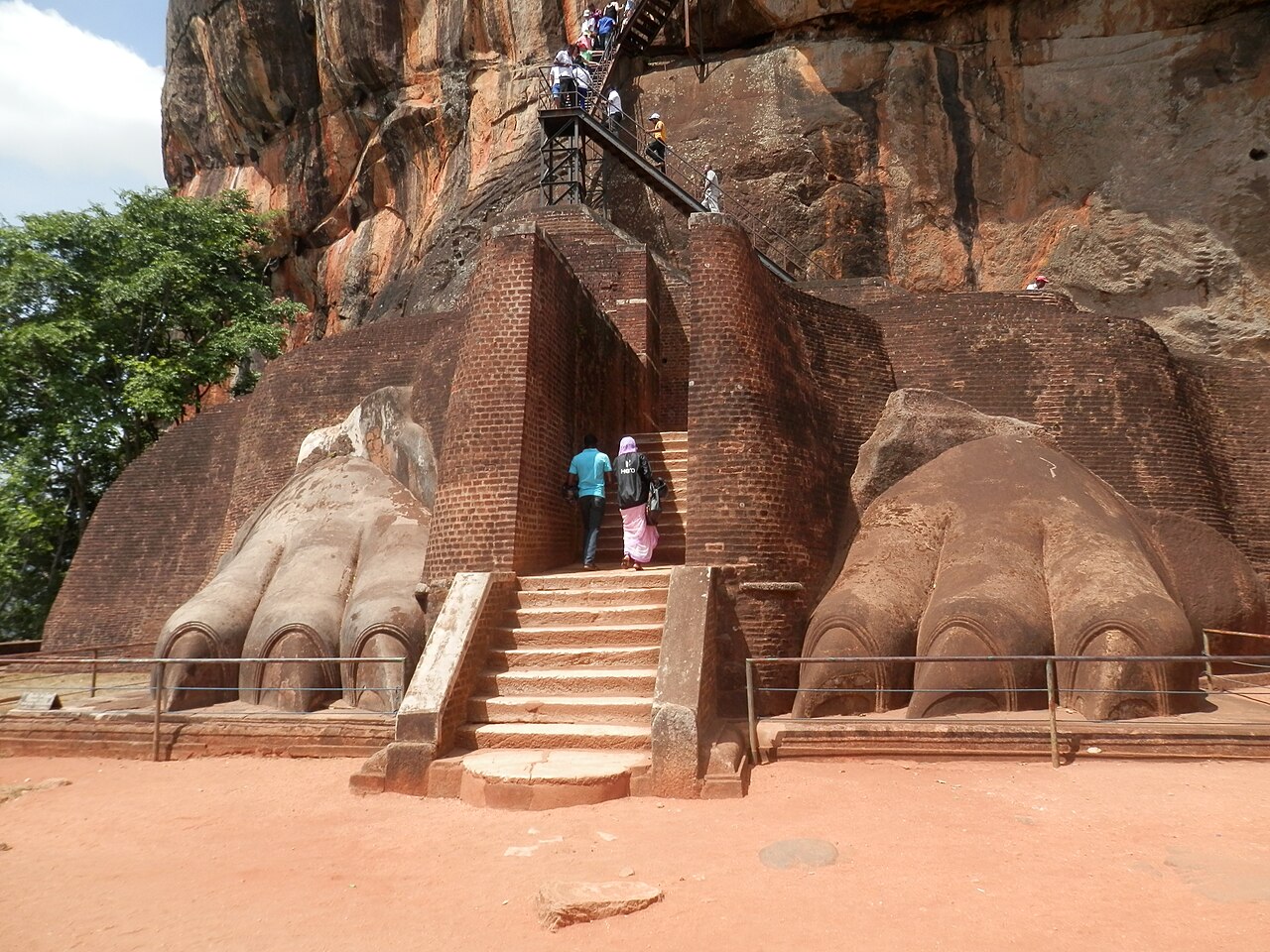
The volcanic plug at Sigiriya stands 200 metres above the surrounding plain, and in the late 5th century King Kashyapa I built an entire royal capital on and around it. He had deposed and killed his father Dhatusena, feared retribution from his half-brother Moggallana, and chose this near-vertical rock as both palace and stronghold. When Moggallana eventually returned from India with an army, Kashyapa descended to fight on the plain and lost; the palace was abandoned to monks.
The ascent passes through what remains of the most elaborate water-garden complex in the ancient world south of Asia Minor — symmetrical pools, fountains fed by hydraulic pressure, and boulder gardens that still function during the rains. Halfway up, a sheltered gallery holds the 5th-century frescoes known as the Ladies of Sigiriya: figures in ocher and green whose identity — heavenly nymphs, portraits of royal women, apsaras — scholars have debated for over a century. The Mirror Wall below once carried a plaster surface polished enough to reflect the king; today it bears centuries of visitor graffiti in Old Sinhala, the oldest surviving record of the language. UNESCO inscribed the site in 1982.
Getting there: Continue north from Dambulla on the A9, then east. The climb takes 30–45 minutes; the upper sections involve metal staircases and exposed ledges. Allow: 3–4 hours including water gardens. Best for: Travellers combining archaeology with landscape; those comfortable with heights and moderate physical effort.
Ancient City of Polonnaruwa 140 km northeast — approx. 3 hr by road
After the fall of the ancient capital Anuradhapura to South Indian forces, Polonnaruwa served as the second seat of Sinhalese kingship from 1070 to roughly 1200 AD. The Chola king Rajendra I had held it briefly before King Vijayabahu I retook the north of the island, and it was under Parakramabahu I (1153–1186) that Polonnaruwa reached its greatest extent — a planned city of palaces, dagobas and irrigation works, supported by a reservoir so large it was called the Sea of Parakrama.
The site’s single most affecting monument is Gal Vihara, where four colossal figures — a seated Buddha in meditation, a standing figure 7 metres tall, a smaller seated form, and a 14-metre reclining Buddha in parinirvana — were carved directly from a single curved face of granite in the 12th century. The seated figure retains traces of original paint in the folds of the robe. Elsewhere, the Vatadage circular relic house preserves its concentric stone railings, and the Lankathilaka image house rises 18 metres despite having lost its roof eight centuries ago. UNESCO inscribed the site in 1982.
Getting there: Northeast from Kandy via Matale or from Dambulla; a bicycle is the most practical way to cover the spread-out ruins once there. Allow: A full day, ideally overnight in Polonnaruwa town. Best for: Visitors willing to combine Sigiriya and Dambulla into a two-day loop through the Cultural Triangle.
Old Town of Galle and Its Fortifications 120 km southwest of Colombo — approx. 3 hr from Kandy via Colombo
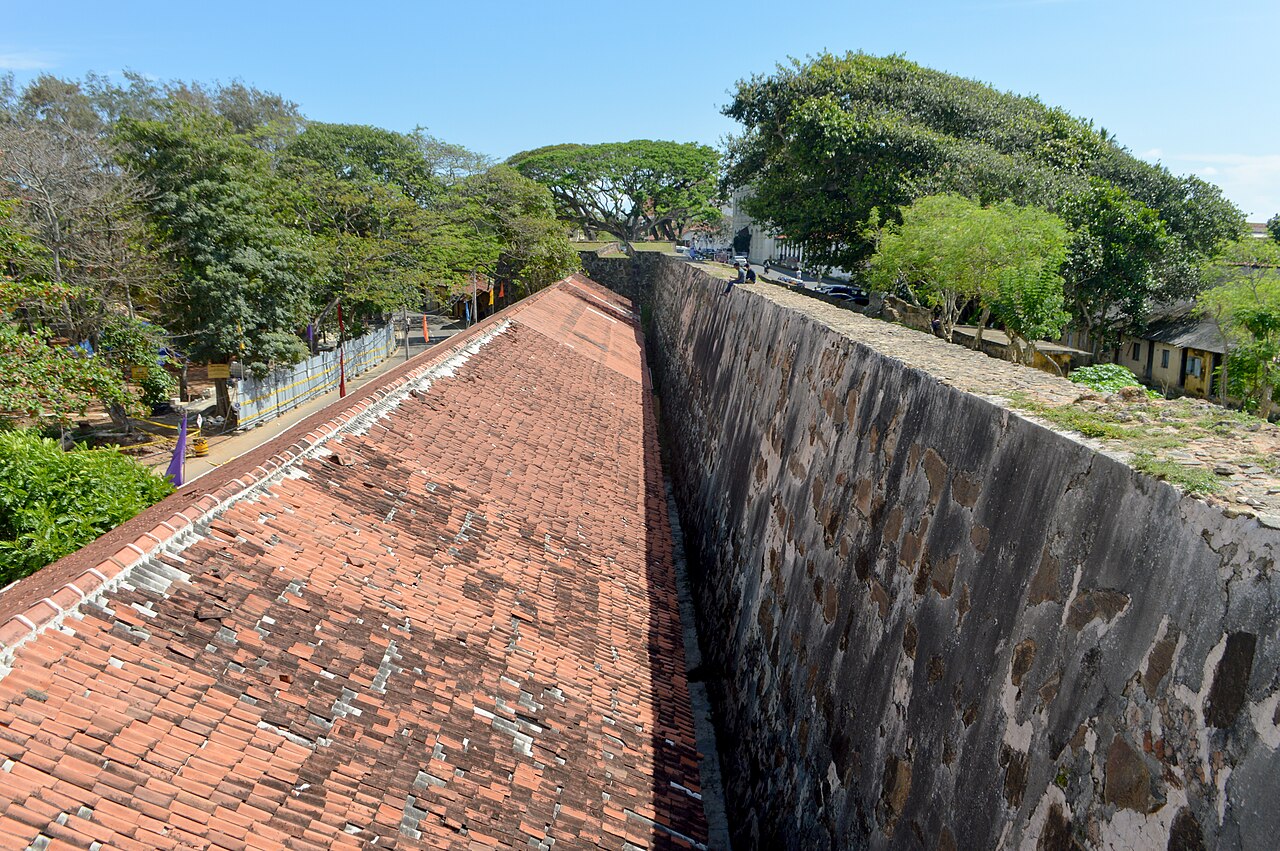
At the southwestern tip of Sri Lanka, a Dutch colonial town occupies a headland almost entirely enclosed by 17th-century fortifications. The Portuguese built the first modest fort here after establishing a trading post in 1589; the Dutch East India Company captured it in 1640 and spent the following decades constructing the massive bastion system — moon bastions, star bastions, a sea gate — that survives largely intact. When the British took control in 1796, they found little to improve and left the walls standing.
Inside the ramparts, streets laid out by Dutch engineers still follow their original grid. Church Street, Leyn Baan Street, Pedlar Street — the names are Dutch, the buildings are a layered accumulation of colonial and later construction, and the whole peninsula remains a functioning town rather than an open-air museum. The walk along the top of the ramparts at the end of the afternoon, with the Indian Ocean on three sides, is one of the more disorienting pleasures in Sri Lanka: you are standing on a wall of coral stone built by engineers who died three hundred years ago, watching container ships cross toward the horizon. UNESCO inscribed the site in 1988.
Getting there: Train or bus south to Colombo, then south on the coastal railway or expressway to Galle; or a direct bus from Kandy. Best combined with a night on the southern coast. Allow: Half a day minimum; an overnight stay reveals the fort after day-visitors leave. Best for: Travellers interested in European colonial history and Indian Ocean trade networks.
Frequently Asked Questions
How many UNESCO World Heritage Sites are near Kandy?
Sri Lanka has 8 UNESCO World Heritage Sites in total, and five cluster within a day’s reach of Kandy: the Sacred City of Kandy (inscribed 1988), the Golden Temple of Dambulla (1991), the Ancient City of Sigiriya (1982), the Ancient City of Polonnaruwa (1982), and the Old Town of Galle and Its Fortifications (1988). The remaining three — Anuradhapura, Sinharaja Forest Reserve, and the Central Highlands — are also reachable from Kandy with additional travel time.
How do you visit the Sacred City of Kandy from within the city?
The Temple of the Tooth Relic (Sri Dalada Maligawa) is walkable from most accommodation in central Kandy. Entry requires modest dress — shoulders and knees covered — and shoes are removed before entering the inner shrine. The three daily puja ceremonies (around 5:30 am, 9:30 am and 6:30 pm) offer the most atmospheric experience; arrive 20–30 minutes early as crowds are significant at the evening puja. Photography of the inner relic casket is not permitted.
Can you combine Dambulla and Sigiriya in a single day trip from Kandy?
Yes, though it makes for a long day. Leave Kandy early — by 7 am — to reach Dambulla for the cave temples in the cooler morning hours, then continue 20 km northeast to Sigiriya for the afternoon ascent. The Sigiriya rock is best climbed before 3 pm to avoid the worst heat and to ensure enough time for the water gardens at the base. Return to Kandy the same evening or overnight in Sigiriya or Dambulla town. November through April is the driest period in the Cultural Triangle and the most comfortable for this itinerary.
What are the frescoes at Sigiriya, and why do scholars debate their identity?
The Sigiriya frescoes are a set of painted figures, now numbering around 22 surviving images from what was once a much larger gallery, sheltered in a westward-facing pocket of the rock face roughly halfway up the climb. They were painted in the 5th century, during the reign of King Kashyapa I, using a tempera technique on a lime-plastered surface. The figures are female, richly adorned, and shown from the waist up carrying flowers and vessels. Whether they represent apsaras (celestial maidens), the king’s consorts, a goddess of lightning, or women attending a religious ceremony has been argued since the 19th century, and no consensus has been reached. The ambiguity is part of what makes them compelling.
Sources
- S1 — de Silva, K. M. A History of Sri Lanka. University of California Press, 1981. ISBN 978-0-520-04320-6.
- S2 — Seneviratna, Anuradha. The Golden Rock Temple of Dambulla. Central Cultural Fund, 1983. ISBN 978-955-9226-00-0.
Spotted an error? Write to editorial@culturalheritageonline.com and we correct it the same day.
.jpg)
.jpg)

.jpg)