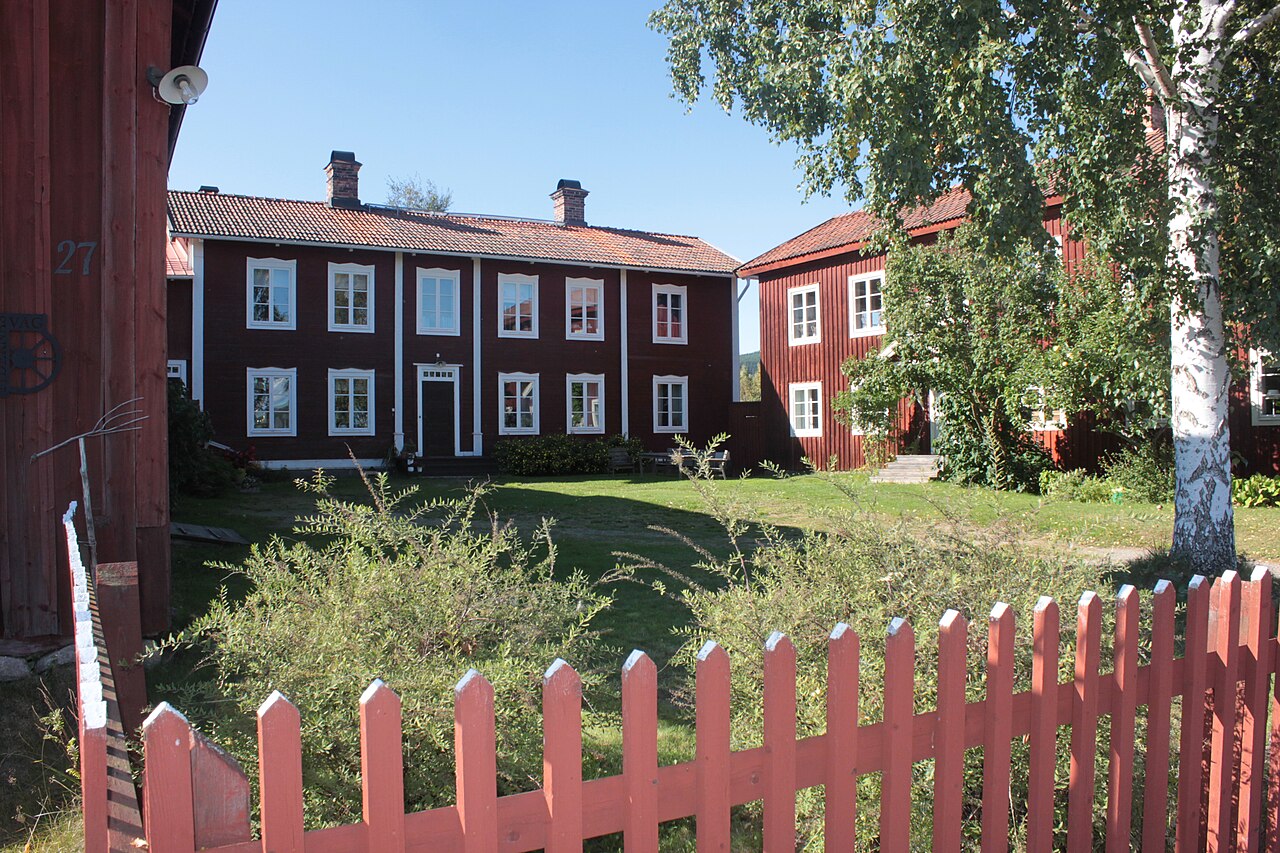
The Decorated Farmhouses of Hälsingland, inscribed as a UNESCO World Heritage Site in 2012, are seven large wooden farmsteads scattered across Gävleborg County in central Sweden, some 250 to 350 kilometres north of Stockholm. Each preserves a suite of painted “best rooms” that were never used for daily life, created between roughly 1790 and 1870 by itinerant painters commissioned by prosperous linen-farming families. Together they constitute the world’s finest surviving collection of rural painted interiors from the 19th century — rooms that were sealed from ordinary use for most of the year and, in several cases, papered over in the late 19th century and only rediscovered when 20th-century owners stripped back the wallpaper.
Linen wealth and the painted room tradition Gävleborg County, central Sweden
Hälsingland’s unusual rural prosperity in the 18th and early 19th centuries had a specific economic cause: flax. The province was Sweden’s principal linen-producing region, with a tradition of home weaving that reached back several centuries. Flax cultivation and the spinning and weaving of linen cloth were conducted by individual farming families on a scale that, in particularly productive households, generated income far beyond subsistence needs. Unlike the aristocratic or mercantile wealth that financed grand interiors in the towns and manor houses of southern Sweden, the money behind the Hälsingland farmhouses was agricultural — earned by families who grew their own raw material, processed it through the winter months, and sold the finished cloth at regional markets.
This prosperity found its expression not in stone or brick — building materials that remained expensive and logistically difficult in the forested north — but in elaborately constructed wooden complexes following the traditional Nordic farmstead layout, with separate structures for dwelling, storage, animals and threshing arranged around a central courtyard. The main dwelling building in the wealthiest farmsteads was typically two storeys, with the upper floor reserved entirely for the decorated rooms. These rooms — known as the “best rooms” or “painted rooms” — were used on exceptional occasions only: weddings, funerals, baptisms, and the Christmas period. For the remaining forty-odd weeks of the year they were locked.
The painters who created these interiors were itinerant specialists who moved between farms and parishes on commission. Several developed recognisable regional styles; a few are known by name from estate records and church registers. They worked on lime-plastered wooden walls, sometimes on linen stretched over a wooden frame, using pigments derived from minerals and plants — red ochre, yellow ochre, bone black, malachite green, lead white — mixed with a binding medium of oil or size. The preparation was painstaking: the wooden walls were planed flat, a base coat of linseed oil applied, then the primer, then the pigmented layers.
The style that emerged in the Hälsingland painted rooms is a distinctive regional synthesis. Its sources are clearly identifiable: Swedish 18th-century Baroque ornament provided the garlands, swags of drapery, putti and trompe-l’œil architectural framing that recur across the rooms; Swedish Gustavian neoclassicism contributed the more restrained palette and the oval medallions of the late 18th century; and the conventions of Swedish folk painting — flattened perspective, bold unmixed colours, the reduction of architectural detail to outline and pattern — gave the Hälsingland interiors their particular character, at once sophisticated in their compositional ambition and direct in their execution. Biblical scenes appear repeatedly, painted not in the manner of academic religious painting but with the same directness and economy as the plant ornament and the draped curtain borders.
The seven farmhouses: what survives and what was lost 250–350 km north of Stockholm
The seven farmhouses selected for UNESCO inscription represent a curated sample of a tradition that was once widespread across Hälsingland but has been drastically reduced by demolition, fire, renovation and the covering-over of painted surfaces with subsequent decorative materials. The seven are: Bortom Åa in Alfta parish; Gästgivars and Pallars in Ljusdal municipality; Erik-Anders in Järvsö; Erik-Ers, Jon-Ers and Sjöstugan in the parishes of Järvsö and Forsa respectively. Each is privately owned, in most cases by descendants of the families who built and commissioned them.
The tradition’s effective end came in the 1860s and 1870s, when cheap machine-printed wallpaper became available even in the remoter parts of central Sweden. Wallpaper was fashionable in a way that painted walls, by then, were not; it was also easier to apply and renew. Families who had invested considerable sums in their painted rooms covered the paintings with successive layers of paper over the following decades. The cultural irony is that this act of erasure inadvertently preserved a significant proportion of the paint surface: the wallpaper protected the painted plaster from light damage, abrasion and the smoke of oil lamps. When 20th-century owners, often in the context of restoration or renovation, removed the wallpaper, they found complete painted schemes that had been invisible for 80 or 100 years.
The rediscovery process was neither quick nor consistent across the seven farmhouses. Some paintings were identified and documented by regional ethnographers in the early 20th century. Others came to light later, and the scholarly understanding of the tradition deepened through the work of Swedish art historians and conservation specialists over the post-war decades. The Swedish National Heritage Board (Riksantikvarieämbetet) coordinated documentation and conservation work across the sites before and following the UNESCO inscription, which provided both international recognition and leverage for funding continued preservation work.
Access to the seven farmhouses is organised individually; they are not a single museum complex, and visiting all seven requires careful advance planning and transport through the Gävleborg countryside. Some are open to guided tours during the summer season on set days; others can be visited by appointment. The Hälsingland Museum in Hudiksvall holds contextual collections and can assist with current access arrangements. The landscape they sit in — rolling agricultural land broken by conifer forest, with the Ljusnan and its tributaries threading through — is itself a significant part of the visit, providing the environmental context for the linen farming economy that made the rooms possible.
Practical information
The seven decorated farmhouses of Hälsingland are located in Gävleborg County, central Sweden, roughly 250–350 km north of Stockholm. The nearest regional hub is Hudiksvall (rail connections from Stockholm, approximately 2.5–3 hours by X2000 express train); the farmhouses lie within a radius of roughly 80 km from Hudiksvall. A car is necessary to visit multiple sites: public transport connections to the individual parishes are limited. The Hälsingland Museum (Hälsinglands Museum), Rådhustorget 1, Hudiksvall, provides introductory context and current visitor information for all seven sites. Opening arrangements for the farmhouses themselves vary: Gästgivars and Erik-Anders are among the most accessible to summer visitors; others require advance contact. The UNESCO inscription includes a management plan administered through the County Administrative Board of Gävleborg (Länsstyrelsen Gävleborg), which maintains current information on visiting conditions. The best visiting season is June to August, when the farmhouses that offer summer tours are open and the countryside roads are clear. Some sites can be visited outside the summer season by arrangement with owners.
Frequently Asked Questions
Why were the decorated rooms used only on special occasions and never for daily life?
The separation between the “best room” and the everyday living space is a pattern found across Scandinavian rural culture from the 17th century onwards, but in Hälsingland it reached an extreme form that reflects both the scale of investment in the paintings and the social logic that governed their use. The painted rooms were not comfortable domestic spaces in the modern sense; they were stages — settings for the presentation of the household’s prosperity and cultural standing to the community at precisely those moments when the community was gathered: weddings, funerals, baptisms, the Christmas visit of the parish priest. On these occasions the room’s painted walls, its formal furniture and its textile furnishings (often equally elaborate, with woven and embroidered wall hangings complementing the paintings) communicated the family’s position in the local social hierarchy more effectively than any verbal statement could. Using such a room for everyday purposes would have risked soiling or wearing out the surfaces that constituted this social statement, and would also have diminished the room’s special status — the sense that entering it was a significant event. The everyday rooms of the same farmhouses were whitewashed and plain, their walls undecorated and their furniture functional. The contrast between the two kinds of space within a single building was intentional and meaningful: the everyday room said “we work hard here,” and the painted room said “and this is what our work has produced.” The Swedish cultural historian Sigurd Erixon documented this spatial logic across Nordic rural buildings in the early 20th century, identifying the best-room tradition as a widespread Nordic pattern; the Hälsingland painted rooms are its most elaborate surviving expression.
Who were the itinerant painters and what is known about them?
The painters who decorated the Hälsingland farmhouses worked in conditions that left fewer documentary traces than comparable urban craftsmen: they were not guild members, did not typically sign their work in visible locations, and were paid in cash or goods that passed through informal local economies rather than notarised contracts. What is known comes from estate inventories, church registers, tax records and occasional diaries or letters that mention the commissioning of a painted room. Several painters have been identified with reasonable confidence through stylistic comparison across multiple surviving rooms and corroboration with documentary references. Among the best known is the painter identified in records as Måler-Bäck — a regional nickname reflecting his origin near a stream called Bäcken — who worked in the Järvsö area in the early 19th century and whose distinctive handling of garland borders and figure types can be traced across a number of surviving interiors. Other painters are known only by regional designations derived from their home parish or a family name fragment. The training these painters received is incompletely understood: some may have apprenticed with established decorative painters in Stockholm or Uppsala before returning to work in the countryside; others appear to have developed their competence through the local tradition itself, working as assistants to established painters before taking independent commissions. The hybrid style of the Hälsingland interiors — combining Baroque, Gustavian neoclassical and folk conventions — suggests that multiple training backgrounds fed into the tradition over its eighty-year active period.
How were the paintings rediscovered after being covered by wallpaper?
The story of the Hälsingland paintings’ rediscovery is not a single dramatic event but a series of local discoveries spread across roughly a century, beginning in the late 19th century and continuing through the 20th. The mechanism was typically domestic renovation: an owner who wished to redecorate, repair water damage, or address structural problems in a farmhouse wall would strip back successive layers of wallpaper and find, beneath them, a painted surface in a state of preservation that was often surprising given how long it had been sealed. The earliest such discoveries attracted the attention of regional ethnographers and local historians, who recognised that the paintings represented a threatened category of rural cultural heritage. The Swedish National Museum (Nordiska museet) in Stockholm began systematic documentation of surviving decorated interiors in the early 20th century, developing photographic archives and scale drawings that proved invaluable for sites where the paintings subsequently deteriorated. After the Second World War, the growing Swedish heritage conservation infrastructure — the National Heritage Board, the county museums, the regional cultural foundations — provided frameworks for supporting conservation work on farmhouses whose owners lacked the resources to maintain them independently. The UNESCO inscription in 2012 formalised international recognition of the surviving farmhouses’ importance, but the underlying scholarly work that established their significance had been conducted over the preceding century by Swedish researchers working at regional level, often with limited resources and against the competing pressures of agricultural modernisation that had already destroyed many comparable buildings.