
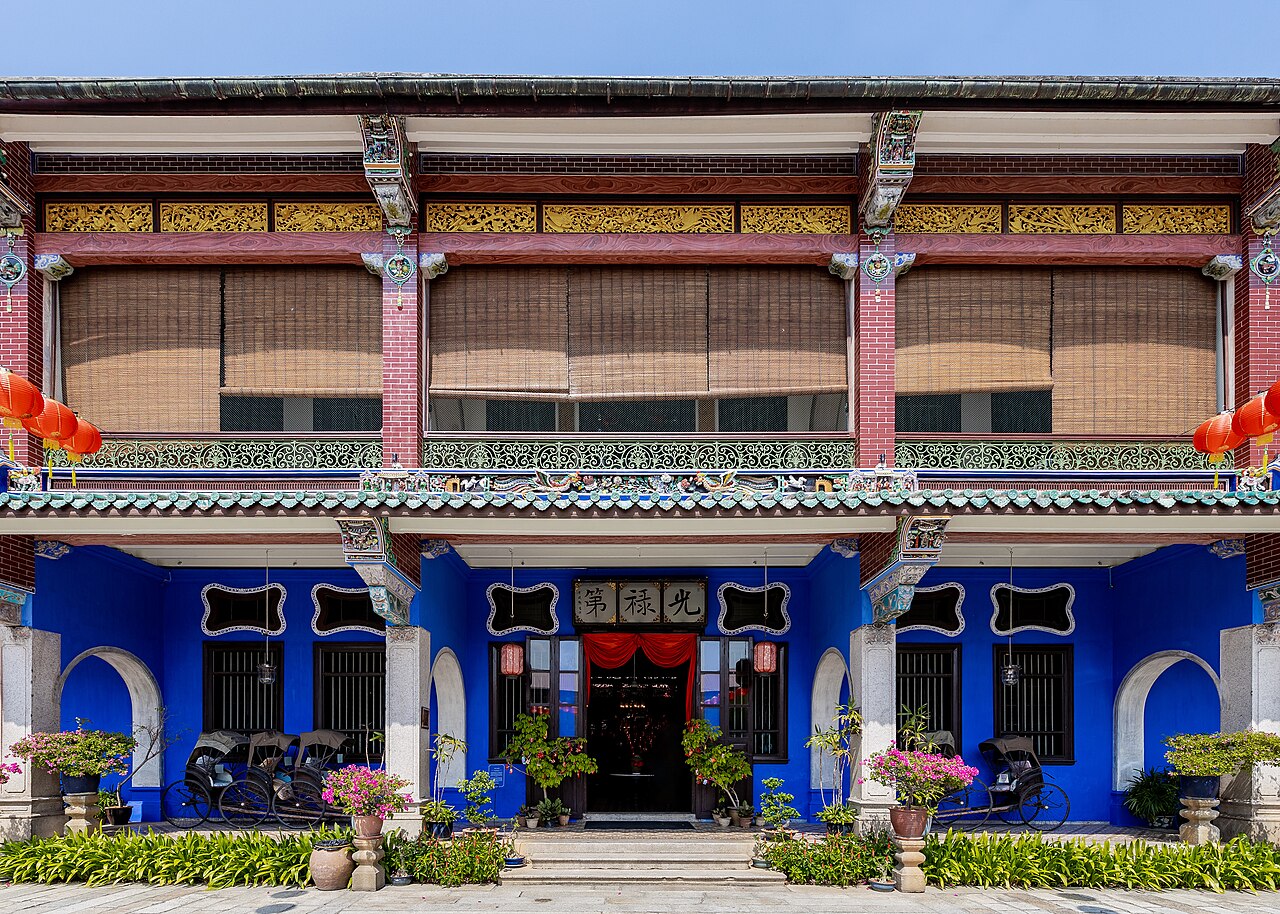
George Town, part of the UNESCO inscription “Melaka and George Town, Historic Cities of the Straits of Malacca” (2008), is the most multicultural heritage city in Southeast Asia — a Malaysian city on the island of Penang where Malay, Chinese, Indian, and British colonial architectural traditions coexist within blocks of each other, where the world’s best street food scene overlaps with one of the finest collections of pre-war shophouses in Asia, and where the Cheong Fatt Tze Blue Mansion is the most celebrated Chinese Straits mansion in the region.
George Town: Where Five Cultures Built One City Penang Island (Pulau Pinang), northwest Malaysia, Straits of Malacca
George Town (Melaka and George Town, Historic Cities of the Straits of Malacca, inscribed in 2008 under criteria (ii), (iii), (iv)) is the capital of the Malaysian state of Penang — a UNESCO World Heritage City on the northern end of Penang Island, founded in 1786 CE by Captain Francis Light of the East India Company as the first British settlement in Southeast Asia (pre-dating Singapore’s founding in 1819 and Penang remains the second most important British colonial settlement in the Straits, after Raffles’s Singapore). The historic core of George Town (the buffer zone covers approximately 1.6 km²) is remarkable for the exceptional density and variety of its heritage architecture: the British colonial administrative buildings (Fort Cornwallis, the first British settlement; Penang Town Hall, the State Museum in the former Suffolk House); the Chinese “shophouses” (ground-floor commercial, upper-floor residential buildings of two to five storeys, built by successive waves of Chinese migrants — Hokkien from Fujian Province, Cantonese from Guangdong, Hakka, Teochew — from the late eighteenth century onward); the Indian precinct (around the Sri Mahamariamman Hindu temple and the Kapitan Keling Mosque, serving the Tamil Hindu and Muslim Indian communities respectively); the Malay quarter; and the interlaced clan association buildings (Chinese dialect group associations, some of which are among the finest examples of Qing dynasty vernacular architecture outside China). The result is a living urban heritage landscape where five cultural traditions (Malay, Chinese Hokkien, Indian Tamil, British colonial, and Peranakan Baba-Nyonya) produced architecturally distinct buildings within the same city blocks — a cultural plurality that is increasingly rare in the urbanizing cities of Southeast Asia.
The Cheong Fatt Tze Mansion and Peranakan Culture 14 Leith Street, George Town, Penang
The Cheong Fatt Tze Mansion (Blue Mansion, c. 1880s, named for its owner Cheong Fatt Tze — the “Straits Chinese Rockefeller,” a self-made multi-millionaire who was born poor in Guangdong Province, came to Southeast Asia as a migrant worker, and became one of the wealthiest men in the Straits Settlements through trade in tin, rubber, and opium) is the most celebrated individual heritage building in George Town — a Chinese Straits Eclectic mansion of brilliant indigo-blue paint (a colour traditionally used in China to ward off evil spirits, now so associated with the building that it is known simply as the “Blue Mansion”), with ornate cast-iron verandah columns (imported from Glasgow, Scotland), louvred shuttered windows, and a floorplan that follows the principles of traditional southern Chinese feng shui within the constraints of the George Town street grid. The Peranakan (Baba-Nyonya) culture represented by the Cheong Fatt Tze Mansion is the culture of the Chinese community that settled in the Straits Settlements (Penang, Melaka, Singapore) from the fifteenth century onward and underwent centuries of cultural fusion with the Malay world — adopting Malay dress, cuisine, and language (Baba Malay, a Malay-inflected Chinese creole) while maintaining Chinese religious practices and architectural preferences. The Peranakan aesthetic (the characteristic combination of Chinese motifs, Malay batik textiles, and European colonial furniture) is the most distinctive cultural product of the Straits Settlements and is best represented in the heritage buildings of George Town and Melaka.
Practical information
Penang International Airport (PEN) has direct flights from Singapore, Kuala Lumpur, Bangkok, Jakarta, Taipei, Hong Kong, and several Indian and Middle Eastern cities. Penang is also accessible by the North-South Expressway from Kuala Lumpur (4 hours) via the Penang Bridge (the second-longest bridge in Southeast Asia). The UNESCO heritage zone is in the northeast of Penang Island; the Georgetown Hop-On Hop-Off bus connects the main heritage sites. The Penang Street Art trails (outdoor murals by Ernest Zacharevic and others, installed since 2012) have made George Town an international street art destination as well as a heritage destination. The Penang food scene (Char Koay Teow, Assam Laksa, Penang Hokkien Mee, Cendol) is UNESCO recognized as part of the city’s intangible heritage. The best season is December–February (dry northeast monsoon); May–October has heavier rainfall.
Frequently Asked Questions
Is George Town a UNESCO World Heritage Site?
Yes. George Town is included in the UNESCO inscription “Melaka and George Town, Historic Cities of the Straits of Malacca” (inscribed in 2008 under criteria (ii), (iii), (iv)). The inscription covers both cities as a joint nomination recognizing the shared heritage of the Straits of Malacca trading zone. Malaysia has 4 UNESCO World Heritage Sites (as of 2024): the Gunung Mulu National Park (2000, natural), the Kinabalu Park (2000, natural), and Melaka and George Town, Historic Cities of the Straits of Malacca (2008). George Town is significant in the UNESCO inscription for its exceptional multicultural urban heritage — the simultaneous coexistence of Malay, Chinese, Indian, and European architectural traditions in a single historic city centre is cited as one of the Outstanding Universal Values of the inscription.
What is Penang street food and why is it considered the best in the world?
Penang street food is a culinary tradition that evolved in the Straits Chinese (Peranakan) and Tamil Indian communities of Penang from the late eighteenth century onward — a fusion of southern Chinese Hokkien, Malay, Thai, and Indian Tamil cooking traditions, produced in the hawker centres (outdoor food courts) and street stalls of George Town. The key dishes of the Penang street food tradition include: Char Koay Teow (flat rice noodles stir-fried with shrimp, cockles, Chinese lap cheong sausage, eggs, and bean sprouts in a hot wok over charcoal), a dish that is claimed to be the most-ordered single dish in Malaysia; Assam Laksa (fish-based sour noodle soup with tamarind, galangal, and local herbs — a tamarind-sour variation on the standard coconut-cream Malaysian laksa), ranked No. 7 in CNN Travel’s 2011 World’s 50 Best Foods list; Penang Hokkien Mee (shrimp-based noodle soup); and Cendol (a cold dessert of pandan-flavoured green rice-flour jelly, coconut milk, and palm sugar syrup). The concentration of excellent hawker stalls in George Town (particularly on Gurney Drive, Kimberley Street, and the Esplanade area) makes Penang the destination for serious food travelers in Southeast Asia; it is regularly ranked the world’s best street food destination by food media.
What is the Peranakan culture and how does it differ from mainstream Chinese Malaysian culture?
Peranakan (from the Malay “peranakan,” meaning “locally born”) refers to the culture of the Straits Chinese — Chinese settlers (primarily Hokkien from Fujian Province) who came to the Straits Settlements (Penang, Melaka, Singapore) from the fifteenth to nineteenth centuries and underwent cultural assimilation with the Malay world over generations. The male Peranakan are called Baba; the female, Nyonya. Peranakan culture is distinctive in: (1) language — the traditional Peranakan language was Baba Malay (a Malay-based creole with Hokkien loanwords and grammatical structures); (2) costume — Nyonya women traditionally wore the sarong kebaya (a Malay-style sarong and fitted lace blouse), decorated with intricate silver kerosang (brooch) closures; (3) cuisine — Nonya cuisine combines Hokkien Chinese ingredients (pork, soy, Chinese spices) with Malay techniques (rempah spice paste, coconut milk, Southeast Asian herbs); (4) architecture — the Peranakan shophouse has a distinctive interior organization (the “five-footway” or covered arcade at street level, the ancestral altar in the main hall, the air-well courtyard) and a decorative programme that combines Chinese motifs with European tiles; and (5) religion — Peranakan practice a syncretic form of Chinese folk religion, Taoism, and Buddhism, with significant Malay ritual influences (especially in life-cycle ceremonies). Mainstream Malaysian Chinese culture (the more recent immigrants of the nineteenth and twentieth centuries) tends to be more closely aligned with the specific dialect and regional cultures of southern China; Peranakan culture is distinctly local, a Southeast Asian hybrid product.
Sources
- S1 — Khoo, Salma Nasution. Streets of George Town, Penang. Areca Books, 2007. ISBN 978-983-9886-00-9.
- S2 — Tan, Sooi Beng. Bangsawan: A Social and Stylistic History of Popular Malay Opera. Oxford University Press, 1993. ISBN 978-967-65-3032-5.
Spotted an error? Write to editorial@culturalheritageonline.com and we correct it the same day.
.jpg)