From transatlantic wartime shipping to Europe’s foremost artificial silk empire.
Founded in Turin in 1917, SNIA (originally Società di Navigazione Italo Americana) exemplifies the dramatic industrial metamorphosis of the interwar era, evolving from a wartime transatlantic shipping enterprise into the world’s leading producer of artificial textile fibers.
Transatlantic Logistics in the Great War
In 1917, industrialist and financier Riccardo Gualino joined forces with FIAT president Giovanni Agnelli to incorporate the Società di Navigazione Italo Americana with an initial capital of 5 million lire. With Italy deeply reliant on Allied supply lines during the First World War, the company’s primary mandate was maritime logistics: acquiring cargo steamships to haul coal, lumber, and essential industrial provisions across the Atlantic Ocean from the United States to Mediterranean ports. Agnelli served as vice-president of SNIA from 1917 until 1926, cementing an intricate network of cross-shareholdings with FIAT.
The Pivot to Artificial Silk and Industrial Supremacy
The cessation of hostilities in late 1918 brought a severe crisis to commercial shipping, as freight rates plummeted and global tonnage surged. Recognizing the impending collapse of maritime cargo profits, Gualino engineered a bold corporate conversion in 1919-1920, reallocating capital into the emerging chemical fiber sector. Acquiring textile mills in Pavia, Venaria Reale, and Varedo, the enterprise rebranded as SNIA Viscosa (Società Nazionale Industria Applicazioni Viscosa) and mastered the mass production of rayon (artificial silk). It rapidly grew into Italy’s premier multinational corporation and the first Italian firm listed on the London and New York stock exchanges.
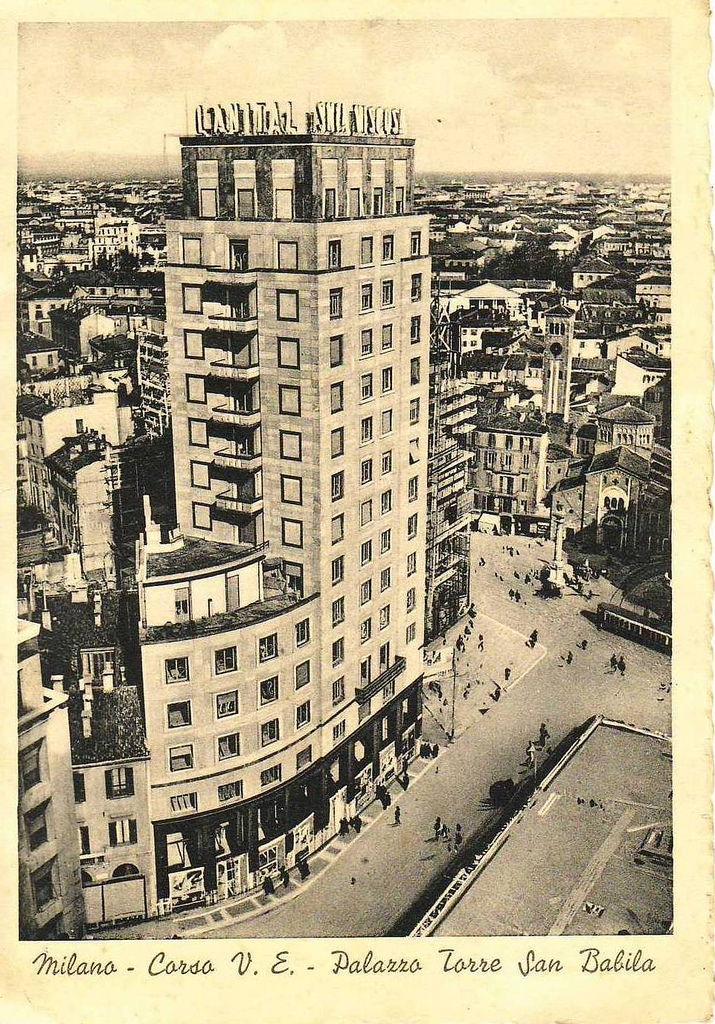
The company’s architectural legacy peaked in the 1930s with the construction of the Torre Snia Viscosa in Piazza San Babila in Milan. Designed by architect Alessandro Rimini in 1935-1937, the tower rose as Milan’s first true skyscraper and an enduring landmark of Italian rationalist urbanism, standing today as a protected architectural monument in the heart of the city.
Historic Site & Location
Historic Address: Corso Romania 546, Torino, TO, Italy
Nearby in the archive
Sources
- S1 — Dizionario Biografico degli Italiani (Treccani), voce «Riccardo Gualino» (G. Mori) — https://www.treccani.it/enciclopedia/riccardo-gualino_(Dizionario-Biografico)/
- S2 — Dizionario Biografico degli Italiani (Treccani), voce «Giovanni Agnelli» (P. Bairati) — https://www.treccani.it/enciclopedia/giovanni-agnelli_(Dizionario-Biografico)/
- S3 — Fondazione ISEC, Fondo Storico SNIA Viscosa, Sesto San Giovanni — https://www.fondazioneisec.it/
- S4 — Museimpresa, Associazione Italiana Archivi e Musei d’Impresa — https://www.museimpresa.com/
Spotted an error? Write to editorial@culturalheritageonline.com and we correct it the same day.