The Central Sector of the Imperial Citadel of Thăng Long (Hoàng thành Thăng Long), inscribed by UNESCO in 2010, preserves the core of the imperial capital of Vietnam for approximately 13 consecutive centuries — from the construction of the first citadel at the future site of Hanoi by the Lý dynasty founder Emperor Lý Thái Tổ in 1010 CE to the transfer of the royal court to Huế by the Nguyễn dynasty in 1802 CE — making it the longest continuously functioning imperial administrative centre in Southeast Asian history. The inscribed property encompasses the 18.3-hectare central sector of the original citadel, which is also the site of the D67 underground command bunker from which the North Vietnamese military leadership (including General Võ Nguyên Giáp) directed the Vietnam War operations from 1967 to 1975 CE — a stratification of imperial heritage and 20th-century military history that gives the Thăng Long site a layered historical significance unique among Southeast Asian UNESCO inscriptions. The inscription’s Outstanding Universal Value rests on the archaeological evidence of the successive Vietnamese dynasties (Lý, Trần, Lê, Mạc, Lê restoration, Tây Sơn, and partially Nguyễn) whose imperial buildings occupied the citadel site in sequence — primarily the archaeological layer exposed by the 2004 excavations of the National Assembly construction site adjacent to the current citadel, which revealed approximately 40,000 m² of multi-period imperial architecture and artefacts including ceramic tile roofing, ornate dragon-decorated architectural elements, and the foundations of successive palace complexes built one on top of another from the 11th to the 18th centuries CE.
The Thăng Long citadel and the Hanoi heritage landscape Đoan Môn Gate · D67 Bunker · Hoan Kiem Lake Temple of Literature — 0.5 to 3 km
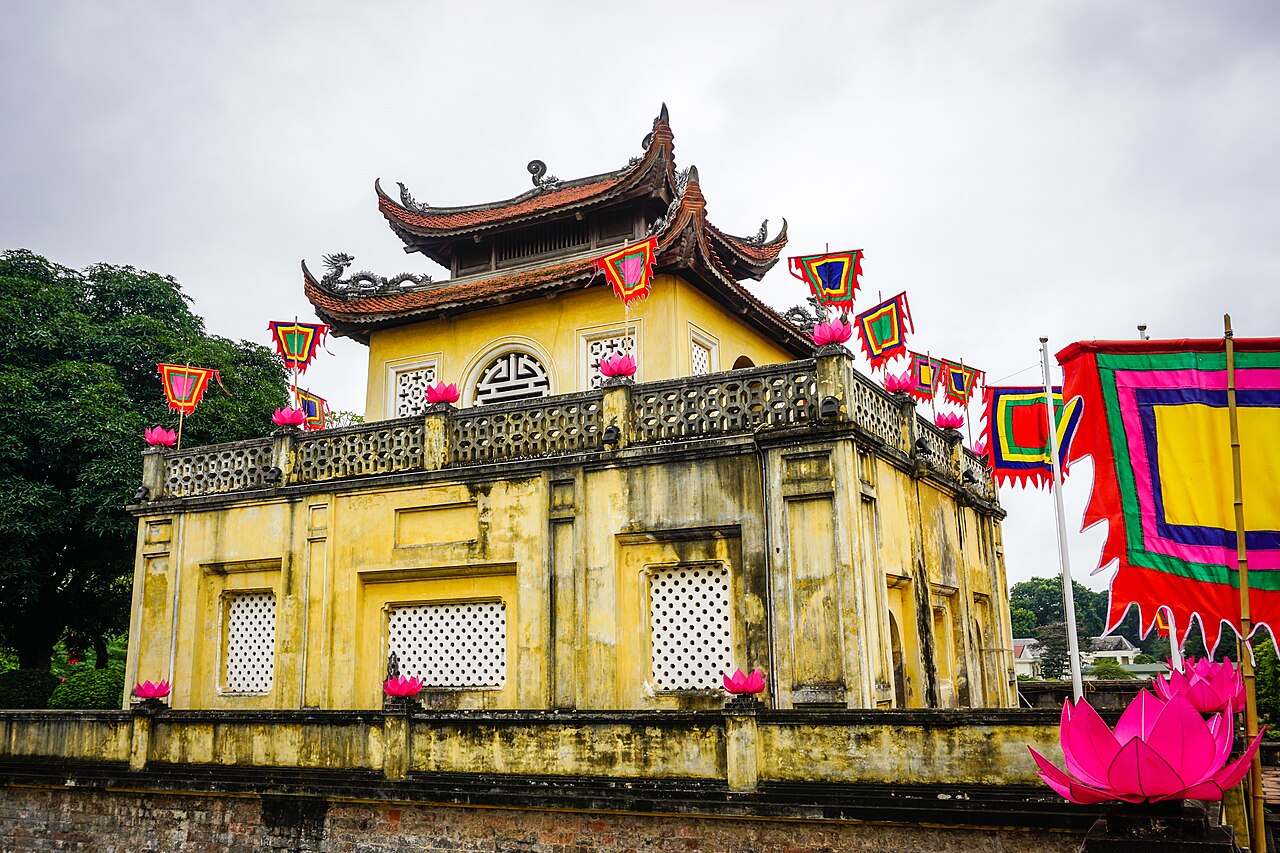
The currently accessible Imperial Citadel site (the 18.3-hectare central sector opened to visitors in 2010 following the UNESCO inscription) is structured around three primary components: the above-ground Lê dynasty heritage (the Đoan Môn Gate (Cổng Đoan Môn, 15th century CE, the ceremonial southern gateway to the Imperial City, a three-passage gate with the central passage reserved for the Emperor and lateral passages for imperial guard use — the only substantially intact above-ground architecture from the Lê dynasty citadel), the Kính Thiên Palace terrace (the stone-balustrade approach terrace to the Kính Thiên Palace, “Palace of Reverence for Heaven”, the primary ceremonial audience hall of the Lê dynasty, with the palace building destroyed by the French colonial army in 1886 CE and only the stone dragon-decorated balustrade of the approach terrace surviving), and the Hậu Lâu tower (Princess Tower, 19th century, the most intact standing structure on the site, used during the French colonial period as a barracks and water tower)); the underground archaeological site (Khu khảo cổ 18 Hoàng Diệu, the Archaeological Site at 18 Hoàng Diệu Street, a 4.5-hectare open excavation area adjacent to the main citadel compound, opened to visitors in a partially covered format, with stratigraphic profiles showing the successive occupation layers from the 7th–9th century CE pre-Lý period through the 18th century Lê restoration); and the D67 military heritage (the D67 Underground Command Bunker and Conference Room (Nhà D67 và hầm D67), a 1967 CE reinforced concrete bunker complex built 2 m below the citadel courtyard surface as the command centre for the Vietnam People’s Army during the American War — still containing original military maps, communication equipment, and the conference table at which General Võ Nguyên Giáp and the Politburo of the Communist Party of Vietnam planned the 1968 Tết Offensive and the 1975 Ho Chi Minh Campaign). The Flag Tower (Cột cờ Hà Nội, 1812 CE, built by the Nguyễn dynasty Emperor Gia Long as a transitional monument during the move of the capital to Huế — the tower served the function of signalling the capital’s political status even after the court relocated south — 33 m in height, the most photographed landmark of the citadel site) stands at the southern approach to the citadel compound. The Temple of Literature (Văn Miếu, Quốc Tử Giám, approximately 1 km south of the citadel gate, built 1070 CE by Lý dynasty Emperor Lý Thánh Tông, the oldest university in Vietnam and the primary Confucian educational institution of the imperial capital, with 82 stone steles recording the names of 1,307 doctoral graduates of the imperial examination from 1442 to 1779 CE — the steles being inscribed on UNESCO’s Memory of the World Register in 2010 simultaneously with the Thăng Long citadel UNESCO World Heritage inscription) provides the cultural context for understanding the Thăng Long citadel’s educational and administrative function: the citadel and the Temple of Literature together constituted the twin institutional centres of the Vietnamese imperial state.
The broader Hanoi heritage landscape extends from the citadel and Temple of Literature to the Hoan Kiem Lake historic quarter (approximately 2.5 km east of the citadel by walking or cyclo): the Ngọc Sơn Temple (Jade Mountain Temple, on an island in Hoan Kiem Lake, 19th century, accessible via the 1885 CE red-painted Thê Húc Bridge — the “Bridge of the Rising Sun”) and the Hoan Kiem Lake (the central urban lake of Hanoi, associated with the legend of the magical sword returned to the Golden Turtle God by King Lê Lợi after his victory over the Ming Chinese in 1428 CE) provide the mythological and civic context for the imperial capital’s founding story. The Old Quarter of Hanoi (36 guild streets, each traditionally specialising in a specific trade — silk, lacquerware, paper, tin goods, medicinal herbs — approximately 2 km east of the citadel, the most intact traditional urban commercial district in northern Vietnam) represents the commercial sector that functioned as the economic base for the imperial capital during the Lê dynasty period. The Hanoi Museum (Bảo tàng Hà Nội, in the Ba Đình district adjacent to the citadel) houses the most comprehensive collection of Thăng Long archaeological finds, including the decorative tiles, ceramic dragon figurines, and building foundations recovered from the 2004 National Assembly excavation — the museum visit is recommended before the citadel for contextualising the archaeological evidence.
Practical information
The Central Sector of the Imperial Citadel of Thăng Long is located in the Ba Đình district of Hanoi (approximately 2 km west of Hoan Kiem Lake, 800 m north of the Ho Chi Minh Mausoleum complex), accessible by taxi (10 minutes from the Old Quarter), by Hanoi metro (Bus Rapid Transit to Ba Đình Square, then 5 minutes on foot), or on foot from the Ho Chi Minh Mausoleum. The site is open Tuesday–Sunday 08:00–17:00 (closed Monday), with a moderate admission fee covering all components (citadel gates, Kính Thiên terrace, Hậu Lâu tower, archaeological site, and D67 bunker). The D67 bunker is available in English-language guided tours (depart from the main citadel entrance at scheduled times, approximately 45 minutes per tour, included in admission); independent visits to the bunker are permitted but English signage is limited. The archaeological site at 18 Hoàng Diệu (entered via the main citadel compound or separately from the Hoàng Diệu Street gate) is partially covered with a climate-controlled viewing structure — the most compelling single component of the citadel experience for visitors interested in archaeology, as the stratified excavation profiles clearly show the multi-period occupation sequence. Combined visits with the Temple of Literature (approximately 1 km south, recommended visiting sequence: citadel in the morning, Temple of Literature after midday, Old Quarter in the late afternoon) form the standard half-day imperial Hanoi itinerary. Best visiting season: October–November and March–April (mild temperatures 20–28°C, relatively low humidity; avoid June–August peak heat 35–40°C with high humidity). The Ho Chi Minh Mausoleum (approximately 800 m south of the citadel entrance, closed for renovation on Mondays and Fridays, requiring specifically regulated visitor conduct including no photography inside the mausoleum) is a natural extension of the Ba Đình district visit for visitors interested in 20th-century political history alongside the imperial heritage.
Frequently Asked Questions
Why did Emperor Lý Thái Tổ choose the Thăng Long site for his new capital in 1010 CE?
Emperor Lý Thái Tổ (Lý Công Uẩn, r. 1009–1028 CE, founder of the Lý dynasty, the first stable Vietnamese imperial dynasty after the country’s independence from China in 938 CE) issued the Edict on the Transfer of the Capital (Chiếu dời đô) in 1010 CE, announcing the relocation of the Vietnamese capital from Hoa Lư (a fortified mountain valley in present-day Ninh Bình Province, approximately 100 km south of Hanoi, chosen by the Đinh and Early Lê dynasties specifically for its defensible terrain during the period of military consolidation after independence) to the Đại La citadel (the old Tang dynasty administrative centre at the Red River delta, at the future site of Hanoi). The edict articulates the geomantic and strategic rationale for the choice: the Đại La site is described as occupying the “centre of heaven and earth” of the Vietnamese territory, with the Red River and its tributaries providing natural water boundaries on three sides, the location at the delta apex providing access to the river trade network of the entire northern Vietnamese interior, and the flat terrain allowing the construction of a large-scale imperial compound impossible in the mountain valleys of Hoa Lư. The emperor reported seeing a golden dragon rising from the river at the new site on the day of his arrival — an omen that gave the new capital its name: Thăng Long (昇龍, “Rising Dragon”). The geomantic rationale was not decorative: Vietnamese imperial geomancy (phong thuỷ) evaluated capital sites by the configuration of surrounding mountains (left and right “guardians”), the direction of approach water (ideally from the north), and the orientation of the site’s main axis (south, following the Chinese imperial convention of facing the sun). The Thăng Long site satisfied all these criteria in the natural Red River delta landscape, and its selection by Lý Thái Tổ established a capital location that functioned continuously for nearly 800 years — the longest continuous period of any capital city in Southeast Asian history.
What did the 2004 archaeological excavation at 18 Hoàng Diệu Street reveal about the Thăng Long palaces?
The 2004–2008 CE archaeological excavation at 18 Hoàng Diệu Street (conducted by the Vietnam Institute of Archaeology and the Hanoi Department of Culture in the area cleared for the new National Assembly building construction, a 4.5-hectare site immediately west of the surviving Thăng Long citadel compound) was the most significant archaeological discovery in Vietnam since the identification of the Mỹ Sơn sanctuary by the EFEO — and ultimately the primary basis for the 2010 UNESCO inscription. The excavation revealed approximately 40,000 m² of multi-period imperial architectural remains in a stratigraphic sequence of seven identified occupation layers from the pre-Lý (7th–10th century CE) period through the Lê dynasty (15th–18th century CE), including: the foundation remains of successive palace complexes built in the same location across the Lý, Trần, and Lê dynasty periods (the Vietnamese imperial tradition of rebuilding palace complexes in each new dynasty’s architectural style on the same footprint explains the superimposed foundation sequence); approximately 8,000 post-holes documenting the positions of wooden columns of the palace halls (Vietnamese imperial architecture used wooden post-and-beam construction rather than the Chinese-style masonry that would have left more substantial foundations, making the post-hole pattern evidence particularly important for the reconstruction of palace dimensions and spatial organisation); and approximately 500,000 individual artefacts (decorative ceramic roof tiles in dragon, phoenix, and floral designs, each dynastic period with a distinct decorative vocabulary that allows dating of the layers; architectural terracotta figurines; glazed ceramic vessels from the imperial workshops; bronze objects including court seals, belt fittings, and ritual vessels) that constitute the most complete material-culture record of Vietnamese imperial court production across the Lý, Trần, and Lê periods. The roof tiles are the most visually striking finding: the Lý dynasty tiles (11th–12th century CE) use yellow-glazed dragon decoration on a red clay base; the Trần dynasty tiles (13th–14th century CE) shift to a more complex multi-coloured floral pattern; the Lê dynasty tiles (15th–18th century CE) are unglazed with moulded geometric borders — three distinct aesthetic systems reflecting three different dynasties’ visual culture, all produced by the same imperial workshop tradition in the same location.
What is the relationship between the Thăng Long citadel and Vietnam’s wars in the 20th century?
The Thăng Long citadel’s function in Vietnam’s 20th-century wars is the most distinctive aspect of its UNESCO World Heritage inscription — no other UNESCO cultural heritage site in Southeast Asia combines pre-modern imperial archaeology with intact 20th-century military command infrastructure in a single inscribed property. The citadel’s wartime significance stems from the same property that made it valuable to 13 centuries of Vietnamese emperors: its thick masonry walls (the 19th-century Nguyễn dynasty walls, rebuilt using French Vauban fortress design principles adapted to Vietnamese brick construction, created an enclosure resistant to conventional artillery) and its central position in the political geography of Hanoi made it the natural choice for the Vietnamese People’s Army High Command headquarters from the beginning of the resistance against French colonial reconquest in 1946 CE. The Việt Minh (the independence coalition led by Hồ Chí Minh) retained partial control of the citadel compound during the 1946–1954 First Indochina War, and after the Geneva Accords divided Vietnam at the 17th Parallel in 1954 CE and French forces departed Hanoi, the North Vietnamese government made the citadel’s Ba Đình district (adjacent to the citadel’s western wall) the administrative centre of the Democratic Republic of Vietnam — the Presidential Palace (formerly the French Governor-General’s residence), the Ho Chi Minh residential complex, and the Ba Đình Square (where Ho Chi Minh declared independence on 2 September 1945 CE) are all within 500 m of the citadel gate. The D67 Underground Command Bunker (construction completed 1967 CE, the year after the US began systematic air strikes on North Vietnamese infrastructure) was built within the citadel compound as the primary hardened command facility for the Vietnam People’s Army High Command — it replaced an earlier, less protected command post that was vulnerable to air strike and provided General Võ Nguyên Giáp and the politburo with a direct command link to the front lines via buried telephone cable and radio communication systems installed in the bunker’s communication room. The bunker’s historical significance was confirmed by a declassified US National Security Agency signals intelligence analysis (released in the 1990s) that identified the D67 complex as the primary target of a 1972 “Linebacker II” strategic bombing planning option that was ultimately rejected — if carried out, the strike would have destroyed the citadel’s remaining Lê dynasty archaeological layer as well as the military infrastructure.
Sources
- S1 — UNESCO World Heritage Centre — Central Sector of the Imperial Citadel of Thang Long – Hanoi (Ref. 1328) — https://web.archive.org/web/20230601000000/https://whc.unesco.org/en/list/1328/
- S2 — UNESCO World Heritage Centre — Statement of Outstanding Universal Value (Ref. 1328) — https://whc.unesco.org/en/list/1328/
Spotted an error? Write to editorial@culturalheritageonline.com and we correct it the same day.