
Ethiopia’s most exuberant Christian festival celebrates the baptism of Jesus through nocturnal liturgy, water blessing, ritual immersion, and daylong processions that restore the sacred Tabot—a model of the Ark of the Covenant—to its church shrine.
In UNESCO’s words
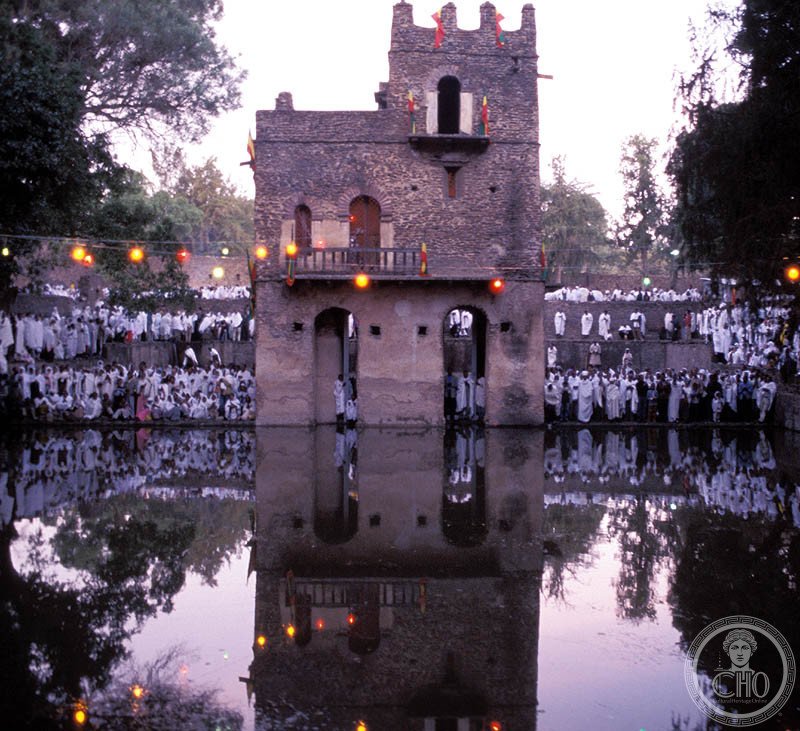
Ethiopian epiphany is a colourful festival celebrated all over Ethiopia to commemorate the baptism of Jesus Christ by John the Baptist in the River Jordan. The commemoration starts on the eve of the main festival on 18 January. The eve is known as Ketera, which means blocking the flow of water for the blessing of the celebrants. On the eve of Ketera, people escort their parish church tabot (replicas of the Ark of the Covenant) to Timkete-Bahir (a pool, river or artificial reservoir), transported by a priest of the parish and accompanied by a great ceremony. The people spend the night attending night-long prayers and hymn services, including the Eucharistic Liturgy. Hundreds of thousands participate in the actual festival on the following day – 19 January. The celebration starts early in the morning with pre-sunrise rituals. These are followed by the sprinkling of the blessed water on the congregation, as well as other ceremonies. At around 10 a.m., each tabot begins its procession back to its respective church, involving an even more colourful ceremony with various traditional and religious songs. The viability of the element is ensured through its continued practice, with Orthodox clergies playing a pivotal role: they sing the praises dedicated to the rituals and hymns, carry the Ark, and preach relevant texts.
Official description, UNESCO Intangible Cultural Heritage List — Ethiopian epiphany
At a glance
Timkat is Ethiopia's festival celebrating the baptism of Jesus Christ by John the Baptist in the River Jordan. The celebration centres on the tabot, a replica of the Ark of the Covenant ordinarily kept hidden on church altars. Over two days—starting on the evening of 18 January and continuing through 19 January—entire communities gather for night-long prayers, liturgy, and water blessings that draw hundreds of thousands of participants.
Origins & history
Timkat has deep roots in Ethiopian Christian tradition, with its structure of nocturnal liturgy followed by public water blessing and procession developing as a living enactment of baptismal theology central to the Ethiopian Orthodox church. The festival's cycles of night prayer and daytime ceremony have evolved into a seasonal rhythm that embeds baptismal renewal into communal memory and practice.
The practice
On the eve of Ketera, clergy transport the tabot from the parish church to a pool, river, or artificial reservoir in solemn procession. The community spends the night in prayer, hymn services, and the Eucharistic Liturgy. On the festival day, pre-sunrise rituals begin the celebration, followed by the sprinkling of blessed water on those gathered. Around 10 a.m., each tabot processes back to its church in colourful ceremony accompanied by traditional and religious songs. Orthodox clergy lead the observance through singing, carrying the Ark, and preaching.
Cultural significance
Timkat affirms baptismal identity and renews bonds between the community, clergy, and the sacred. The water blessing sanctifies both individual renewal and collective belonging. The festival's nocturnal and daytime cycles mirror spiritual rhythm, while its emphasis on water links ancient baptismal practice to Ethiopian geography and seasons. The element's survival depends on continued practice and the central role of Orthodox clergy in performing its rituals and hymns.
Key facts
- Country: Ethiopia
- Inscribed: 2019
- UNESCO list: Representative List of the Intangible Cultural Heritage of Humanity
- UNESCO reference: 01491
- UNESCO vocabulary: Festivals; Orthodox Churches; Procession; Religious practice
- Map: not shown — UNESCO’s official description of this element names no locality, and a living tradition is practised across a community, not at one address.
Where to experience it
Timkat is celebrated throughout Ethiopia at pools, rivers, and artificial reservoirs designated as Timkete-Bahir. Communities gather on the eve of 18 January for night-long prayers and hymn services, then participate in the main festival on 19 January, which begins with pre-sunrise rituals and continues with the blessing of water and ceremonial processions. Local Orthodox churches transport their tabots to these water sources and lead the rituals; participation is open to believers and respectful observers who wish to witness this ancient commemoration of Christ's baptism.
Sources & resources
- UNESCO — official element page: Ethiopian epiphany
- UNESCO — open data record: Intangible Heritage List, reference 01491
- UNESCO — official video: UNESCO film on this element — embedded on this page
- UNESCO — official photograph: During Ehtiopian Epiphany, priests wearing ecclesial vestment and holding prayer stick, rum and sistrums perform the rhythm 'Worede World Emsemayat Wuste Mitmakat' (God the Son goes to the place of paptism) in Axum, world heritage site of Ethiopia — Mamehr Encobarhrey Tekeste — Authority for Research and Conservation of Cultural Heritage (ARCCH), EThiopia, 2018
- Reference — Wikipedia (secondary): Timkat — consulted as a secondary reference, not as confirmation
- Cultural Heritage Online: Our archive and city guides

Sources
- S1 — Phillipson, David W. Ancient Churches of Ethiopia. Yale University Press, 2009. ISBN 978-0-300-14156-6.
- S2 — Pankhurst, Richard. The Ethiopians: A History. Wiley-Blackwell, 2001. ISBN 978-0-631-22493-8.
Spotted an error? Write to editorial@culturalheritageonline.com and we correct it the same day.