
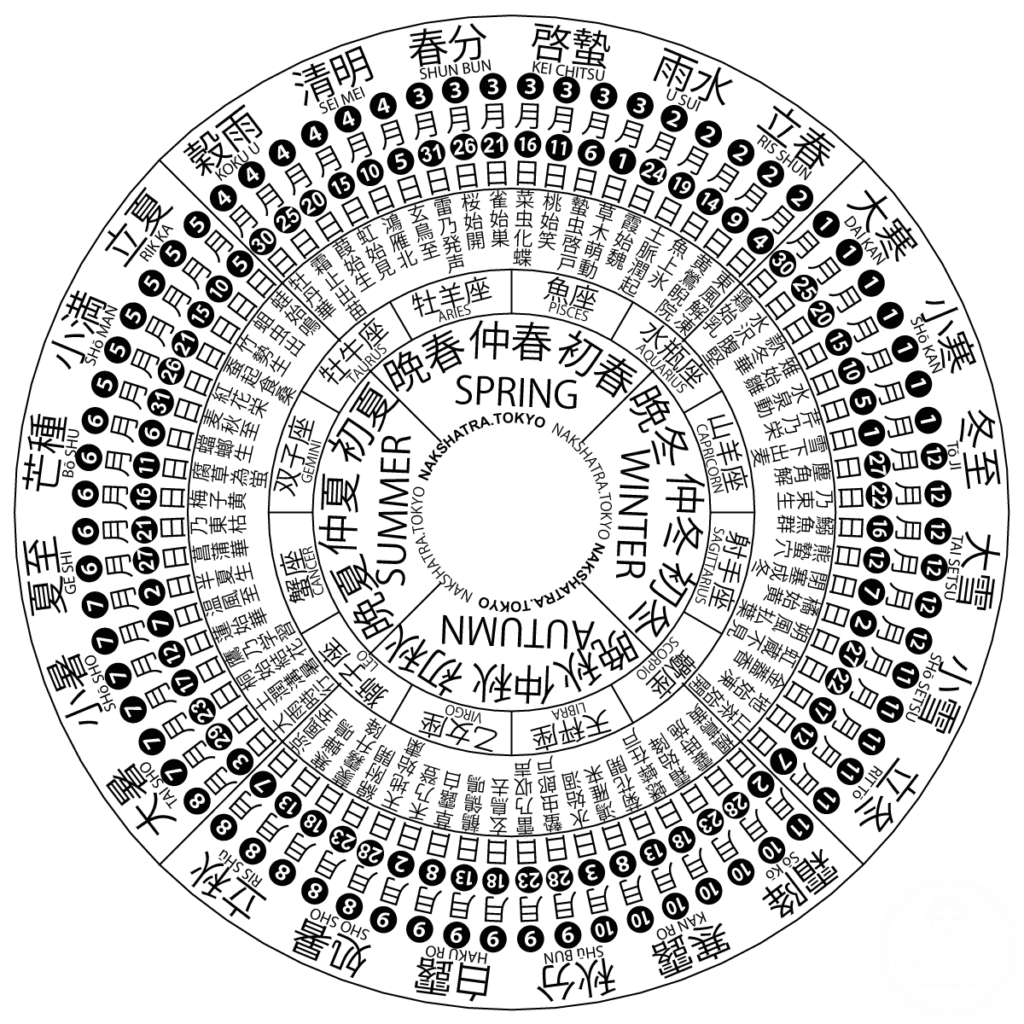
A system of twenty-four moments marking astronomical events and natural phenomena, used for millennia to synchronize lunar calendars with the seasons and guide agricultural practice across East Asia.
In UNESCO’s words
The ancient Chinese divided the sun’s annual circular motion into 24 segments. Each segment was called a specific ‘Solar Term’. The element of Twenty-Four Solar Terms originated in the Yellow River reaches of China. The criteria for its formulation were developed through the observation of changes of seasons, astronomy and other natural phenomena in this region and has been progressively applied nationwide. It starts from the Beginning of Spring and ends with the Greater Cold, moving in cycles. The element has been transmitted from generation to generation and used traditionally as a timeframe to direct production and daily routines. It remains of particular importance to farmers for guiding their practices. Having been integrated into the Gregorian calendar, it is used widely by communities and shared by many ethnic groups in China. Some rituals and festivities in China are closely associated with the Solar Terms for example, the First Frost Festival of the Zhuang People and the Ritual for the Beginning of Spring in Jiuhua. The terms may also be referenced in nursery rhymes, ballads and proverbs. These various functions of the element have enhanced its viability as a form of intangible cultural heritage and sustain its contribution to the community’s cultural identity. Knowledge of the element is transmitted through formal and informal means of education.
Official description, UNESCO Intangible Cultural Heritage List — The Twenty-Four Solar Terms, knowledge in China of time and practices developed through observation of the sun’s annual motion
At a glance
The Twenty-Four Solar Terms is a system of timekeeping that divides the sun's annual motion into 24 segments, each marking observable changes in seasons and natural phenomena. Originating in the Yellow River region, this knowledge has been transmitted across generations and is used to direct farming practices and daily routines. Today it is integrated into the Gregorian calendar and shared by many ethnic groups throughout China.
Origins & history
The system originated in the Yellow River reaches of China, where criteria for its formulation were developed through observation of seasonal changes, astronomy, and natural phenomena. It was progressively applied nationwide over time. The cycle begins with the Beginning of Spring and ends with the Greater Cold, repeating annually. This framework has been handed down through formal and informal education across generations.
The practice
Each Solar Term spans roughly 15 days and marks specific natural shifts. Farmers and communities observe changes in weather, plants, and animals to determine the right moments for planting, harvesting, and other agricultural tasks. Knowledge is transmitted orally and through written calendars and inherited practice. The terms also guide the timing of rituals and festivities, and appear in nursery rhymes, ballads, and proverbs.
Cultural significance
The Solar Terms sustain the community's cultural identity and remain particularly important to farmers for guiding their practices. Certain rituals and festivals are closely associated with specific terms. This living knowledge system enhances cultural heritage by embedding practical wisdom about local climate and seasonal cycles, coordinating human activity with natural and celestial rhythms.
Key facts
- Country: China
- Inscribed: 2016
- UNESCO list: Representative List of the Intangible Cultural Heritage of Humanity
- UNESCO reference: 00647
- UNESCO vocabulary: Calendars; Technical skills
- Map: not shown — UNESCO’s official description of this element names no locality, and a living tradition is practised across a community, not at one address.
Where to experience it
The Twenty-Four Solar Terms remain integral to daily life across China, guiding farmers' practices and shaping seasonal rhythms for communities nationwide. Visitors can encounter the tradition through agricultural practices, traditional calendars, and seasonal festivals that mark each term's arrival. The First Frost Festival celebrated by the Zhuang People and the Ritual for the Beginning of Spring in Jiuhua exemplify how these ancient divisions continue to structure cultural life. The terms also appear in nursery rhymes, ballads, and proverbs passed through generations, reflecting their deep embedding in Chinese cultural identity across multiple ethnic groups.
Sources & resources
- UNESCO — official element page: The Twenty-Four Solar Terms, knowledge in China of time and practices developed through observation of the sun’s annual motion
- UNESCO — open data record: Intangible Heritage List, reference 00647
- UNESCO — official video: UNESCO film on this element — embedded on this page
- UNESCO — official photograph: Students from the primary and middle schools are instructed to measure sun shadow and calculate solar terms through on-the-spot trainings, facilitated by the local communities, at the ancient observatory which is located in Gaocheng Township, Dengfeng City, Henan Province — Niu, Songfenf — China Agricultural Museum, 2014
- Reference — Wikipedia (secondary): Solar term — consulted as a secondary reference, not as confirmation
- Cultural Heritage Online: Our archive and city guides

Sources
- S1 — Needham, Joseph. Science and Civilisation in China, Volume 3: Mathematics and the Sciences of the Heavens and the Earth. Cambridge University Press, 1959. ISBN 978-0-521-05801-8.
- S2 — Aslaksen, Helmer. The Mathematics of the Chinese Calendar. National University of Singapore, 2010. / Wilkinson, Endymion. Chinese History: A New Manual. Harvard University Asia Center, 2013. ISBN 978-0-674-06715-8.
Spotted an error? Write to editorial@culturalheritageonline.com and we correct it the same day.