

A centuries-old relief printing technique in which artisans carve wooden blocks to create impressions of text, images and patterns—a laborious craft that enabled the mass reproduction of books, art and sacred texts across East Asia.
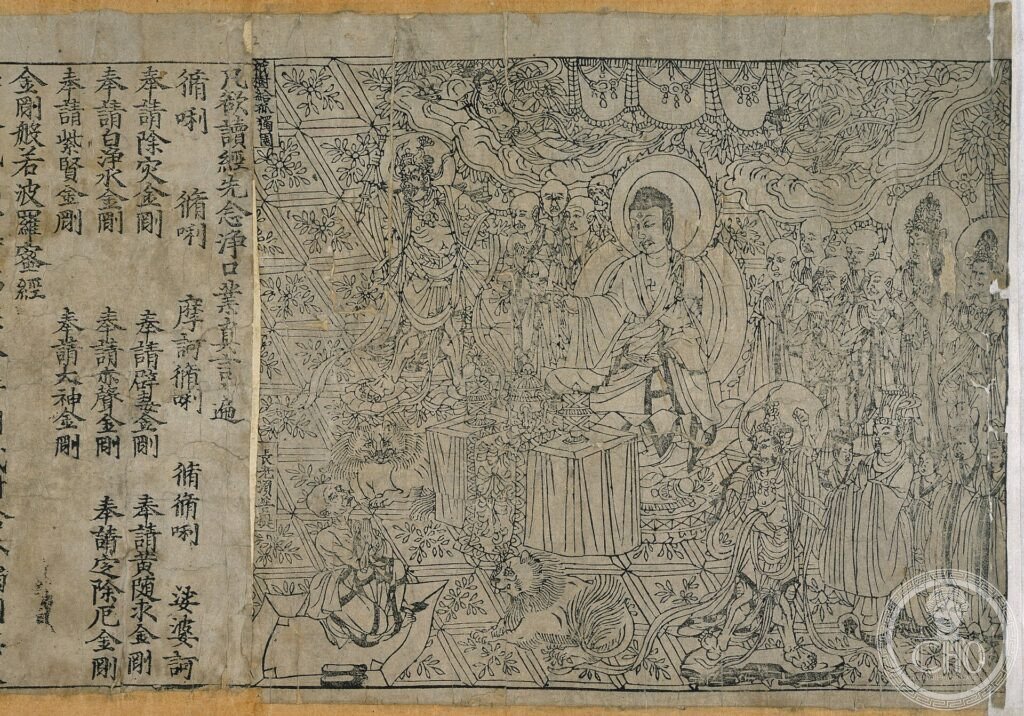
In UNESCO’s words
The traditional China engraved block printing technique requires the collaboration of half a dozen craftspeople possessed of printing expertise, dexterity and team spirit. The blocks themselves, made from the fine-grained wood of pear or jujube trees, are cut to a thickness of two centimetres and polished with sandpaper to prepare them for engraving. Drafts of the desired images are brushed onto extremely thin paper and scrutinized for errors before they are transferred onto blocks. The inked designs provide a guide for the artisan who cuts the picture or design into the wood, producing raised characters that will eventually apply ink to paper. First, though, the blocks are tested with red and then blue ink and corrections are made to the carving. Finally, when the block is ready to be used, it is covered with ink and pressed by hand onto paper to print the final image. Block engraving may be used to print books in a variety of traditional styles, to create modern books with conventional binding, or to reproduce ancient Chinese books. A number of printing workshops continue this handicraft today thanks to the knowledge and skills of the expert artisans.
Official description, UNESCO Intangible Cultural Heritage List — China engraved block printing technique
At a glance
Chinese engraved block printing is a relief printing technique where craftspeople carve designs into wooden blocks, leaving raised surfaces that receive ink and transfer images onto paper. The blocks, made from fine-grained pear or jujube wood and polished smooth, can produce many impressions from a single carved design. The method has been used to print books in traditional styles, create modern bound volumes, and reproduce ancient Chinese texts.
Origins & history
The earliest surviving examples of woodblock printing on cloth in China date to before 220 AD. By the Tang dynasty in the 7th century, the technique had become established and would remain the dominant method of printing books, texts and images throughout East Asia until the 19th century. The practice shaped the production and dissemination of knowledge, literature and art across the region for over a millennium.
The practice
The practice requires collaboration among half a dozen craftspeople working with printing expertise and dexterity. Designs are first brushed onto thin paper and checked for errors before transfer to blocks cut to two centimetres thick. The carver cuts the picture into the wood to produce raised characters, then tests the block with red and blue ink, making corrections as needed. Once ready, the block is covered with ink and pressed by hand onto paper to print the final image.
Cultural significance
The tradition matters to communities that continue it through printing workshops staffed by expert artisans. These craftspeople preserve and transmit the knowledge and skills required for this handicraft, ensuring the technique survives. The survival of block printing workshops depends on the dedication of artisans who maintain the tradition across generations.
Key facts
- Country: China
- Inscribed: 2009
- UNESCO list: Representative List of the Intangible Cultural Heritage of Humanity
- UNESCO reference: 00229
- UNESCO vocabulary: Engraving; Printing methods; Technical skills; Wood carving
- Map: not shown — UNESCO’s official description of this element names no locality, and a living tradition is practised across a community, not at one address.
Where to experience it
The tradition of engraved block printing persists through printing workshops across China, where skilled artisans continue to practise this collaborative craft. Visitors can observe the technique in action at active workshops, where craftspeople work with pear and jujube wood blocks, carefully cutting designs and testing prints with coloured inks. Those interested in learning more about the tradition are encouraged to seek out cultural institutions dedicated to preserving this heritage handicraft. While specific locations and workshop hours vary, enquiries made locally will guide visitors to artisans keeping this ancient technique alive.
Sources & resources
- UNESCO — official element page: China engraved block printing technique
- UNESCO — open data record: Intangible Heritage List, reference 00229
- UNESCO — official video: UNESCO film on this element — embedded on this page
- UNESCO — official photograph: Photograph of this element — Cai bin — YZYQ, 2008
- Reference — Wikipedia (secondary): Woodblock printing — consulted as a secondary reference, not as confirmation
- Cultural Heritage Online: Our archive and city guides

Sources
- S1 — Tsien, Tsuen-Hsuin. Paper and Printing: Science and Civilisation in China, Vol. 5, Part 1. Cambridge University Press, 1985. ISBN 978-0-521-08603-5.
- S2 — Brokaw, Cynthia J. Commerce in Culture: The Sibao Book Trade in the Qing and Republican Periods. Harvard University Asia Center, 2007. ISBN 978-0-674-02449-6.
Spotted an error? Write to [email protected] and we correct it the same day.