
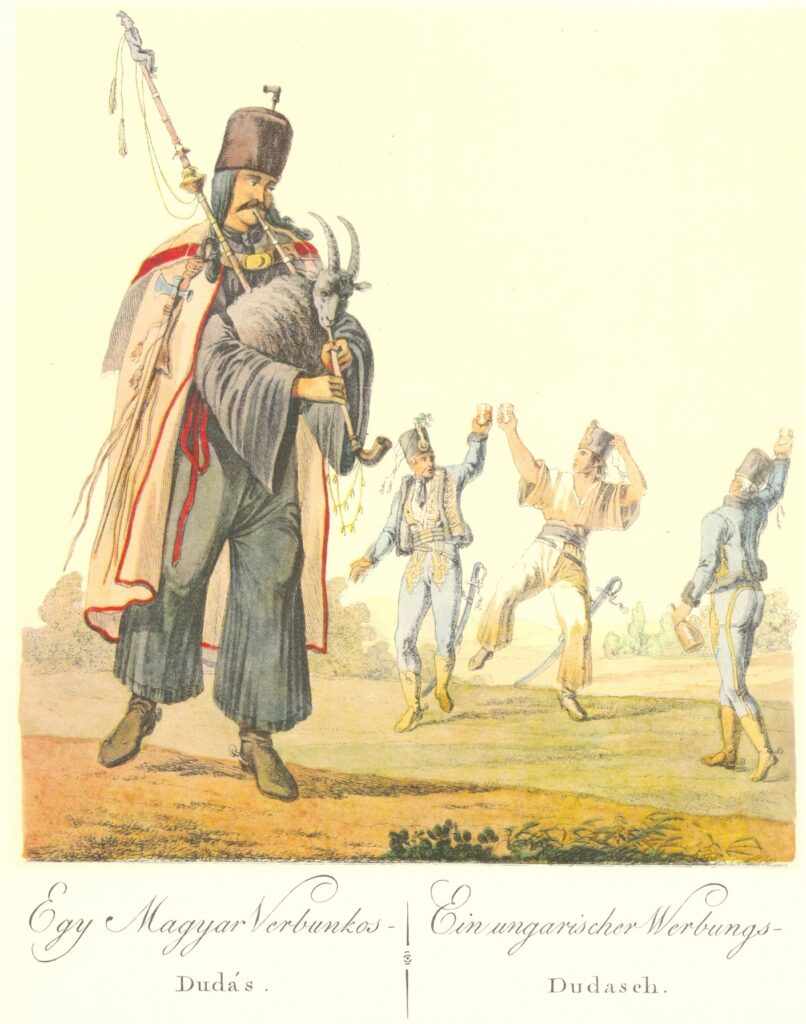
A Hungarian military recruitment dance in which soldiers of descending rank perform a sequence from slow, dotted rhythms to explosive jumps and spur-clicks, accompanied traditionally by Romani musicians.
In UNESCO’s words
The Slovácko verbŭnk is an improvised dance performed by boys and men living in the South Moravia and Zlín districts of the Czech Republic. The name of the dance is derived from the German term Werbung (changed into verbŭnk), meaning “recruitment”, reflecting its historical origins in the recruitment of dancers and soldiers for the military in the eighteenth century.Today, it is performed by folk dance groups in most towns and villages of the Slovácko region, mostly in connection with festivities, such as the annual Hody community celebration. The Slovácko verbŭnk is danced to music called New Hungarian songs and usually consists of three parts. At the beginning, a song is performed, followed first by slow movements and then by faster dancing parts. The dancing is not bound to a precise choreography, but is marked instead by spontaneity, improvisation, and individual expression, including jumping contests. It is usually performed by groups, with each dancer interpreting the music in his own way. There are six different regional types of Slovácko verbŭnk, which account for the great variety of figures and dance rhythms. These types evolved in the early twentieth century and continue to change. The dances are an essential component of local customs, ceremonies and celebrations and are performed at the annual contest of the best dancer at the International Folklore Festival in Strážnice. The migration of young and middle-aged people to the country’s urban centres is considered the greatest threat to the viability of the different regional types of Slovácko verbŭnk. Another risk is the dance’s reliance on financial support since the traditional costumes and musical instruments are made by hand and require regular maintenance.
Official description, UNESCO Intangible Cultural Heritage List — Slovácko Verbuňk, recruit dances
At a glance
The Slovácko verbŭnk is an improvised dance performed by boys and men in the South Moravia and Zlín districts of the Czech Republic. Danced to music known as New Hungarian songs, it typically unfolds in three parts: an opening song followed by slow movements and then faster dancing. The dance emphasizes spontaneity and individual expression rather than fixed choreography, with dancers interpreting the music in their own way. Six distinct regional types exist, each with different figures and rhythms.
Origins & history
The dance's name comes from the German word Werbung, meaning recruitment, reflecting its eighteenth-century origins when it was used to recruit dancers and soldiers for the military. Six regional types evolved during the early twentieth century and continue to change over time. Today the Slovácko verbŭnk remains an essential part of local customs and ceremonies throughout the region.
The practice
Folk dance groups perform the verbŭnk mostly during festivities, particularly at the annual Hody community celebration. Dancers interpret the music individually, with performances marked by jumping contests and personal expression. The tradition includes an annual competition for the best dancer at the International Folklore Festival in Strážnice, where regional variations are showcased and celebrated.
Cultural significance
The dance forms an integral part of Slovácko community life and local celebrations. Its survival faces two serious challenges: the migration of young and middle-aged people to urban centres threatens the transmission of the different regional types, while the reliance on handmade traditional costumes and musical instruments—both requiring regular maintenance—strains resources needed for the practice's continuation.
Key facts
- Country: Czechia
- Inscribed: 2008
- UNESCO list: Representative List of the Intangible Cultural Heritage of Humanity
- UNESCO reference: 00147
- UNESCO vocabulary: Boys; Dance; Men; Recruitment
- Map: not shown — UNESCO’s official description of this element names no locality, and a living tradition is practised across a community, not at one address.
Where to experience it
The Slovácko verbŭnk thrives in the South Moravia and Zlín districts of the Czech Republic, where folk dance groups in most towns and villages of the Slovácko region keep the tradition alive. Visitors can encounter the dance at local festivities and community celebrations, particularly at the annual Hody gathering. The International Folklore Festival in Strážnice showcases the dance through its annual contest of the best dancer, offering an opportunity to see the six different regional types and their varied figures and rhythms performed by groups who interpret the music through individual expression and improvisation.
Sources & resources
- UNESCO — official element page: Slovácko Verbuňk, recruit dances
- UNESCO — open data record: Intangible Heritage List, reference 00147
- UNESCO — official video: UNESCO film on this element — embedded on this page
- UNESCO — official photograph: Photograph of this element — Rudolf Chudoba — 2002 National Institute of Folk Culture
- Reference — Wikipedia (secondary): Verbunkos — consulted as a secondary reference, not as confirmation
- Cultural Heritage Online: Our archive and city guides
