Santiniketan (শান্তিনিকেতন, “abode of peace”), inscribed by UNESCO in 2023, is a cultural landscape and university campus in the Birbhum district of West Bengal — the ashram-university established by the Nobel laureate poet and philosopher Rabindranath Tagore (1861–1941 CE, the first non-European Nobel laureate in Literature, awarded 1913 CE for the poetry collection “Gitanjali”) at the site of a meditative retreat (the “Santi Niketan”, built in 1863 CE by his father Debendranath Tagore on the red laterite land of the Birbhum plateau, approximately 160 km north of Kolkata) — transforming the original ashram into an experimental school (Patha Bhavana, founded 1901 CE, based on Tagore’s educational philosophy of learning in nature: outdoor classes under trees, integration of music, dance, and art into the daily curriculum, and the rejection of the rote-learning model of colonial British education) and subsequently into Visva-Bharati University (founded 1921 CE, with a formal university charter from the Indian government), which became one of the most influential centres of the Bengali cultural renaissance and the Indian independence movement. The UNESCO inscription recognises Santiniketan as “an exceptional instance of convergence of Eastern and Western educational philosophies” and as the birthplace of Tagore’s aesthetic philosophy that synthesised Indian classical traditions (Baul folk music, Bharatanatyam, Rabindra Sangeet — the approximately 2,000 songs composed by Tagore that constitute a distinct musical genre), visual arts (Tagore’s own modernist paintings, influenced by Japanese ink painting and the Bengal school), and the international arts and crafts movement, producing a cultural synthesis that influenced generations of Indian artists, writers, musicians, and independence leaders (among the Visva-Bharati students and faculty who shaped 20th-century India: Indira Gandhi, Satyajit Ray, Amartya Sen).
Santiniketan and the West Bengal cultural heritage corridor Visva-Bharati campus · Rabindra Bhavana · Biswa Bangla Mela · Kolkata · Murshidabad — 0 to 180 km
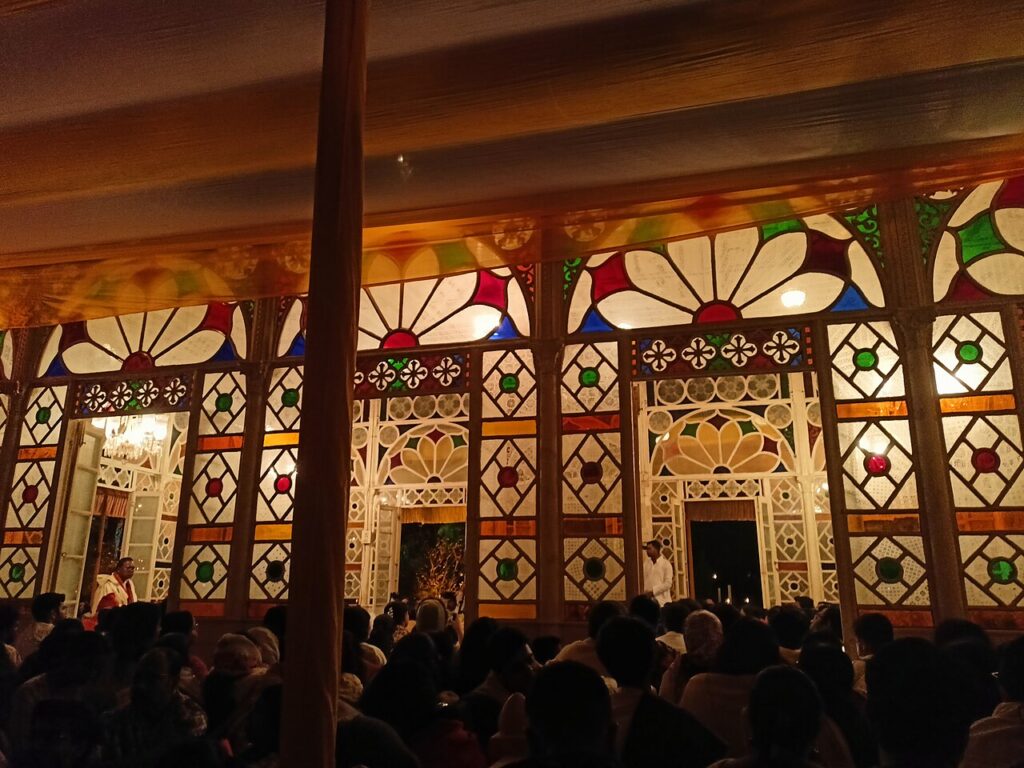
The Santiniketan UNESCO inscription covers the core ashram-university campus of Visva-Bharati (approximately 90 ha of the broader Santiniketan municipality area, which is considerably larger) — the historic buildings that Tagore designed and built from the 1890s through the 1930s in a distinctive architectural style that represents his specific educational philosophy in built form: the buildings are small in scale (no large institutional buildings — the largest is the Sangit Bhavana music faculty building, still relatively modest), built in local laterite stone and terracotta brick with Bankura-terracotta decorative panels (the Bankura district of West Bengal is the traditional centre of terracotta craft production, and Tagore incorporated terracotta craft into the campus buildings as a specific aesthetic and pedagogical choice — the craftsmen who made the decorative panels were from the local artisan communities, connecting the university to its Bengal cultural context), with shading trees planted throughout the campus as essential components of the outdoor classroom system (the “tal” open-air classroom, where students and teachers sat on the ground or on mats under specific trees designated for different subjects, is the most famous image of the Santiniketan educational model). The most significant individual buildings include: the Upasana Griha (the prayer hall, built 1891 CE by Debendranath Tagore as the original ashram prayer space — a simple glass-walled structure with terracotta decoration and a large central space for meditation and communal prayer, still used weekly for the Maghotsav and Poush Mela festival prayers); the Uttarayan complex (the cluster of six small houses built by Tagore for his own residence on the northern edge of the campus — each in a different architectural style reflecting Tagore’s experiments with vernacular Bengal architecture, Mughal architectural elements, and European modernism); and the Rabindra Bhavana museum (the former Tagore family residence “Udayan”, now a museum housing manuscripts, artworks, letters, and personal objects of Tagore and his extended family). The Poush Mela (the December-January fair held annually on the Santiniketan campus since 1894 CE, at the winter solstice — one of the largest rural crafts fairs in West Bengal, attracting Baul musicians, Santali tribal performers, and crafts sellers from across the region) and the Basanta Utsav (the Holi/spring festival celebrated at Santiniketan with specific Tagore-composed songs and dance performances, a living example of the Tagore educational tradition’s continuing practice) are the cultural events that most vividly express the living heritage of the site.
Kolkata (approximately 160 km south of Santiniketan, 3 hours by express train — the Shantiniketan Express from Howrah to Bolpur Station, the nearest station to Santiniketan) is the major regional city and heritage centre, with the Victoria Memorial, the Howrah Bridge, the Marble Palace, and the colonial-era heritage of the former British Indian capital. Murshidabad (approximately 90 km north of Santiniketan — the last Nawab of Bengal’s capital before the Battle of Plassey 1757 CE, with the Hazarduari Palace’s 1,000 doors and the Imambara mosque complex) is the closest regional heritage centre to Santiniketan in Birbhum district.
Practical information
Santiniketan/Bolpur is approximately 160 km north of Kolkata. Best transport: train from Howrah Station (Kolkata) to Bolpur Station — the Shantiniketan Express (daily, approximately 3 hours) or the Intercity Express (daily, approximately 2.5 hours). Bolpur is the nearest railway junction; Santiniketan campus is approximately 2 km from Bolpur station (auto-rickshaw or cycle-rickshaw). Airport: Kolkata Netaji Subhash Chandra Bose International Airport (CCU), with international and domestic connections; take train from Howrah. The Visva-Bharati University campus is accessible to visitors for guided tours (contact the Santiniketan Tourism office or the Visva-Bharati Guest House); the Rabindra Bhavana museum is open Tuesday–Sunday 10:00–17:00 (closed Wednesday mornings). The Uttarayan complex (the Tagore residence cluster) requires museum ticket purchase at the main gate. The Poush Mela fair (December 22–25 approximately, at winter solstice) is the peak visitor period — accommodation books out months in advance; the Basanta Utsav (Holi, approximately March) is the second major festival. Year-round, the campus is busy with Visva-Bharati students and provides a living experience of Tagore’s educational philosophy. Best visiting months: November–February (temperatures 10–25°C, comfortable; the campus is lush and the light is soft). The Shantiniketan area is well-known for terracotta craft shopping (the Sonajhuri hat — the Saturday weekly market under the sal trees at the Khowai riverbank, 2 km from campus, is the most atmospheric local market for Baul music, folk craft, and vernacular Bengal food).
Frequently Asked Questions
Who was Rabindranath Tagore and why is Santiniketan his most significant legacy?
Rabindranath Tagore (রবীন্দ্রনাথ ঠাকুর, 1861–1941 CE, born in Kolkata to the Tagore family — one of the most intellectually prominent Bengali Brahmin families of the 19th century, the family that had been among the leaders of the Bengal Renaissance that was reforming and modernising Bengali society from the 1820s onward) is the most significant figure of Indian literary and cultural modernism — simultaneously a poet (the author of approximately 2,000 “Rabindra Sangeet” songs that constitute a complete musical genre still performed daily across Bengal; the composer of the national anthems of both India and Bangladesh — the only person in history to have written the national anthems of two countries), a playwright, a novelist, a painter (he began painting at 67 and produced approximately 2,000 visual artworks in the last years of his life that are now regarded as early examples of Indian modernism), a philosopher-educator, and a political thinker (his response to Gandhi’s nationalism — Tagore supported Indian independence but disagreed with Gandhi’s economic nationalism and village romanticism, arguing for a cosmopolitan humanism that transcended national boundaries — is documented in their famous correspondence and remains a significant intellectual debate in Indian cultural history). Tagore’s Nobel Prize for Literature (1913 CE, awarded for the English-language version of his Bengali poetry collection “Gitanjali” — “Song Offerings” — which W.B. Yeats helped translate and wrote the introduction for) was the first Nobel Prize awarded to a non-European and the first awarded for work in a South Asian language, and its award precipitated a significant international interest in Indian literature and philosophy that was entirely new (previously, European engagement with India was primarily archaeological and orientalist, focused on ancient Sanskrit texts rather than living literary traditions). Santiniketan represents Tagore’s most sustained practical attempt to implement his educational philosophy — a philosophy that rejected the colonial British model of rote memorisation and examination-centred learning in favour of a pedagogy based on: direct engagement with nature (outdoor classes, seasonal celebrations tied to agricultural cycles, observation of the natural world as primary learning); integration of art, music, dance, and craft into every subject (not as separate disciplines but as modes of understanding applicable to all learning); and the aspiration to cosmopolitan humanism expressed by the name Visva-Bharati (“world” + “India” = the world embraced by India) — the concept that India’s cultural tradition was not separate from but continuous with the global human intellectual tradition, expressed in Santiniketan’s practice of inviting Japanese, Indonesian, Chinese, and European scholars as faculty alongside Indian teachers. The living legacy of Santiniketan at the time of the UNESCO inscription (2023) is a specific and somewhat paradoxical situation: the educational philosophy that Tagore designed for a small ashram of 20–40 students under the personal supervision of poet-teachers has had to be adapted to an accredited university of approximately 7,000 students within the Indian national university framework, with formal degrees, examinations, and syllabi that partially conflict with Tagore’s original open-learning model. The UNESCO inscription was motivated in part by the desire to protect the physical campus from the development pressures generated by the university’s expansion — the historic buildings and the outdoor classroom spaces under the specific trees designated for different subjects are increasingly threatened by new building construction on the campus periphery, and the inscription creates a protected zone around the core historic fabric.
What is “Rabindra Sangeet” and how did Tagore’s music influence Indian cultural life?
Rabindra Sangeet (রবীন্দ্র সংগীত — “Tagore’s music” or “Rabindranath’s songs”, also called “Tagore songs”) is a genre of approximately 2,000 songs composed by Rabindranath Tagore between approximately 1878 CE and his death in 1941 CE — texts written by Tagore himself in Bengali, composed to specific ragas (melodic frameworks) of the Hindustani classical tradition, Baul folk music of the Bengal countryside, Bangasangit (the traditional Bengali music of religious and seasonal festivals), and occasionally Western classical music influences (Tagore studied piano briefly in England and incorporated some Western harmonic elements into specific songs). The 2,000 songs are categorised in the “Sangit Chintamani” collection (published by the Visva-Bharati University press) into sub-genres: “Puja” (devotional songs), “Prem” (love songs), “Prakriti” (nature songs, considered the finest examples of the genre), “Swadesh” (patriotic songs), and “Prabhandha” (narrative and dramatic songs). The genre is unique in Indian music history for several reasons: (1) Tagore composed both text and music himself for all 2,000 songs — unlike classical music where a composer sets texts from the existing poetic canon, Tagore was his own lyricist, creating a unified artistic vision in each song that is different from either the classical music tradition (where the music is primary and the text is subordinate) or the Bengali literary tradition (where the text is primary and the music incidental); (2) Tagore specified the performance style for each song in notation systems he developed specifically for this purpose — the songs have specific notated melodies that are taught precisely in the Rabindra Sangeet tradition, making it a hybrid between composed classical music and folk/devotional improvised music; (3) the songs are culturally pervasive in West Bengal and Bangladesh in a way that no other individual composer’s work is pervasive in any comparable cultural context — Rabindra Sangeet is performed at birth ceremonies, marriage ceremonies, funerals, political rallies, festivals, and in daily domestic life across the Bengali-speaking world, making Tagore’s personal artistic output effectively the shared musical cultural heritage of approximately 250 million Bengali speakers. The two national anthems composed by Tagore are the clearest example of this pervasiveness: Jana Gana Mana (the national anthem of India, adopted 1950 CE) and Amar Sonar Bangla (the national anthem of Bangladesh, adopted 1971 CE — the line “Amar Sonar Bangla, ami tomay bhalobashi” — “My Golden Bengal, I love you” — became the rallying song of the Bangladesh Liberation War) are both Rabindra Sangeet, meaning that Tagore’s personal artistic voice is literally heard at every formal state occasion in both countries — a unique situation in world cultural history where a single poet’s work constitutes the foundational musical identity of two nation-states.
EXCERPT: Santiniketan, UNESCO-inscribed in 2023, is Rabindranath Tagore’s ashram-university campus in West Bengal — 90 ha of outdoor classrooms under trees, Bankura terracotta campus buildings, and the site where Indira Gandhi, Satyajit Ray, and Amartya Sen studied, birthplace of Rabindra Sangeet (Tagore’s 2,000 songs including the national anthems of both India and Bangladesh).
META: UNESCO World Heritage Sites near Santiniketan West Bengal India: Bishnupur Terracotta Temples Bankura district 100 km (nationally protected), Sundarbans National Park 300 km south (UNESCO 1987) — Rabindranath Tagore Visva-Bharati University UNESCO heritage, Bolpur Bengal cultural renaissance, Poush Mela Basanta Utsav Santiniketan.
Sources
- S1 — UNESCO World Heritage Centre — Santiniketan (Ref. 1675) — https://web.archive.org/web/20230601000000/https://whc.unesco.org/en/list/1675/
- S2 — UNESCO World Heritage Centre — Statement of Outstanding Universal Value (Ref. 1675) — https://whc.unesco.org/en/list/1675/
Spotted an error? Write to the editors and we correct it the same day.