The Pyu Ancient Cities (inscribed by UNESCO in 2014, the first UNESCO World Heritage site in Myanmar), comprising three major city-state sites — Halin (approximately 1st–9th century CE, in Sagaing Region), Beikthano (Vishnu City — approximately 1st–5th century CE, in Magway Region), and Sri Ksetra (Thayekhittaya, “Field of Good Fortune” — approximately 5th–9th century CE, near modern Pyay/Prome in Bago Region) — represent the archaeological remains of the Pyu civilisation, the earliest historical urban civilisation in the mainland of Southeast Asia and the precursor to the Burmese/Bamar kingdoms that established Bagan and the subsequent Burmese political tradition. The Pyu people (known in their own Mon-Khmer inscriptions as “Tircul” and in Chinese Tang dynasty sources as “Pyū”) were an early Tibeto-Burman-speaking people who established walled, moated city-states in the Irrawaddy river basin from approximately the 1st century BCE — creating the first cities in Southeast Asia’s river-valley agricultural systems and the first societies in the region to adopt Theravada and Mahayana Buddhism as a state religion (documented in the Pyu inscriptions, which constitute the oldest known Buddhist epigraphic record in mainland Southeast Asia). The three city-states together represent the full chronological span of the Pyu urban tradition: Beikthano is the earliest and smallest (approximately 1st–5th century CE, a fortified city of approximately 3 km² within its walls); Halin is the northernmost (approximately 1st–9th century CE, with extensive moats and a double city wall enclosure of approximately 6.6 km²); and Sri Ksetra is the largest and most archaeologically significant (approximately 5th–9th century CE, with a walled city area of approximately 9 km² and extensive extra-mural ruins extending beyond the main walls, including the distinctive cylindrical brick stupas of the Pyu tradition — the Bawbawgyi, Payagyi, and Payama stupas — that are the most visible monuments remaining at the site).
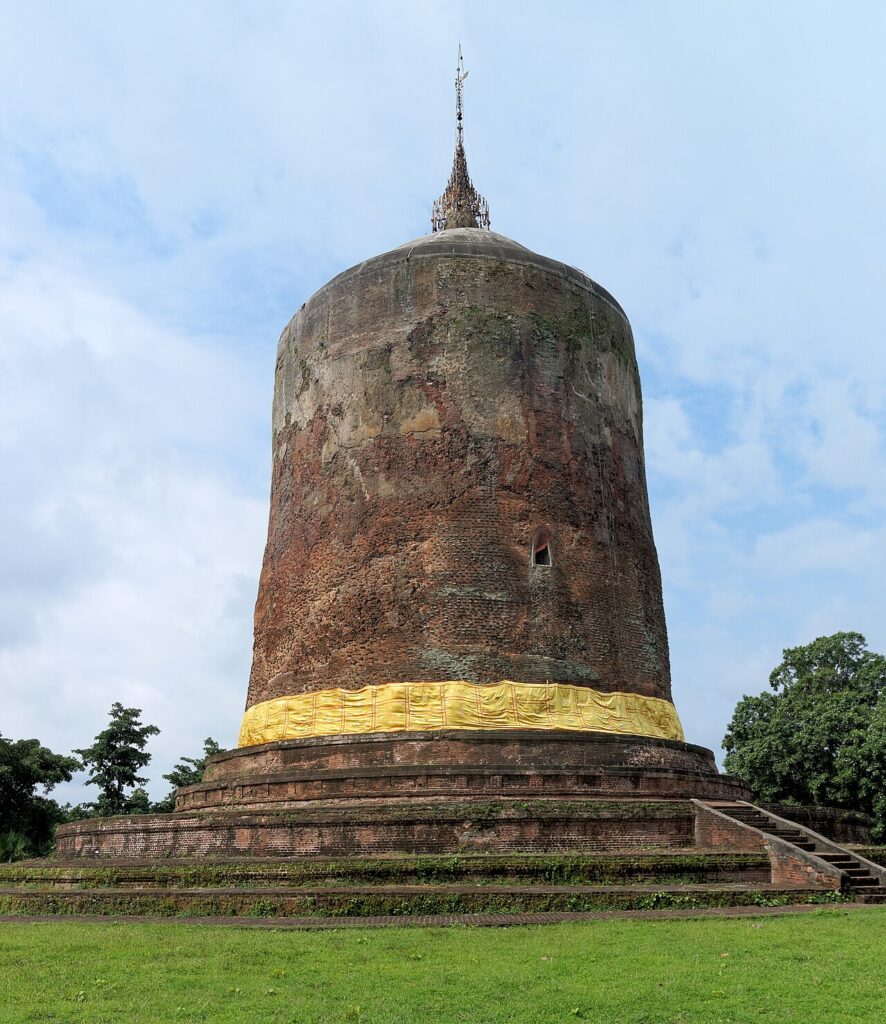
Sri Ksetra’s Pyu stupas and the Myanmar heritage corridor Bawbawgyi Stupa · Sri Ksetra Museum · Pyay · Bagan — 0 to 270 km
The architectural significance of the Pyu ancient cities lies in the specific character of Pyu urbanism — city-states whose walled enclosures, moat systems, palace complexes, and Buddhist monasteries represent an urban tradition that is clearly distinct from both the Indianised city-state models of maritime Southeast Asia (the Funan and Zhenla traditions of the Mekong delta) and the Chinese city-state model of the northern mainland — a specifically Tibeto-Burman urban type that adapted Indian urban planning principles (the Hindu/Buddhist concept of the city as a mandala-shaped representation of the cosmic order, with the palace at the centre and the city walls symbolising the cosmic mountain ranges surrounding the world) to the specific landscape of the Irrawaddy river valley. The most architecturally distinctive Pyu contribution is the cylindrical stupa form — the Pyu brick stupas (the Bawbawgyi at Sri Ksetra, which stands approximately 46 metres high with a circular plan approximately 29 metres in diameter, and is the largest surviving Pyu monument; the Payagyi and Payama stupas of similar cylindrical form, smaller) are clearly different from both the hemispherical “bell” stupa form of Sri Lanka and the Burmese tradition and the tapering spire stupa of the later Burmese and Thai traditions. The cylindrical Pyu stupa type is the earliest surviving form of Burmese stupa architecture and represents the local adaptation of the Indian reliquary mound form to the specific Pyu architectural tradition. The Chinese Tang dynasty sources (the “Old Book of Tang” and “New Book of Tang”, compiled approximately 945 CE and 1060 CE respectively) record the Pyu kingdom in considerable detail — the Tang sources describe the Pyu as musicians (a Pyu musical troupe visited the Tang court in Chang’an approximately 802 CE), weavers of fine cotton cloth, and practitioners of Buddhist non-violence (the Tang annals note that the Pyu “do not kill living things for food”). The Pyu cities were sacked and depopulated by the Nanzhao kingdom (in modern Yunnan, China) approximately 832 CE, after which the Pyu population dispersed and gradually merged with the expanding Bamar people who established Bagan (approximately 849–1297 CE, approximately 270 km north of Sri Ksetra). The Bagan period thus directly succeeded and drew from the Pyu urban and Buddhist tradition — the Bagan Theravada Buddhist monastic tradition and the brick stupa building programme of the Bagan kings are the direct continuation of the Pyu tradition.
Practical information
The three Pyu city sites are spread over central Myanmar: Sri Ksetra is approximately 8 km east of Pyay (Prome) in Bago Region, approximately 290 km north of Yangon (6 hours by road/bus from Yangon, or approachable by Ayeyarwady River boat). Halin is approximately 110 km north of Mandalay in Sagaing Region (road access from Mandalay). Beikthano is approximately 260 km south of Mandalay near Taungdwingyi. Sri Ksetra is the most accessible and archaeologically significant of the three sites — the Sri Ksetra Archaeological Museum (on-site at the Thayekhittaya city ruins area) has displays of Pyu gold objects, inscriptions, pottery, and Buddhist artefacts from the site. Myanmar entry requirements and internal travel regulations should be checked in advance (political situation in Myanmar has been unstable since the 2021 military coup — check current Foreign Ministry travel advisories before planning). The nearest major city to Sri Ksetra is Pyay (with basic hotel accommodation) or Naypyidaw (Myanmar’s capital, approximately 110 km north). Access to Sri Ksetra from Pyay is by local bus, motorcycle taxi, or hired vehicle to the archaeological zone. Best visiting months: November–February (dry season, temperatures 25–30°C; the rainy season June–October makes unpaved site roads impassable).
Frequently Asked Questions
Who were the Pyu people and what happened to them?
The Pyu people (also written “Pyū” in the transliteration of the Chinese character renderings of the name) were a Tibeto-Burman-speaking ethnic group who inhabited the Irrawaddy river valley of central Myanmar from approximately the 1st century BCE (when the earliest Pyu archaeological evidence appears in the archaeological record) to approximately the 9th–10th century CE (when the Pyu cultural and linguistic identity was absorbed into the emerging Burmese/Bamar ethnic and cultural identity). The specific linguistic and genetic relationship between the Pyu and the Bamar (Burmese) people is debated in both historical and linguistic scholarship: the most common scholarly position is that the Pyu were an early wave of Tibeto-Burman-speaking settlers in the Irrawaddy valley who preceded the Bamar migration, and that the Pyu and the Bamar are closely related linguistically (both in the Tibeto-Burman language family) but represent distinct migration episodes. The Tang dynasty Chinese sources (which are the most detailed external accounts of the Pyu before their absorption into the Burmese cultural tradition) describe the Pyu in terms that suggest a highly organised Buddhist society: the Pyu had 100 Buddhist monasteries in their capital; Pyu boys were educated in Buddhist monasteries from age 7 to 20; the Pyu did not use gold or silver in commerce (using lead, iron, and clay coins instead); and the Pyu maintained strict Buddhist non-violence principles. The military defeat of the Pyu capital Halin by the Nanzhao kingdom of Yunnan approximately 832 CE (the Nanzhao took 3,000 Pyu captives to Yunnan) is the last recorded historical event of the independent Pyu political tradition; the subsequent establishment of the Bagan kingdom by the Bamar (approximately 849 CE) marks the transition to the next phase of Burmese history. The Pyu language (documented in a small corpus of inscriptions, the most important of which are the “Pyu inscriptions” from Sri Ksetra, now partially deciphered) became extinct approximately 1100–1200 CE as the Bamar language expanded through the Irrawaddy valley; the last known Pyu-language inscription dates to approximately 1093 CE. The Pyu contribution to the subsequent Bamar/Burmese tradition is substantial and clearly documented: the Bagan kingdom’s Theravada Buddhist monastic tradition, the brick stupa building programme, the use of Pali as the Buddhist liturgical language, and the specific administrative and urban planning conventions of the Bagan city were all inherited directly from the Pyu urban civilisation of the preceding five centuries.
What is the architectural significance of the cylindrical Pyu stupa and how does it differ from later Burmese stupa forms?
The cylindrical Pyu stupa form — represented most completely by the Bawbawgyi (“Great Old Pagoda”) at Sri Ksetra, which stands approximately 46 metres high with a circular floor plan approximately 29 metres in diameter and a cylindrical drum approximately 14 metres high supporting a tapering conical upper section — is a specific architectural type that has no close parallel in either the Indian or the Sri Lankan stupa traditions and represents the earliest and most distinctive contribution of the Burmese region to Buddhist monumental architecture. The Indian stupa tradition produced the hemispherical “anda” form (the Sanchi stupa type, where the relic chamber is covered by a solid hemisphere of brick or stone sitting on a low circular drum, surmounted by a vertical shaft/harmika and a parasol crown) and the “beehive” form (the South Indian tower-stupa of the Andhra tradition, with a more pointed profile). The Sri Lankan stupa tradition produced the “bell-shaped” stupa (the dagoba form of Anuradhapura and Polonnaruwa, with a larger hemisphere on a high circular drum, closer to a bell profile). The Burmese Bagan tradition (9th–13th century CE) produced the “tapering spire” stupa type that dominates the Bagan skyline today — the tall, slender, tapering pagoda form (the “zedi” or “hpaya”) that is the canonical form of Burmese Buddhist architecture. The Pyu cylindrical stupa form (the Bawbawgyi type) is architecturally intermediate between all of these and clearly distinct from all of them: the cylindrical drum is too tall to be called a “hemisphere” (it is a true cylinder, approximately equal in height and diameter); the conical upper section has a specific profile unlike either the bell-shaped Sri Lankan dagoba or the tapering Burmese zedi; and the entire composition lacks the complex multi-tiered base and decorated drum of the Sri Lankan tradition. The likely origin of the Pyu cylindrical form is the Indian Andhra/Amaravati tradition (the “cylindrical stupa” form of the Amaravati school, active approximately 200 BCE–300 CE, which produced tall cylindrical drum stupas decorated with elaborate carved limestone panels), transmitted to the Pyu through the maritime trade contacts that connected the Bay of Bengal coast to the Irrawaddy valley via the ancient Pyu port cities. The Bawbawgyi stupa’s survival in its original cylindrical form (without the subsequent rebuilding in the Bagan or later Burmese style that modified most other early Burmese stupas) makes Sri Ksetra one of the only sites where the pre-Bagan Pyu stupa tradition can be directly experienced architecturally.
EXCERPT: Pyu Ancient Cities, Myanmar’s first UNESCO World Heritage site (2014), are three Pyu civilisation city-states (Sri Ksetra, Halin, Beikthano, 1st century BCE–9th century CE) in the Irrawaddy valley — the earliest urban civilisation in mainland Southeast Asia, Bawbawgyi’s 46-metre cylindrical brick stupa at Sri Ksetra, and the direct precursor of the Bagan Buddhist kingdom.
META: UNESCO World Heritage Sites near Pyu Ancient Cities Myanmar: Bagan temples (Myanmar serial tentative nomination, adjacent region) — Pyu ancient cities Sri Ksetra Halin Beikthano Myanmar UNESCO 2014, Bawbawgyi stupa Pyay Prome, Pyu civilisation Tibeto-Burman Irrawaddy valley, Nanzhao sack 832 CE, earliest Buddhist inscriptions mainland Southeast Asia.
Sources
- S1 — UNESCO World Heritage Centre — Pyu Ancient Cities (Ref. 1444) — https://web.archive.org/web/20230601000000/https://whc.unesco.org/en/list/1444/
- S2 — UNESCO World Heritage Centre — Statement of Outstanding Universal Value (Ref. 1444) — https://whc.unesco.org/en/list/1444/
Spotted an error? Write to the editors and we correct it the same day.