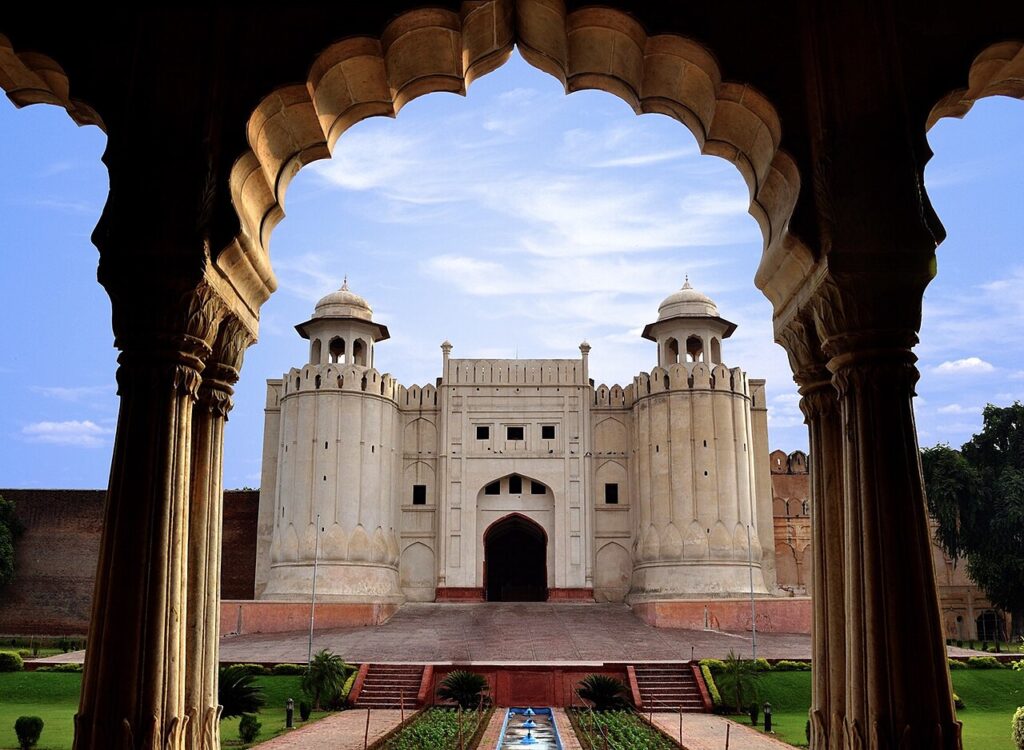
The Fort and Shalamar Gardens in Lahore (Punjabi: “لاہور قلعہ تے شالامار باغ” — “Lahore Fort and Shalamar Garden”), inscribed by UNESCO in 1981, is the primary monument complex of Mughal Lahore — the walled city that served as the second capital of the Mughal Empire (after Agra) from approximately the reign of Akbar the Great (1556–1605 CE) through the reign of Aurangzeb (1658–1707 CE), during which period the Fort, the adjacent Badshahi Mosque, and the Shalamar Garden were all built within a generation of each other (1642–1673 CE) in the most intensive period of Mughal imperial construction at Lahore. The Lahore Fort (Shahi Qila — “Royal Fort”) is a walled citadel covering approximately 20 hectares on a natural raised plateau (an artificial mound whose lowest archaeological layers date to approximately 1025 CE, when the Ghaznavid sultan Mahmud of Ghazni is believed to have built the first fortification on the site) in the northwestern corner of the walled city of Lahore, containing 21 major monuments built by successive Mughal emperors from Akbar (who built the first surviving structures — the Akbari Gate and a large madrassa, approximately 1566–1605 CE) through Jahangir (who added the Jahangiri Quadrangle — the largest of the fort’s internal courtyards, with the painted tile mosaic facade of the “Picture Wall” covering the entire 167-metre-long northern exterior wall of the quadrangle in a continuous frieze of elephant fights, combat scenes, hunting scenes, and decorative floral patterns executed in the “Kashi” tile-mosaic technique brought from the Islamic tradition of Persian and Central Asian architecture) to Shah Jahan (who added the Sheesh Mahal — “Hall of Mirrors”, a private royal pavilion entirely lined with mirror-glass inlay in a technique called “aina kari” — mirror-work — that creates an effect of infinite reflecting surfaces when a lamp is held inside) and Aurangzeb (who added the Alamgiri Gate, the last great construction at the fort, facing the Badshahi Mosque’s courtyard). The Shalamar Garden (from Kashmiri “shalimar” — possibly derived from “shali-mar” meaning “abode of love” or “garden of high heaven” in the tradition of Persian-Mughal garden naming) is a formal Mughal garden covering approximately 16 hectares approximately 7 km northeast of the Fort, built 1641–1642 CE by Shah Jahan (the same emperor who built the Taj Mahal in Agra 1632–1648 CE) on a rectangular plan with a central water channel axis and three terraced levels, following the “charbagh” (four-garden) Mughal formal garden tradition derived from the Paradise garden concept of Persian Islamic garden design.
Lahore Fort’s Mughal monuments and the Lahore heritage district Lahore Fort · Badshahi Mosque · Walled City · Shalamar Garden · Taxila — 0 to 260 km
The Lahore Fort complex’s most spectacular features are: the Sheesh Mahal (Hall of Mirrors, built approximately 1631–1632 CE by Shah Jahan — a private royal apartment suite whose walls, ceilings, and archways are entirely covered in “aina kari” mirror-work: small convex pieces of mirror-glass set in plaster in geometric and floral patterns, the total reflecting surface covering approximately 1,500 m² of interior surface; the effect when a single lamp is lit inside is of an infinite field of sparkling points of light — the Sheesh Mahal is the most elaborate surviving example of Mughal interior mirror-work, created at the same time and by the same craftsmen as the mirror-work rooms of the Agra Fort’s Musamman Burj, and represents the peak of the Shah Jahan period’s interior decorative arts); the Picture Wall (the northern exterior wall of the Jahangiri Quadrangle, approximately 167 m × 16 m of tile mosaic created 1617–1631 CE, showing scenes of imperial elephant fights, polo matches, tiger hunting, combat, and court ceremonies in a register system of approximately 50 individual frieze panels — the most extensive surviving Mughal tile-mosaic exterior programme); and the Naulakha Pavilion (a small marble pavilion approximately 9 m × 3 m in floor area but inlaid with extremely fine semi-precious stone “pietra dura” inlay work — the Naulakha’s name means “valued at nine lakhs” [900,000 rupees] in the tradition of naming Mughal luxury objects by their cost — and is one of the most concentrated examples of the “khatam-bandi” inlay tradition that reached its peak expression in Shah Jahan’s Agra and Lahore buildings). The Badshahi Mosque (Badshahi = “Royal” — the mosque of the emperor, built 1671–1673 CE by the emperor Aurangzeb adjacent to the Lahore Fort’s Alamgiri Gate, facing the fort across a wide courtyard/esplanade that functions as a visual axis between the two monuments) is one of the largest mosques in the world — its courtyard (approximately 159 m × 159 m) can accommodate approximately 100,000 worshippers, and the mosque’s four minarets (each approximately 53 m high with a diameter of 4.5 m — the narrowest-to-height ratio of any major mosque minaret in the world) are among the most slender in Islamic architecture.
Practical information
Lahore is the capital of Punjab Province and Pakistan’s second largest city (population approximately 13 million), with an international airport (Allama Iqbal International Airport, LHE, with direct connections to Doha, Dubai, Riyadh, London, and Toronto among others) and a comprehensive domestic flight and train network. The Lahore Fort is open daily 08:00–18:00 (winter) / 08:00–19:00 (summer); entrance fee applies. The Fort and the Badshahi Mosque are approximately 700 m apart, with the wide Royal Esplanade/Hazuri Bagh (the formal garden courtyard between the Fort and the Mosque, and the site of the Sikh Baradari pavilion built by the Sikh ruler Ranjit Singh approximately 1818 CE from materials salvaged from Mughal-period demolitions) between them. The Shalamar Garden is approximately 7 km northeast of the Fort — accessible by rickshaw, taxi, or the Lahore Metro’s Orange Line (the Shalimar station is approximately 1 km from the garden). The Walled City of Lahore (the historic urban core, approximately 2.5 km × 2 km, with the Delhi Gate as the main entry point for heritage tourism) contains numerous historic mosques, havelis (merchant mansions), bazaars, and shrines that complement the UNESCO fort and garden visit. Best visiting months: October–March (Lahore summers are extremely hot, with temperatures above 40°C June–August; the winter months are mild and pleasant for outdoor monument visiting).
Frequently Asked Questions
How did Lahore become the Mughal Empire’s second capital and what was its cultural significance?
Lahore’s emergence as the Mughal Empire’s second capital (after Agra/Delhi in the imperial centre of the Gangetic plain) was driven by the strategic importance of the Punjab as the gateway between Central Asia and the Indian subcontinent. The city had been a significant regional capital since at least the 11th century CE (when Mahmud of Ghazni used it as an administrative centre for his Punjab domains approximately 1021 CE) and had been the eastern capital of the Ghaznavid and Ghurid sultanates before the Mughal conquest. Akbar the Great (ruled 1556–1605 CE) effectively established Lahore as the Mughal co-capital — he moved his court to Lahore from Fatehpur Sikri/Agra approximately 1585 CE and remained at Lahore until 1598 CE (a 13-year period that coincided with his major military campaigns in the northwest: the Kabul campaign of 1585 CE, the Qandahar campaigns, and the Kashmir campaigns of the 1580s–1590s CE — Lahore’s proximity to the northwest frontier and to the Khyber Pass made it the natural base for operations in this direction). Akbar’s son Jahangir (ruled 1605–1627 CE) was born in Lahore and had a particular emotional attachment to the city — the Jahangiri Quadrangle that he added to the fort (with the Picture Wall) and the extensive gardens he created at Lahore (the Shalimar Garden’s basic layout was begun during Jahangir’s reign, completed by his son Shah Jahan) reflect the peak of Mughal investment in Lahore as an imperial capital. The city’s cultural significance in the Mughal period was profound: the major Persian-language poets and scholars of the Mughal court included many who worked at Lahore (Abul Fazl, the court historian and author of the “Akbarnama” and “Ain-i-Akbari”, was closely associated with Akbar’s Lahore court), the Lahore calligraphic school produced major practitioners of the Nastaliq script, and the Mughal miniature painting tradition of the Lahore court (the Jahangiri period’s naturalistic portrait and animal painting style, exemplified by the court painter Ustad Mansur’s bird and animal studies) was one of the most sophisticated in the Islamic world. The post-Mughal history of Lahore is equally significant: the Sikh Empire of Maharaja Ranjit Singh (1799–1849 CE) made Lahore the capital of the “Lion of Punjab” — the one sovereign entity in the Indian subcontinent that successfully resisted British conquest until after Ranjit Singh’s death — leaving a layer of Sikh architectural patronage (the Hazuri Bagh Baradari, the Samadhi/mausoleum of Ranjit Singh adjacent to the Badshahi Mosque, the Golden Mosque renovation) that overlays the Mughal layer.
What is the Shalamar Garden and how does it exemplify the Mughal charbagh garden tradition?
The Shalamar Garden in Lahore (also known as Shalimar Bagh — “Bagh” = garden in Urdu/Persian) is one of the three great surviving Mughal formal gardens that exemplify the “charbagh” (from Persian “chahar bagh” = “four gardens”) tradition: the symmetrical four-part garden divided by a central water-channel axis (the “nahar” — “river”) and a perpendicular cross-axis, with the crossing point marked by a central pavilion, pool, or fountain — a garden plan that represents the Islamic cosmological concept of the Garden of Paradise (in Quranic and Persian tradition, Paradise is described as a garden of four rivers flowing in the four cardinal directions, providing the spiritual source for the formal garden’s water-axis design). The three great Mughal charbagh gardens are: the Shalamar Garden in Lahore (1641–1642 CE), the Shalimar Garden in Srinagar, Kashmir (1619–1620 CE, begun by Jahangir), and the Taj Mahal garden in Agra (1632–1648 CE, part of the Taj Mahal complex built by Shah Jahan). The Lahore Shalamar Garden is distinguished from the Agra and Srinagar gardens by its three-terrace system: the garden is laid out on three platforms (terraces) at different elevations, connected by cascades — the uppermost terrace (approximately 5 m above the lowest) was the most private level, accessible only to the imperial household and the emperor’s harem; the middle terrace was the semi-public courtly level, where official garden receptions were held; and the lowest terrace was the most accessible, with the main entrance from the public road. The water supply for the garden’s 410 fountains (the total number of fountain nozzles in the garden’s channels and pools, all of which were originally functional at the same time) was provided by the Hasli Canal, a branch of the Ravi River’s irrigation system extended to the garden by Shah Jahan’s engineers in the construction campaign — a hydraulic infrastructure achievement that required diverting river water approximately 160 km from the Ravi River through a new canal channel to maintain the garden’s water features. The current state of the Shalamar Garden (inscribed on UNESCO’s List of World Heritage in Danger from 2000 to 2012 CE, then removed, with deterioration concerns still ongoing) reflects the impact of two centuries of non-imperial management: many of the original marble pavilions (the Sawan and Bhadon pavilions, named after the monsoon months in which they were most used — the monsoon rain falling on a reflective pool while the court sheltered in the open marble pavilion was the characteristic Mughal garden aesthetic experience) have been lost to neglect, theft of marble, and unauthorized encroachment on the garden boundary. The garden is still functional as a public park and the central water channel and several of the main pools retain their original marble revetment; the restoration programme funded by the Pakistan government and UNESCO has partially recovered the water circulation system.
EXCERPT: Fort and Shalamar Gardens in Lahore, Pakistan, UNESCO-inscribed 1981, is the Mughal Empire’s second capital — the Lahore Fort’s Sheesh Mahal (1,500 m² of mirror-glass inlay turning a single lamp into infinite sparkling points), the Picture Wall’s 167-metre tile-mosaic frieze, the Naulakha Pavilion “valued at nine lakhs” of pietra dura, and Shah Jahan’s Shalamar Garden’s 410 fountains fed by a 160-km canal from the Ravi River.
META: UNESCO World Heritage Sites near Fort and Shalamar Gardens Lahore Pakistan: Taxila 260 km northwest (UNESCO 1980), Rohtas Fort 220 km southeast (UNESCO 1997), Historical Monuments Makli Thatta 1100 km south (UNESCO 1981) — Lahore Fort Shalamar Garden Pakistan UNESCO 1981, Mughal Sheesh Mahal mirrors, Badshahi Mosque Aurangzeb, charbagh Persian garden tradition, Picture Wall Jahangiri Quadrangle tile mosaic.
Sources
- S1 — UNESCO World Heritage Centre — Fort and Shalamar Gardens in Lahore (Ref. 178) — https://web.archive.org/web/20230601000000/https://whc.unesco.org/en/list/178/
- S2 — UNESCO World Heritage Centre — Statement of Outstanding Universal Value (Ref. 178) — https://whc.unesco.org/en/list/178/
Spotted an error? Write to the editors and we correct it the same day.