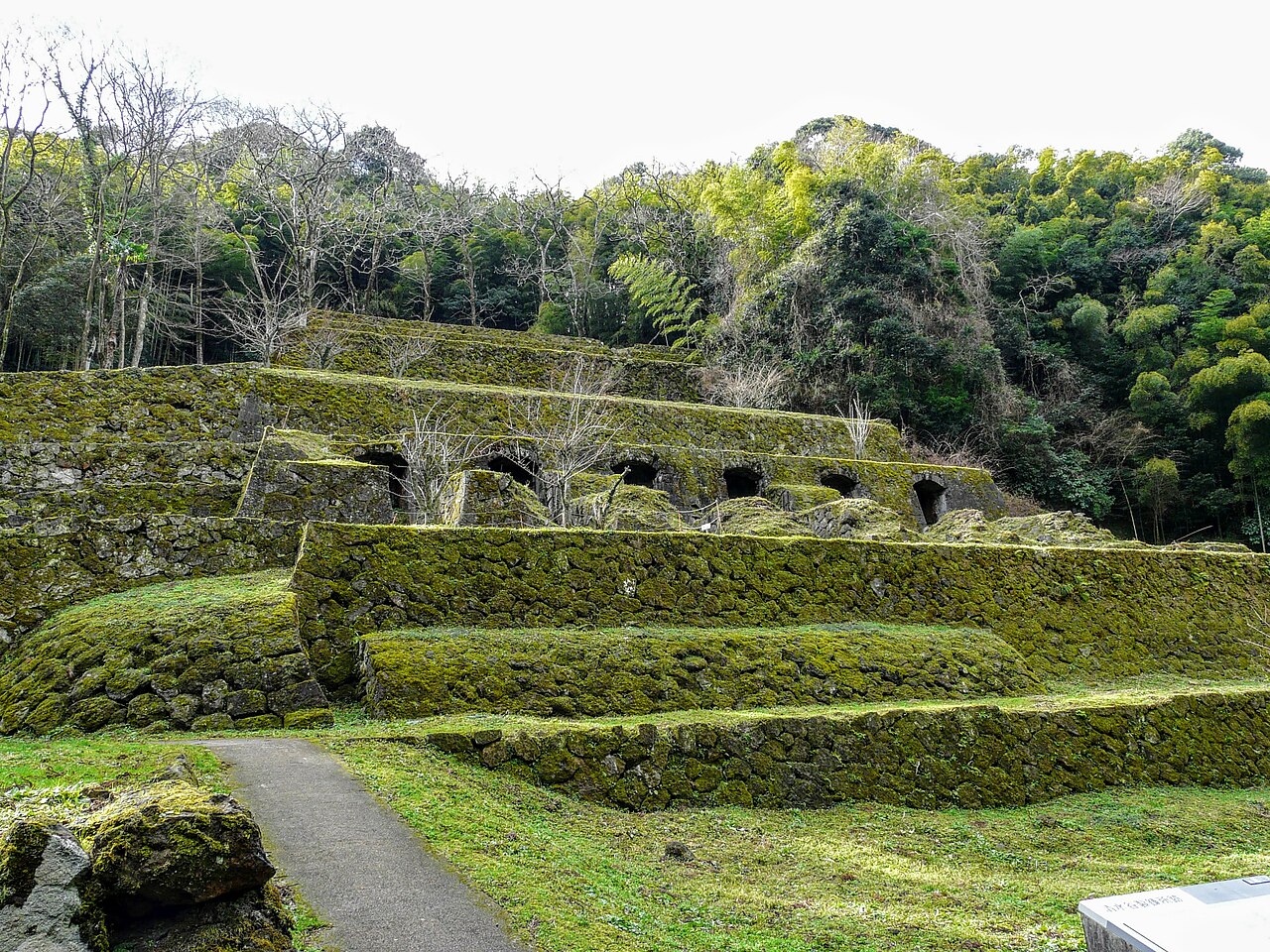
The Iwami Ginzan Silver Mine and its Cultural Landscape, inscribed by UNESCO in 2007, was the world’s most productive silver source in the 1580s, supplying an estimated one-third of global silver output during peak extraction. The site in Oda City, Shimane Prefecture, preserves the complete operational landscape: 700 mine shafts in the Nishimikawa gold deposit, valley processing facilities and furnace foundations, and the intact port-route town of Tomogaura at the estuary. At peak activity the area supported a population of 200,000 and 53 active religious sites.
The San’in coast and western Honshu Hiroshima · Miyajima · Himeji — 240 to 400 km
Two hundred forty kilometres east of Iwami Ginzan by limited express to Hiroshima (approximately 2 hours), the paired Hiroshima UNESCO inscriptions represent the dominant heritage cluster of western Honshu. Itsukushima Shrine on Miyajima Island was patronized by the Taira clan in 1168 CE — a period when Iwami Ginzan’s silver deposits had not yet been identified or exploited. The shrine’s position as the ritual centre of the Seto Inland Sea maritime corridor directly parallels the mine’s role as the commercial centre of the same geography two centuries later: both sites owed their significance to control over the sea routes through which the Seto Inland Sea connected western Japan to external trade. The silver from Iwami Ginzan moved through the Seto Inland Sea ports to Dutch and Portuguese merchants; the O-torii gate of Itsukushima marked the same passage as a sacred threshold. From Oda City (the nearest Shinkansen station to the mine), the Hiroshima sites are reached by limited express on the JR Sanyo Line (80 minutes) to Hiroshima, with the Miyajima ferry an additional 35 minutes from Hiroshima Station.
Two hundred forty kilometres east by the same route, the Hiroshima Peace Memorial stands 20 minutes by JR and ferry from Itsukushima Shrine. The A-Bomb Dome — the ruin of the 1915 Industrial Promotion Hall preserved unreconstructed since the detonation of 6 August 1945 — stands in the centre of the city that Iwami Ginzan’s silver trade helped establish as western Japan’s primary commercial hub. Hiroshima’s 16th-century growth as a port city was directly connected to the silver traffic from Shimane through the Seto Inland Sea; the castle town established by Mori Terumoto in 1589 was intended to manage exactly this commercial geography. The connection between the silver mine’s 16th-century commercial significance and the modern industrial port that the atomic bomb destroyed in 1945 is one of the longer historical arcs available in western Japan’s UNESCO inventory. From the mine site, the Peace Memorial is reachable in the same 2-hour limited-express connection as the Itsukushima Shrine ferry connection.
Three hundred eighty kilometres east by Sanyo Shinkansen from Hiroshima to Himeji (approximately 55 minutes) — reached via the Hiroshima connection — Himeji Castle is the most architecturally complete surviving feudal castle in Japan. The 83-building complex was completed in 1609, during the period when the Iwami mine was transitioning from peak extraction under Tokugawa state administration. The mine’s silver had financed, in part, the military campaigns that established Tokugawa dominance after the Battle of Sekigahara in 1600; the castle at Himeji was built by a Tokugawa vassal in exactly this period as a regional expression of the shogunate’s new authority. The two sites — mine and castle — document consecutive phases of the same political transition: the silver wealth of the Sengoku period feeding the construction of the Edo-period fortress system that stabilized Japan for 250 years. From Iwami Ginzan, Himeji requires the Hiroshima Shinkansen connection and approximately 3.5 hours total travel.
Four hundred kilometres southwest of Iwami Ginzan by Shinkansen from Hiroshima to Hakata and limited express to Nagasaki (approximately 3.5 hours from Oda City), the Hidden Christian Sites in the Nagasaki Region preserve the material legacy of a faith that survived 250 years of legal prohibition in the same western Japan maritime world that the Iwami Ginzan silver trade had organized. The 12 inscribed properties — churches, ruins, village sites, and the Hara Castle ruins — document the period from the first executions of 1597 through the discovery of the hidden communities in 1865. The Ooura Cathedral in Nagasaki, completed in 1865 and designated Japan’s only Western-style National Treasure, faces the former Dutch trading post of Dejima across Nagasaki harbour — the same Dutch commercial connection that had made Nagasaki the conduit through which Iwami Ginzan silver reached European markets during the isolation period (1639–1853). From Oda City, Nagasaki is most efficiently reached by limited express east to Hiroshima and Shinkansen south to Hakata and Kamome onward.
East toward Kansai and the Japanese heartland Kyoto · Nara · Kii Mountains — 480 to 600 km
Four hundred eighty kilometres east of Iwami Ginzan by limited express to Hiroshima (2 hours) and Shinkansen to Kyoto (90 minutes), the 17 properties of the Historic Monuments of Ancient Kyoto represent the court civilization that provided the administrative framework within which the Iwami Ginzan mine operated. The Tokugawa shogunate that administered the mine from 1600 maintained the emperor in Kyoto as the source of ritual legitimacy while governing Japan from Edo; the silver minted into Tokugawa coinage at the Edo mint circulated as the currency of the same empire. The Kyoto properties — Kinkaku-ji, Ryoan-ji, Nijo Castle, Byodoin — represent this administrative tradition at its most aesthetically accomplished. Nijo Castle, built for the first Tokugawa shogun’s visit to Kyoto in 1603 and equipped with corridors that squeak under footstep pressure to alert guards, was constructed in exactly the decade when Iwami Ginzan silver production was at its Tokugawa-period peak. The two sites can be combined in a single day from either the Hiroshima overnight base (Shinkansen to Kyoto from Hiroshima) or from a Kyoto base with an extension day to Hiroshima and the mine by limited express.
Five hundred kilometres east by the same Hiroshima–Shinkansen route, the Historic Monuments of Ancient Nara — Japan’s first permanent capital, 710–784 CE — predate the silver mining era by seven centuries but document the court tradition that created the administrative vocabulary the Tokugawa shogunate later adapted. Todai-ji’s Great Buddha Hall, the world’s largest wooden building at two-thirds the post-fire 1709 reconstruction scale, was built with the full Buddhist state apparatus of the Nara period and still receives millions of visitors annually in the company of 1,200 deer classified as National Natural Monuments since the 8th century. From Iwami Ginzan, Nara requires the same Hiroshima–Kyoto Shinkansen connection plus Kintetsu onward (approximately 4.5 hours total from Oda City).
Five hundred kilometres east, the Buddhist Monuments in the Horyu-ji Area in Ikaruga contain the world’s oldest surviving wooden buildings — 48 structures from the 7th and 8th centuries. Horyu-ji predates the Nara period’s state Buddhism by a century and represents the Asuka-period introduction of Buddhist architecture to Japan from the Korean Peninsula’s Baekje kingdom. The Five-Storey Pagoda’s central pillar system, absorbing earthquake energy independently of the surrounding floors, has protected the structure since the early 8th century. From Iwami Ginzan, Horyu-ji requires the Hiroshima Shinkansen connection to Kyoto and JR Yamatoji Line to JR Horyuji Station (approximately 5 hours total), making it practical as an extension of a Kansai UNESCO circuit rather than a direct trip from Shimane.
Six hundred kilometres east, the Sacred Sites and Pilgrimage Routes in the Kii Mountain Range document the mountain asceticism tradition that the commercial world of the Seto Inland Sea ports — including the silver trade ports that the Iwami mine used — supported economically. The merchant classes of Osaka and the port towns donated to Kumano shrine construction and funded the pilgrimage infrastructure of the Kii corridor. The Okunoin cemetery at Mount Koya, with 200,000 stone markers around the founder Kukai’s mausoleum, includes grave monuments donated by merchant houses, domain lords, and corporate entities from the Edo period. From Iwami Ginzan, the Kii Mountains are most accessible by limited express to Hiroshima, Shinkansen to Shin-Osaka, and Nankai Koya Line to Koyasan (approximately 5.5 hours total).
Practical information
Iwami Ginzan is in Oda City, Shimane Prefecture, which is on the JR Sanin Line along the Japan Sea coast. The nearest Shinkansen access is from Hiroshima Station (JR Sanyo Line to Oda City, limited express approximately 80 minutes) or from Okayama Station (JR Hakubi Line and Saijo Line route, approximately 2.5 hours). The UNESCO site is accessed from Oda City Station by community bus (approximately 20 minutes to the Omori Ginzan bus stop) or by taxi. The Omori Ginzan historic district — the preserved mining town at the foot of the mine mountain — contains the Iwami Ginzan World Heritage Center museum, the preserved merchant houses and sake breweries of the Edo-period town, and the start of the trail system into the mine mountain. The Ryugenji Mabu mine shaft (160 metres accessible) is open for visits with headlamps. The Kumagai Family Residence, a restored merchant house, is furnished with Edo-period domestic objects and open for guided tours. The full circuit of the UNESCO inscription, including the Tomogaura port area (7 kilometres from Omori by trail or road), requires a full day. The Iwami Ginzan World Heritage Center is open Tuesday through Sunday, closed Monday. Accommodation in the Omori historic district is limited; most visitors base themselves in Oda City or Matsue (1 hour north by limited express).
Frequently Asked Questions
Why was Iwami Ginzan Silver Mine the world’s most productive in the 1580s?
Iwami Ginzan’s peak productivity in the 1580s coincided with three converging factors: the adoption of a new cupellation technique from China that dramatically improved silver recovery from ore, the stabilization of the region under the Mori clan’s military control which allowed uninterrupted extraction, and the arrival of Portuguese and Dutch merchants at the Hakata and Sakai ports who created an export demand that made maximum extraction commercially rational. The mine’s ore was processed using a cupellation method — heating silver-bearing lead ore to separate the silver through oxidation of the lead — that was introduced from Chinese technical knowledge in the 16th century. At peak production, the mine required 200,000 workers, suppliers, administrators, and their families in the surrounding area. One-third of global silver supply is a figure derived from the contemporary Portuguese merchant accounts that recorded Iwami Ginzan silver in the Asian silver-for-Chinese-silk trade that linked Japan, China, Spain, and the Portuguese empire. The actual proportion is debated by historians, but the general order of magnitude is accepted: Iwami Ginzan silver was significant enough to affect the silver supply of Ming China and the global price of silver in the late 16th century. Production declined through the 17th and 18th centuries as the shallow ore bodies were exhausted and deeper mining required increasingly expensive dewatering technology; the mine continued in reduced operation through 1923 before being permanently closed.
What does the Iwami Ginzan UNESCO inscription actually protect and present to visitors?
The UNESCO inscription covers a core zone of 529 hectares and a buffer zone of 3,394 hectares, encompassing the mine mountain (Ginzan), the Tomogaura port area, and the preserved historic town of Omori. Within the mine mountain, 700 shaft openings — tamago-an (egg-holes) in the local terminology — survive in various conditions from intact to partly collapsed; one shaft (Ryugenji Mabu) is preserved and lit for public access to a depth of 160 metres. The valley below the mine mountain holds the stone foundations of multiple ore-processing and furnace facilities from the Edo-period operation; the earthworks are overgrown and require some orientation to interpret. The Omori historic district presents the Edo-period commercial and residential landscape of the mining administration: preserved sake breweries, merchant houses, the domain administrator’s residence, and the grid of the Edo-period town plan. The Tomogaura port area, 7 kilometres from Omori via a maintained heritage trail, preserves the 16th and 17th-century port infrastructure through which the refined silver was shipped. The total site is best understood through the Iwami Ginzan World Heritage Center museum in Omori, which provides the geographic, technical, and historical context that the physical remains require. The site rewards slow exploration — the combination of intact Edo-period townscape and the forest-covered mine remains is unlike any other UNESCO industrial site in Japan.
What is the best route to combine Iwami Ginzan with the Hiroshima UNESCO sites?
The most efficient combination is a 2-day circuit from either Hiroshima or Kyoto. From Hiroshima: Day 1, limited express from Hiroshima to Oda City (80 minutes), bus to Omori Ginzan (20 minutes), full day at the mine site, overnight in Oda City or Matsue. Day 2, return limited express to Hiroshima (80 minutes), JR to Miyajimaguchi and ferry to Miyajima (35 minutes total), morning at Itsukushima Shrine, afternoon at the Hiroshima Peace Memorial Museum. From Kyoto: the circuit requires an additional Shinkansen leg — Kyoto to Hiroshima (90 minutes) before the Sanin Line connection — making a 3-day circuit the most comfortable option. The JR San’in Kinki Pass (7 days) covers the Sanin Line from Hiroshima to Matsue and Oda City, the Shinkansen to Kyoto, and the JR lines within the Kinki region, making it the most economical pass for a western Japan circuit that includes Iwami Ginzan. The mine site itself can be covered in a full day; the Tomogaura trail extension adds approximately 3 hours to the visit if included. Cars are available for hire at Oda City Station, which simplifies the Tomogaura segment that is otherwise served only by intermittent community bus.
Sources
- S1 — UNESCO World Heritage Centre — Iwami Ginzan Silver Mine and its Cultural Landscape (Ref. 1246) — https://web.archive.org/web/20230601000000/https://whc.unesco.org/en/list/1246/
- S2 — UNESCO World Heritage Centre — Statement of Outstanding Universal Value (Ref. 1246) — https://whc.unesco.org/en/list/1246/
Spotted an error? Write to editorial@culturalheritageonline.com and we correct it the same day.