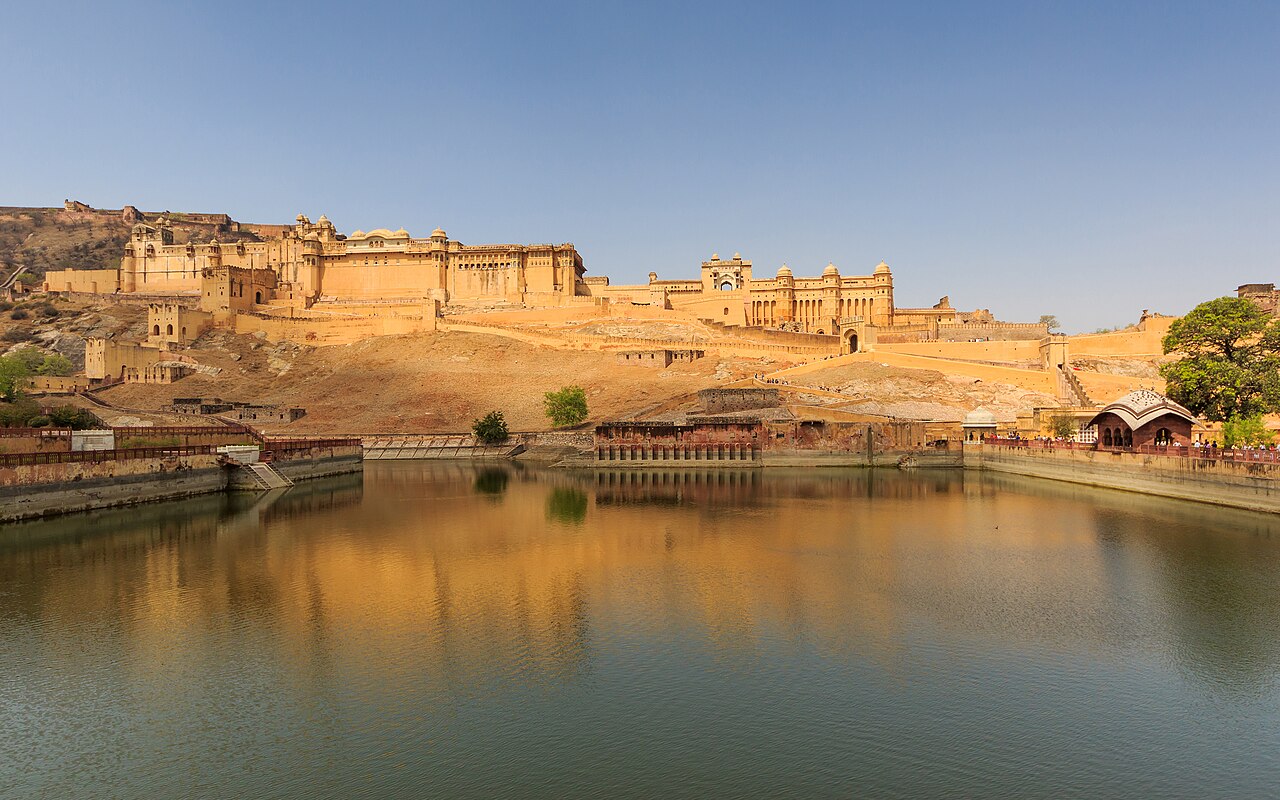
The Hill Forts of Rajasthan (राजस्थान के पहाड़ी किले), inscribed by UNESCO in 2013, is a serial heritage inscription comprising six Rajput fortresses on hilltops and ridges of the Aravalli Range in northwestern India — Chittorgarh Fort (the largest hill fort in India, 691 acres, the former capital of the Mewar kingdom and the site of three Jauhar mass self-immolation events 1303, 1535, and 1568 CE during successive conquests), Kumbhalgarh Fort (the second-longest wall in Asia after the Great Wall of China at approximately 36 km in perimeter, built 1443–1458 CE by the Mewar ruler Rana Kumbha in the Aravalli hills 80 km north of Udaipur), Ranthambore Fort (within the Ranthambore National Park, one of the most important tiger reserves of India, the fort historically commanded the passes through the Aravalli-Vindhya junction where it stands), Gagron Fort (a water fort at the confluence of the Ahu and Kali Sindh rivers, the only naturally moated fort in Rajasthan), Amber Fort (the former capital of the Kachchwaha Rajput clan near Jaipur, the most architecturally refined of the six — built 1592–1727 CE and transitioning from Rajput defensive architecture to Rajput-Mughal palace architecture under rulers who served as high officers in the Mughal imperial administration), and Jaisalmer Fort (the “Golden Fort”, still inhabited by approximately 3,000 permanent residents within its walls, built 1156 CE in yellow Trikuta sandstone in the Thar Desert, the only living fort town in India and the westernmost of the series).
The Hill Forts of Rajasthan as a serial UNESCO inscription — Amber Fort and the Jaipur corridor Amber Fort · Jaipur Walled City · Ranthambore National Park — 0 to 160 km
The serial inscription’s Outstanding Universal Value rests on the collective documentation it provides of the Rajput clan system of military and political organisation (the Rajput clans — Mewar, Kachchwaha, Chahamana, and others — maintained semi-independent kingdoms in the Aravalli mountain region for approximately 600–1,000 years, alternately resisting and accommodating successive external powers including the Gurjara-Pratiharas, Delhi Sultanate, Mughals, and Marathas) — the six forts together represent the military architecture, palace architecture, and hydraulic engineering (each fort has sophisticated water harvesting and storage systems capable of sustaining populations of thousands for months without external water supply) of this political tradition at different scales and in different ecological settings. Amber Fort (Amer Qila, approximately 11 km north of Jaipur city centre, the most visited of the six Hill Forts with approximately 1.5 million visitors annually, accessible by road 30 minutes from Jaipur city centre or by the heritage jeep service from the fort base) is the one most architecturally influenced by the Mughal court aesthetic — the Kachchwaha clan rulers Man Singh I (r. 1589–1614 CE, the Mughal Emperor Akbar’s most important Rajput general, present at the Mughal court as a Mansabdar noble) and Jai Singh I (r. 1621–1667 CE) built the fort’s palace complex in a synthesis of Rajput and Mughal spatial and decorative traditions. The palace complex within Amber Fort contains: the Diwan-i-Am (Hall of Public Audience, in a Rajput-Mughal mixed style with columns in white marble and sandstone and a carved marble throne niche for the ruler); the Sheesh Mahal (Palace of Mirrors, the private audience hall of the maharajas, its ceiling and walls entirely covered with tiny convex mirror pieces set in floral plaster patterns — when a single candle flame is placed in the room, the mirror-covered ceiling appears as a galaxy of reflected stars, the most spectacular interior of any of the six forts); the Sukh Niwas (Hall of Pleasure, with a marble screen facing the Maota Lake through which natural breezes were channelled over a channel of cold water and perfumed with flowers to air-condition the hall — a Mughal-derived passive cooling technique using evaporative cooling from the lake on the breeze’s path); and the Jai Mandir (Temple of Victory, with glass tile and marble inlay decoration comparable in intricacy to Mughal pietra dura work). The fort’s commanding position above Maota Lake (the lake approximately 300 m below the fort’s southeastern walls, with a charbagh garden on the lake island connected by a causeway) provides the most photographed heritage landscape in Rajasthan — the amber-yellow sandstone fort walls reflected in Maota Lake at sunrise is among the most widely reproduced images of Indian heritage.
Jaipur Walled City (UNESCO inscribed separately in 2019, approximately 11 km south of Amber Fort, connected by the main road through the Aravalli foothills) is the directly complementary UNESCO heritage site — planned by Maharaja Sawai Jai Singh II (r. 1699–1743 CE) in 1727 CE on a grid plan derived from ancient Hindu urban planning texts (Vastu Shastra, specifically the Pithapada grid), the walled city is the most important intact example of early 18th-century planned urban design in India and includes the Jantar Mantar astronomical observatory (UNESCO-inscribed separately in 2010, in the Palace of the Winds district of the walled city — the most important of five astronomical observatories built by Jai Singh II between 1724 and 1735 CE, with masonry instruments of extraordinary scale designed to make naked-eye astronomical measurements of unprecedented accuracy for the pre-telescope era). Ranthambore National Park (160 km southwest of Jaipur by road, the fort within the park accessible by park entry, the park itself one of India’s premier tiger-watching reserves with Bengal tiger population approximately 60–70 individuals visible year-round) combines the UNESCO fort and the wildlife tourism of one of India’s most photogenic tiger reserves — the Ranthambore tigers are famously accustomed to human presence and often visible in proximity to the fort ruins and the park’s ancient temples, providing the unusual experience of Bengal tigers in a landscape of medieval Rajput architecture.
Practical information
The Hill Forts of Rajasthan serial inscription comprises six separate forts across Rajasthan state, requiring different journeys from Jaipur (the most convenient base for the eastern forts): Amber Fort (11 km north of Jaipur, 30 minutes by road, by auto-rickshaw or bus from the Jaipur city centre, or jeep service from the fort base — the most accessible of the six forts, open daily 08:00–17:30, admission fee standard); Jaisalmer Fort (564 km west of Jaipur, best reached by overnight train from Jaipur or Jodhpur, 2 hours from Jodhpur — open daily 06:00–18:00, free entry to the inhabited fort town, museum charges apply); Chittorgarh Fort (316 km south of Jaipur, accessible by train from Jaipur to Chittorgarh town, 5 hours — the largest hill fort in India at 691 acres, open daily 07:45–18:00); Kumbhalgarh Fort (369 km southwest of Jaipur, 90 km from Udaipur — best combined with Udaipur visit, open daily 08:00–18:00); Ranthambore Fort (160 km southeast of Jaipur, within Ranthambore National Park — park entry required, combined tiger safari and fort visit recommended, open during park season October–May); Gagron Fort (530 km south of Jaipur, near Jhalawar city). Visiting all six in a single trip requires 5–7 days minimum and is best approached by renting a car from Jaipur for the circuit. Amber Fort alone plus Jaipur city (Jantar Mantar, Hawa Mahal, City Palace) provides a rich 1-day itinerary for visitors with limited time. Best season for Amber Fort and Jaipur: October–February (cool and dry, 10–26°C, clear Aravalli skies). Kumbhalgarh has a Sound and Light show on certain evenings in the fort that is among the finest in Rajasthan. Jaisalmer is best in winter (November–February) and impractical in summer (temperatures regularly exceed 45°C in the fort).
Frequently Asked Questions
What is the Sheesh Mahal at Amber Fort and why is it architecturally significant?
The Sheesh Mahal (شیش محل, “Palace of Mirrors”, also called Jai Mandir in some sources — the terminology overlaps and is used inconsistently in the fort’s historical records and signage) at Amber Fort is the private audience and pleasure hall of the Kachchwaha maharajas — built in the period of Mirza Raja Jai Singh I (r. 1621–1667 CE) using Belgian glass mirror tiles, coloured glass, and gilded plasterwork in a composite decorative technique derived simultaneously from the Mughal court aesthetic (the Sheesh Mahal type was pioneered at the Lahore Fort by the Emperor Shahjahan approximately 1631–1632 CE) and from the indigenous Rajasthani mirror mosaic tradition. The hall’s ceiling and walls are entirely covered with convex mirror pieces (approximately 1 cm in diameter, set in floral and geometric plaster reliefs in white lime plaster mixed with gypsum and egg white) so that a single small lamp or candle placed in the room creates the visual effect of a star-filled night sky — the convex mirror pieces each reflect a distorted image of the flame, producing hundreds of tiny flame reflections at different angles and distances that appear to float at different heights across the ceiling. The technique was simultaneously a showcase of the Kachchwaha court’s access to luxury imports (Belgian glass was imported via the Portuguese trade networks and then through Mughal-era overland routes from the Gujarat coast, 1,100 km to the southwest), an assertion of royal prestige through the scale of the commission, and a practical adaptation to the Rajasthan climate (the mirror surface creates a visual cooling effect — the glittering reflective interior appears lighter and more airy than a plain plaster ceiling, an important aesthetic property in a desert kingdom where the oppressive summer heat is the constant environmental condition). The mirrors are set against a ground of elaborate floral plasterwork in the Mughal arabesque tradition (roses, irises, lilies in plaster relief), with the same flower and plant vocabulary that appears in the pietra dura inlay of Mughal Agra — the parallel development of floral ornament in two different materials (mirror-set plaster in Rajasthan, semi-precious stone inlay in Agra) demonstrates the shared aesthetic programme of the Rajput-Mughal political alliance of the 17th century, in which Rajput nobles served as Mughal generals and Mughal architectural influence permeated Rajput court art.
What happened at Chittorgarh in 1303, 1535, and 1568 CE and why are these events significant in Rajput history?
Chittorgarh Fort (Chittor, approximately 316 km south of Jaipur, the seat of the Mewar kingdom — the most powerful and prestigious of the Rajput clans in historical memory, whose rulers traced their lineage to the sun god Surya through the Suryavanshi dynasty) was the site of three events of mass self-immolation called Jauhar (जौहर, the ritual collective suicide of women and children of the fort’s defending garrison to avoid capture and enslavement, conducted simultaneously with or immediately preceding the suicidal counter-assault by the male warriors — called Saka (शाका), in which the men donned saffron robes and fought to the death against the besieging army) that have become the defining events of Rajput martial culture. The first Jauhar (1303 CE) occurred when the Delhi Sultanate ruler Alauddin Khalji (r. 1296–1316 CE, Alauddin Khalji who later built the Alai Darwaza at the Qutb Minar complex) besieged Chittor and eventually breached the fort — the specific narrative of this Jauhar, given literary form in the 16th-century Rajput bardic poem Padmavat by Malik Muhammad Jayasi (a Muslim poet writing in Awadhi language, approximately 1540 CE), attributes the siege to Alauddin Khalji’s desire to possess the legendary beauty of Padmavati (Padmini), queen of the Mewar ruler Ratan Singh — a narrative almost certainly legendary rather than historical (the Persian chronicle sources for Alauddin Khalji’s reign, which are detailed and reliable on his military campaigns, do not mention Padmavati) but of enormous cultural influence in subsequent Rajput literary and bardic tradition. The second Jauhar (1535 CE) occurred when the Gujarat Sultanate ruler Bahadur Shah (r. 1526–1537 CE) besieged and captured Chittor — this event is documented in both Mughal and Rajput sources, making it the best-documented of the three Jauhars. The third Jauhar (1568 CE) occurred when the Mughal Emperor Akbar personally led the siege of Chittor — the Mughal chronicler Abu’l-Fazl in the Akbarnama records the event with specific casualty figures (he states that approximately 30,000 people died in the fort during and after the siege), while noting that Akbar was distressed by the scale of the carnage. The political significance of these events in modern India has been contested: the three Jauhars are central to Rajput ethnic pride and political identity in Rajasthan (the Karni Sena organisation that violently protested the 2018 Bollywood film Padmaavat, arguing that the film disrespected the memory of Padmavati/Padmini, represents a tradition of treating the Chittorgarh Jauhars as sacred events beyond historical reinterpretation), while academic historians approach them as historical tragedies whose cultural glorification raises questions about the ideological construction of warrior-caste honour culture.
What makes Kumbhalgarh Fort’s perimeter wall the second-longest in Asia?
Kumbhalgarh Fort (Kumbhalgarh, approximately 360 km southwest of Jaipur, 82 km north of Udaipur in the Aravalli hills — at an altitude of approximately 1,100 m, built by the Mewar ruler Rana Kumbha 1443–1458 CE on a ridge of the Aravalli mountains) has a perimeter wall (the outer rampart enclosing the fort and its subsidiary settlements) approximately 36 km in total circumference, which is described in Indian tourism literature as “the world’s second-longest wall after the Great Wall of China”. The comparison requires some qualification — the Great Wall of China’s total extent (depending on which of its many separate sections and construction periods are measured) is typically stated as approximately 21,196 km (the 2012 National Administration of Cultural Heritage China survey figure including all branches and periods), while Kumbhalgarh’s 36-km perimeter is the longest single continuously encircling fortification wall of any single fort or city in the world, making it more specifically “the world’s longest single enclosed fortification perimeter” rather than the second-longest “wall” (the Great Wall is not a perimeter enclosure but a frontier barrier). The wall’s construction required approximately 15 years (Rana Kumbha began in 1443 CE and the work continued until his reign’s end, with sections completed at different dates) and used locally quarried Aravalli granite in a rubble-and-mortar construction method — the wall varies in width from approximately 15 feet (approximately 4.6 m) at the narrowest to reportedly wide enough for eight horses to ride abreast at the wider sections, though this figure appears to be a traditional description rather than a precisely measured average. The wall encloses not only the fort’s primary palace and military structures (on the highest point of the ridge at approximately 1,100 m elevation, within an inner wall of approximately 4 km perimeter) but also the 360+ subsidiary temples and structures within the outer fortification area — including the famous Badal Mahal (Palace of Clouds, a tower at the summit of the fort from which, on clear days in the monsoon season, views extend over approximately 100 km of the Aravalli range). The walls are lit up on a weekly Sound and Light show schedule that makes them dramatically visible against the night sky of the Aravalli hills from 10–15 km distance — a heritage experience that is more impressive than the fort’s interior during the day precisely because the sheer scale of the perimeter wall is comprehensible only from a distance at which the full circumference is visible.
EXCERPT: Hill Forts of Rajasthan, UNESCO-inscribed in 2013, is a serial inscription of six Rajput fortresses — Amber Fort’s Sheesh Mahal mirror ceiling near Jaipur, Kumbhalgarh’s 36-km perimeter wall (the world’s longest single enclosed fortification perimeter), Chittorgarh’s three Jauhar sites, and Jaisalmer’s living fort town in yellow Thar Desert sandstone, spanning 600 years of Rajput clan history in the Aravalli hills.
META: UNESCO World Heritage Sites near Hill Forts of Rajasthan India: Jaipur City 11 km from Amber Fort (UNESCO 2019), Ranthambore National Park within serial inscription (UNESCO 2013), Keoladeo National Park Bharatpur 190 km east of Amber Fort (UNESCO 1985) — Rajasthan UNESCO heritage circuit from Amber Fort and Jaipur through the Aravalli hills to Chittorgarh, Kumbhalgarh, and Jaisalmer.
Sources
- S1 — UNESCO World Heritage Centre — Hill Forts of Rajasthan (Ref. 247) — https://web.archive.org/web/20230601000000/https://whc.unesco.org/en/list/247/
- S2 — UNESCO World Heritage Centre — Statement of Outstanding Universal Value (Ref. 247) — https://whc.unesco.org/en/list/247/
Spotted an error? Write to editorial@culturalheritageonline.com and we correct it the same day.