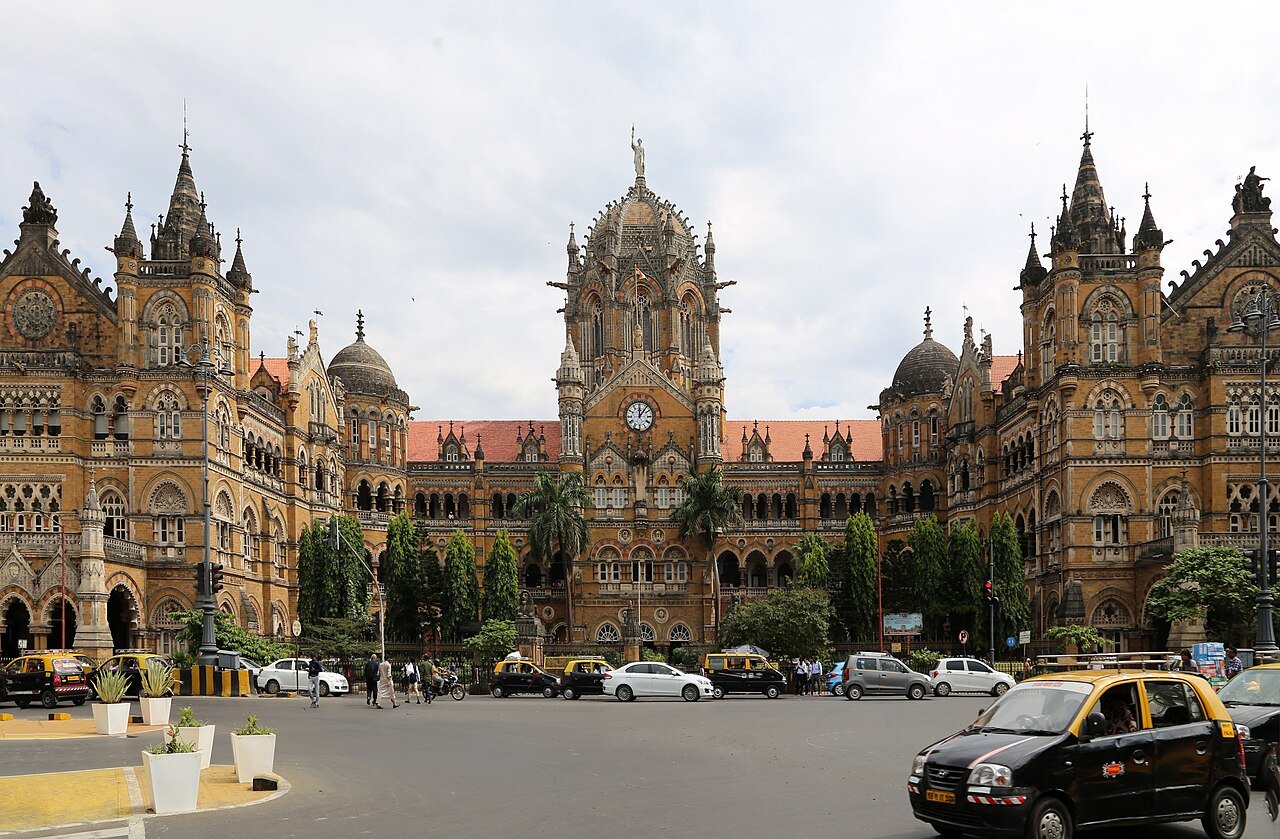
The Chhatrapati Shivaji Maharaj Terminus (CSMT, छत्रपती शिवाजी महाराज टर्मिनस, formerly Victoria Terminus), inscribed by UNESCO in 2004, is a Victorian Gothic Revival railway terminal in Mumbai — built 1878–1888 CE (construction period 10 years, an extraordinarily long construction time for a railway terminal reflecting both the ambition of the project and the complexity of its execution) by the architect Frederick William Stevens (1848–1900 CE, a British architect employed by the Bombay Municipal Corporation who also designed the Bombay Municipal Corporation Building, now the Brihanmumbai Municipal Corporation headquarters across the road from CSMT) for the Great Indian Peninsula Railway (GIPR) — the most architecturally significant Victorian Gothic Revival building outside Britain, fusing the High Victorian Gothic of Ruskin-influenced British architecture (the pointed arches, the polychrome stone construction, the Gothic-profile towers and turrets, the stone tracery windows) with specific Indian architectural decorative elements (peacocks, elephants, mythological animals, lotus motifs, Indian style brackets) in a synthesis that produced what the UNESCO inscription describes as “an outstanding example of Victorian Gothic Revival architecture in India, blending with traditional Indian architecture”. The terminal is still the world’s busiest railway terminus by number of passengers (approximately 3–4 million passengers per day, the highest daily throughput of any railway station on earth, serving the suburban network of Mumbai’s commuter railways — the “lifeline of Mumbai” — and the Indian Railways’ long-distance national network), which means it is a UNESCO World Heritage site in continuous operational use at the highest intensity of any heritage building in the world.
CSMT’s Victorian Mumbai and the Mumbai heritage architectural corridor CSMT · BMC Building · Crawford Market · Victorian Precinct · Art Deco Marine Drive — 0 to 4 km
The CSMT is the anchor monument of the “Victorian Gothic and Art Deco Ensembles of Mumbai” UNESCO inscription (2018 — a separate, larger inscription that encompasses CSMT and the broader Victorian Gothic precinct of South Mumbai plus the Art Deco Marine Drive apartments), which added the ensemble context to the individual building’s 2004 inscription. The area within walking distance of CSMT (approximately 500 m radius) concentrates the highest density of Victorian Gothic civic architecture in Asia: the Brihanmumbai Municipal Corporation Building (directly across the road, also by F.W. Stevens, with a matching dome, completed 1893 CE — the two buildings were designed as a pair that would frame the approach boulevard of what is now D.N. Road, creating an architectural set-piece of Victorian urban design); the Crawford Market (now Mahatma Phule Market, designed by William Emerson and completed 1869 CE, with exterior friezes designed by Rudyard Kipling’s father Lockwood Kipling — the only documented collaboration between Lockwood Kipling and a major Mumbai landmark, the friezes depicting Indian market life in carved stone above the market entrance archways); the High Court of Bombay (1879 CE, also Victorian Gothic, with the figure of Justice and figures of Mercy and Commerce on its towers); and the University of Mumbai’s Rajabai Clock Tower (1878 CE, designed by George Gilbert Scott on the model of Big Ben, with the faces of different Indian communities carved in medallions on the tower base). The coherence of this Victorian Gothic civic precinct — created over approximately 30 years (1860–1895 CE) by a handful of British colonial architects working within the High Victorian Gothic style but incorporating Indian decorative programmes — makes South Mumbai’s Fort area the most complete Victorian civic ensemble in Asia and the primary example of the specific architectural fusion of British Gothic and Indian decorative traditions.
The Victorian Gothic and Art Deco Ensembles of Mumbai (UNESCO 2018, the broader inscription that extends from CSMT/Fort area along Marine Drive to the Art Deco apartment buildings of the Oval Maidan and Marine Drive — the largest coherent Art Deco urban district in Asia, with approximately 94 apartment buildings from the 1930s–1940s designed in the Streamline Moderne and Deco style that was fashionable in the period of the buildings’ construction) is the natural walk extension from CSMT: approximately 3 km southward through the Fort area Victorian precinct (passing the High Court, the University Clock Tower, and the Oval Maidan with its cricket ground flanked by Gothic and Deco buildings facing each other across the grass in one of Mumbai’s most architecturally layered urban spaces) to the Marine Drive seafront.
Practical information
CSMT is in the Fort area of South Mumbai, accessible from any point in Mumbai by the Central and Harbour Line suburban railway (CSMT is the terminus of both lines, the largest passenger-volume railway station in India), by bus, or by taxi/auto-rickshaw. The building’s exterior can be photographed from the street at any time; the interior (the operational railway station with platforms, waiting halls, and the ticket concourses) is accessible as a railway passenger or by purchasing a platform ticket. The Gothic interior includes the original 1888 CE waiting hall ceiling with ribbed vaulting, the iron tracery of the platform roof, and the original Gothic Revival furniture and ticket windows in the booking halls. A heritage gallery documenting the building’s history and architecture is accessible from the main hall. Best photographed at dawn (dramatic light on the dome and towers in the east-facing aspect) or at dusk (warm light from the west illuminating the polychrome stone facade); the evening flood-lighting of the building is dramatic from the street. Heritage walks of the Victorian Gothic precinct are operated by multiple Mumbai heritage walk organisations and are the best way to contextualise CSMT within the broader Fort area ensemble. The Victorian Gothic and Art Deco Ensembles of Mumbai UNESCO site (2018) encompasses the broader heritage area of which CSMT is the anchor monument.
Frequently Asked Questions
Who was F.W. Stevens and how did he create the CSMT’s distinctive architectural style?
Frederick William Stevens (1848–1900 CE) was a British-born architect who arrived in Bombay (Mumbai) in 1867 CE as a draftsman with the Public Works Department of the Bombay government and became the most important architect of the Victorian period in Bombay, designing not only CSMT and the Brihanmumbai Municipal Corporation Building but also the Western Railway Headquarters Building at Churchgate (1899 CE, a comparable Venetian Gothic revival composition), the Watson’s Hotel (1869 CE, the first cast-iron prefabricated building in Asia), and numerous private residences and commercial buildings in Bombay’s Victorian Gothic building boom of the 1860s–1890s. Stevens’s approach to the CSMT commission (awarded by the Great Indian Peninsula Railway in 1878 CE, for a building that would serve as both a functional railway terminal and a monumental civic building representing the commercial ambition of the Bombay business community and the imperial authority of the British Raj) was explicitly synthetic: the dominant architectural vocabulary is High Victorian Gothic (the pointed arches, the polychrome stone construction alternating yellow Kurla stone and blue Daka stone, the Gothic profile towers, the stone tracery windows, the structural iron ribs of the platform roof visible inside the terminal hall) but the decorative sculpture programme (the exterior gargoyles, finials, brackets, and relief panels) specifically incorporates Indian zoological, botanical, and architectural motifs — peacocks at the tower bases, elephants at the entrance portal, lotus petal motifs in the spandrels of the entrance arches, stylised Mughal chhajja brackets under the Corinthian-derived capitals. Stevens articulated this design approach explicitly in his own notes on the building: he was attempting to create a specifically Indian Gothic, analogous to the way that Gothic architecture had incorporated regional sculptural traditions in France, Germany, and England while maintaining the structural Gothic framework. The CSMT’s dome (a small but visually prominent dome above the main building mass, in the profile of a lotus bud rather than a conventional Gothic dome — the one element of the composition that is most clearly derived from Indian rather than European precedent) is the most specific example of this synthesis: it sits visually above the Gothic spire and towers in a way that announces the building’s hybrid identity from across the Bori Bunder terminus forecourt. The UNESCO inscription text specifically acknowledges this hybridisation: “the impressive building (which) blends Victorian Italianate Gothic Revival architecture with themes associated with Indian traditional architecture” — the first UNESCO inscription to specifically recognise the value of colonial-period architectural synthesis rather than treating it as a degraded or inauthentic combination of pure traditions.
How did Victoria Terminus become Chhatrapati Shivaji Maharaj Terminus?
The renaming of Victoria Terminus (VT) to Chhatrapati Shivaji Terminus (CST) in 1996, and subsequently to Chhatrapati Shivaji Maharaj Terminus (CSMT) in 2017, is a specific instance of the broader programme of renaming colonial-period public institutions, streets, and cities across India and Maharashtra in the post-independence period — replacing names associated with the British colonial administration (Queen Victoria, Lord Elphinstone, Lord Sandhurst) with names from the pre-colonial Indian and specifically Maratha history. Chhatrapati Shivaji Maharaj (1630–1680 CE) was the founder of the Maratha Empire — the Hindu warrior-king of the Deccan who organised the Maratha clans into a military confederation that challenged Mughal authority in western India, established an independent Maratha kingdom with Raigad as its capital, and became the defining symbol of Marathi and Maharashtra cultural identity after his death. The renaming sequence was: the city of Bombay became Mumbai in 1995 (a restoration of the Marathi name, derived from the goddess Mumbadevi, whose temple predates the Portuguese and British presence at the location); Victoria Terminus was renamed Chhatrapati Shivaji Terminus in 1996; the city’s major airport (Sahar International Airport) was renamed Chhatrapati Shivaji International Airport in 1999; the statue of Prince Albert in the Bombay Museum grounds was replaced by a statue of Chhatrapati Shivaji Maharaj; and in 2017, “Maharaj” was added to the railway terminus name to complete it to the full honorific form (CSMT). The political significance of the renaming rested on the Maharashtra state government’s position that the original British colonial name honoured the imperial authority of Queen Victoria rather than the Indian history of the Bombay region, and that a building of such central importance to daily Mumbai life should carry a name reflecting the regional heroic tradition rather than the colonial past. The UNESCO inscription (2004) was filed under the building’s then-current name of “Chhatrapati Shivaji Terminus” and the current name “Chhatrapati Shivaji Maharaj Terminus” is both names’ successor — the UNESCO site registration uses the abbreviation “CST” in its documentation though the building’s formal signage uses “CSMT”.
EXCERPT: Chhatrapati Shivaji Maharaj Terminus (CSMT), UNESCO-inscribed in 2004, is a Victorian Gothic Revival railway terminal built 1878–1888 in Mumbai by F.W. Stevens — the world’s busiest railway station (3–4 million daily passengers) blending High Victorian Gothic with Indian decorative motifs in a UNESCO-designated building that is simultaneously a functioning transport hub.
META: UNESCO World Heritage Sites near Chhatrapati Shivaji Maharaj Terminus Mumbai India: Victorian Gothic and Art Deco Ensembles of Mumbai (same city, UNESCO 2018), Elephanta Caves 11 km offshore (UNESCO 1987) — South Mumbai Victorian Gothic architectural circuit, CSMT Fort area heritage walk, Brihanmumbai Municipal Corporation Building, Crawford Market Lockwood Kipling.
Sources
- S1 — UNESCO World Heritage Centre — Chhatrapati Shivaji Terminus (formerly Victoria Terminus) (Ref. 945) — https://web.archive.org/web/20230601000000/https://whc.unesco.org/en/list/945/
- S2 — UNESCO World Heritage Centre — Statement of Outstanding Universal Value (Ref. 945) — https://whc.unesco.org/en/list/945/
Spotted an error? Write to [email protected] and we correct it the same day.