
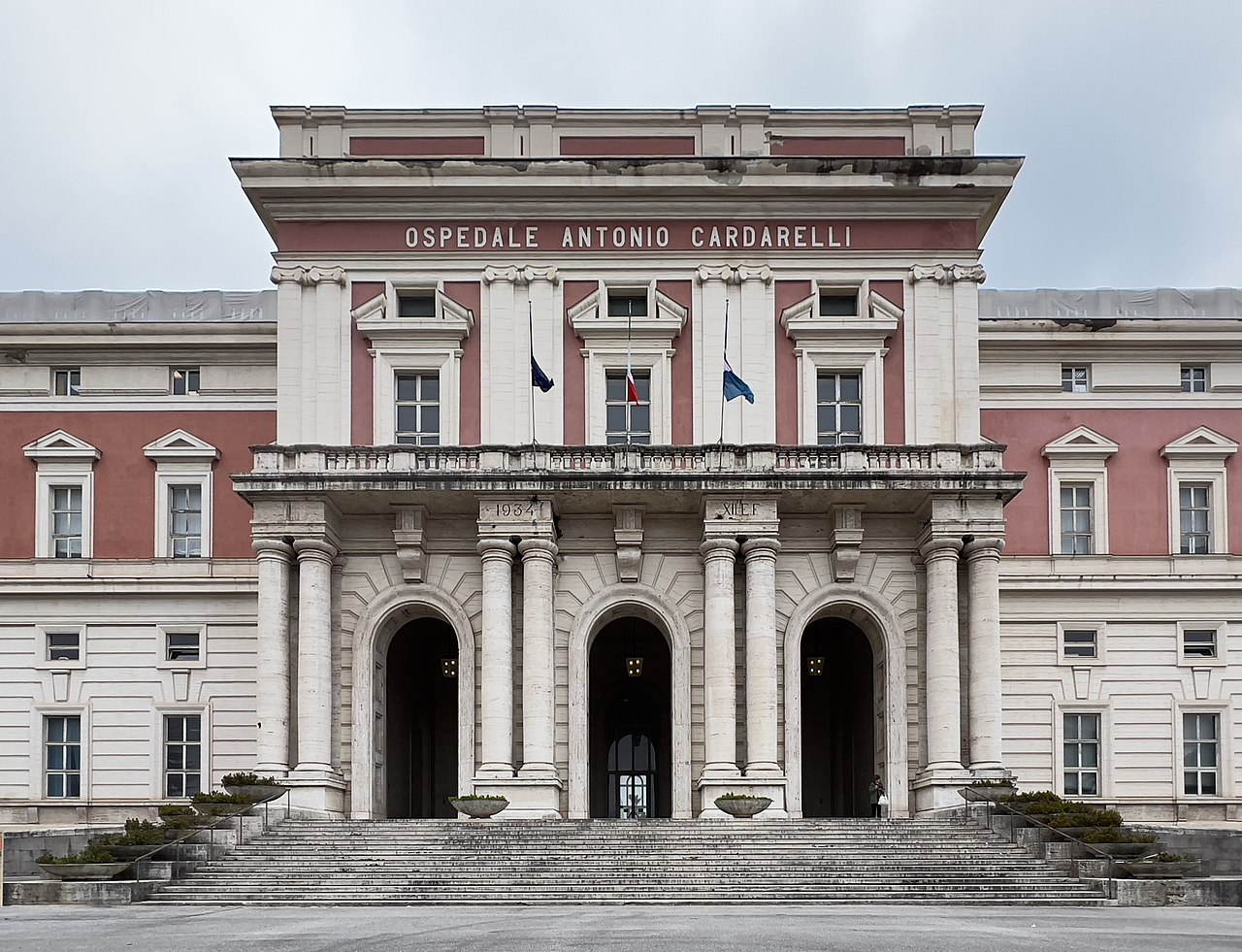
The Ospedale Antonio Cardarelli in Naples was designed by architect Alessandro Rimini and constructed between 1927 and 1934. The hospital represents a significant example of interwar Italian institutional architecture, commissioned during the period of modern healthcare expansion.
Rimini, born in Palermo in 1898, trained at the Academy of Fine Arts in Venice (graduating in 1921) and later studied architecture at the University of Padua. Before establishing himself in Milan as a specialist in cinema auditorium design, he undertook restoration work for the Superintendency of Trieste. His design for the Cardarelli brought together contemporary architectural principles with the functional demands of a major medical facility.
About the Ospedale Antonio Cardarelli
The hospital occupies a central position within Naples’s Hospital Zone and has developed into the largest medical institution in Campania and southern Italy. It now functions as both a hospital and university facility, housing multiple specialized departments and serving as a national centre of excellence in the treatment of severe burns.
Details
- Architect: Alessandro Rimini
- Construction period: 1927–1934
- Location: Hospital Zone, Naples, Campania
- Current status: Major university hospital and national healthcare facility
Explore more: 87 heritage places in Napoli
Frequently asked questions
Who designed the Ospedale Cardarelli?
Architect Alessandro Rimini designed the hospital. Rimini was trained in Venice and Padua, and later became known for designing cinema auditoriums in Milan before undertaking this major institutional commission.
Where is the Ospedale Cardarelli located?
The hospital is situated in the Hospital Zone of Naples, Campania, in southern Italy. It is the largest hospital in the region.
What was the building’s original purpose?
The Cardarelli was built as a modern hospital facility during the interwar period. It remains a functioning hospital today and serves as a university medical centre with specialized departments including burn treatment, poison control, and hepatic transplant services.
Sources
- S1 — Ciucci, Giorgio. Gli architetti e il fascismo: architettura e città 1922-1944. Einaudi, 1989. ISBN 978-88-06-11656-9.
- S2 — Danesi, Silvia, and Luciano Patetta, eds. Il razionalismo e l'architettura in Italia durante il fascismo. Electa, 1976. ISBN 978-88-435-0394-0.
Spotted an error? Write to editorial@culturalheritageonline.com and we correct it the same day.


