
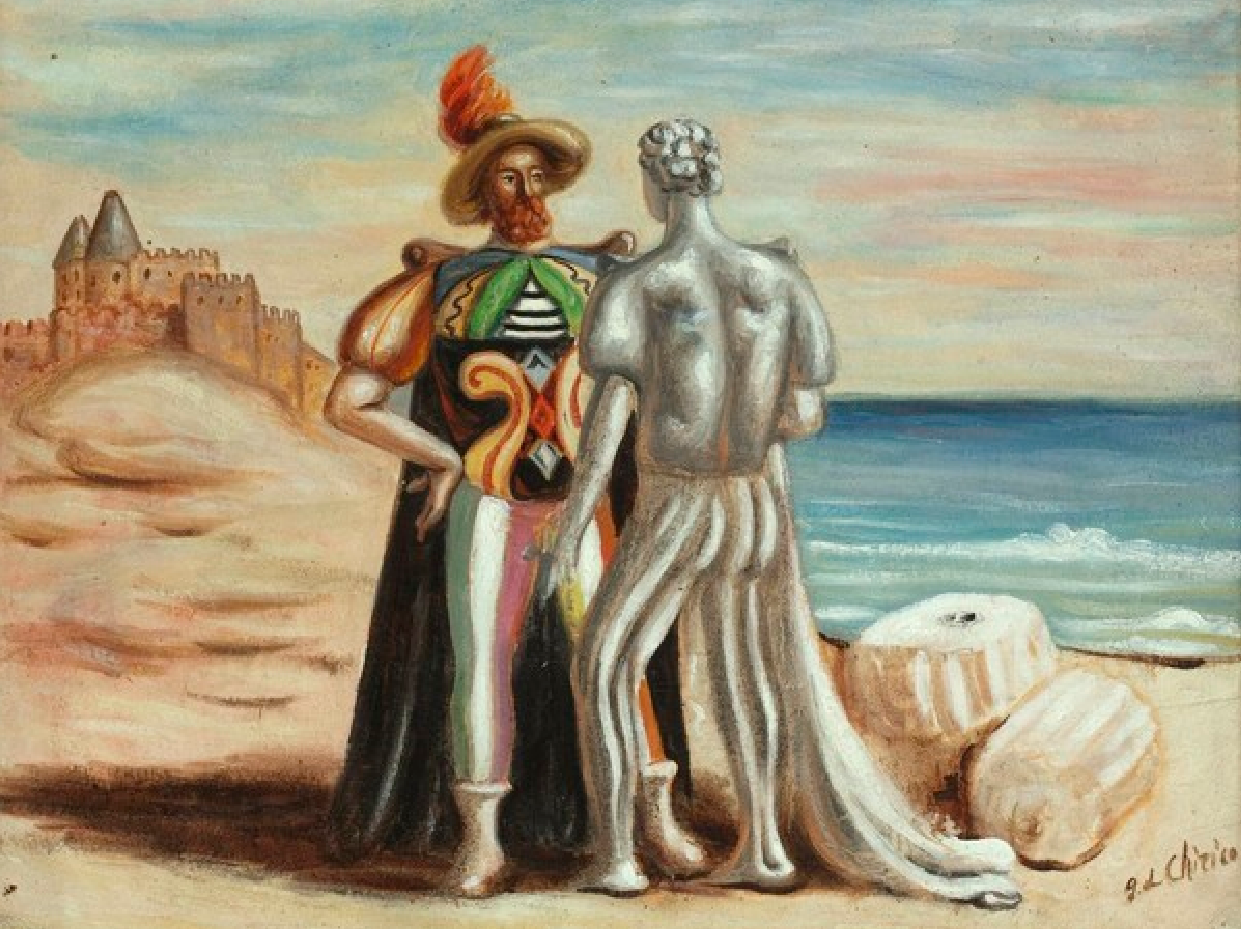
Personaggi sulla spiaggia is a 1933 painting by Giorgio de Chirico, the Greek-Italian artist and founder of the scuola metafisica (metaphysical art) movement. The work presents figures arranged on a beach, a composition typical of de Chirico’s exploration of enigmatic spaces and psychologically charged scenes.
De Chirico’s metaphysical approach, developed in the years before World War I, profoundly influenced the Surrealist movement. His imagery characteristically combines unusual perspective, stark spatial relationships, and a sense of disconnection from rational experience. The beach setting in this work provides an arena for de Chirico’s investigation of human presence within emptied or strangely configured spaces, reflecting his philosophical engagement with the work of Schopenhauer and Nietzsche, as well as the mythological traditions of his Greek birthplace.
About Giorgio de Chirico
De Chirico was born in Volos, Greece, and established himself as a pivotal figure in early twentieth-century avant-garde art. His metaphysical paintings and writings shaped modernist aesthetics and continue to influence contemporary practice across visual art and literature.
Details
- Artist: Giorgio de Chirico
- Year: 1933
- Movement: Scuola Metafisica (Metaphysical Art)
- Subject: Figures on a beach
On video
Frequently asked questions
Who was Giorgio de Chirico?
De Chirico was a Greek-Italian artist and writer born in Volos, Greece, who founded the metaphysical art movement before World War I. His work profoundly influenced the Surrealists and combined philosophical inquiry with visual experimentation.
What is metaphysical art?
The scuola metafisica (metaphysical school) pioneered by de Chirico is an art movement characterized by enigmatic spaces, illogical perspective, mannequins, long shadows, and a sense of psychological unease. It sought to express experiences beyond rational understanding.
What themes appear in de Chirico’s work?
De Chirico’s paintings frequently feature Roman arcades, trains, mannequins, and distorted spatial relationships. His imagery reflects his affinity for Schopenhauer and Nietzsche’s philosophy and draws on the mythology of his Greek origins.
Sources
- S1 — Pontiggia, Elena. Il Novecento Italiano. Abscondita, 2003. ISBN 978-88-8416-048-5.
- S2 — Bossaglia, Rossana. Il Novecento italiano. Electa, 1995. ISBN 978-88-435-6178-0.
Spotted an error? Write to editorial@culturalheritageonline.com and we correct it the same day.


