
A Malayic oral poetic form of intricate emotional expression, pantun pairs a prefatory couplet with a closing statement connected through rhyme, metaphor, and verbal wit rather than narrative logic.
In UNESCO’s words
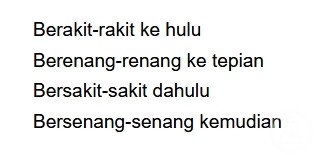
Pantun is a form of Malay verse used to express intricate ideas and emotions. It is a widespread oral form in maritime Southeast Asia. Pantun has a clear a-b-a-b rhyme scheme. The four-line variety is the most common. Pantuns may be transmitted in music, song and writing. Performances are headed by the ‘pemantun’ (the pantun narrator), the singers and customary chiefs. Most verses are devoted to expressing love for a romantic partner, family, the community and the natural world. Pantuns can be recited at weddings, customary rituals, cultural performances and official ceremonies. Knowledge and skills related to the element are transmitted formally in schools and artistic workshops, and informally through sessions and competitions. The practice offers a socially acceptable way to express oneself indirectly and politely. It is also an instrument of moral guidance, as verses often convey religious and cultural values such as restraint, respect, kindness and humility. A treasured oral heritage, pantun has even been used as a diplomatic form of conflict resolution, as it offers a way to gently evoke important issues. Harmony with nature and flexibility in human relationships are also lauded ideals.
Official description, UNESCO Intangible Cultural Heritage List — Pantun
At a glance
Pantun is a form of Malay verse built on an a-b-a-b rhyme scheme, with the four-line variety being most common. It expresses intricate ideas and emotions and is widespread across maritime Southeast Asia. Pantuns are transmitted through music, song, and writing, and may be recited at weddings, customary rituals, cultural performances and official ceremonies.
Origins & history
Earliest literary records of pantun appear in the 15th-century Malacca Sultanate, though some historians believe it may be as old as—or even predate—Classical Malay itself. Pantun is thought to have grown and spread during the Srivijaya era, from which Malacca’s founder originated. During the Malacca period, it was featured prominently in the Malay Annals, the foundational text of classical Malay literature, and regarded as a high art integral to learned circles and daily society alike.
The practice
A pantun performance is headed by the pemantun (pantun narrator), singers, and customary chiefs. Most verses express love for romantic partners, family, the community, and the natural world. Knowledge and skills are transmitted formally through schools and artistic workshops, and informally through sessions and competitions. The form offers a socially acceptable way to express oneself indirectly and politely, often conveying religious and cultural values such as restraint, respect, kindness and humility.
Cultural significance
Pantun serves as an instrument of moral guidance and has been used as a diplomatic form of conflict resolution, offering a gentle way to address important issues. It conveys ideals of harmony with nature and flexibility in human relationships. The practice sustains a treasured oral heritage and allows communities to transmit cultural values across generations.
Key facts
- Country: Indonesia, Malaysia, Brunei Darussalam
- Inscribed: 2025
- UNESCO list: Representative List of the Intangible Cultural Heritage of Humanity
- UNESCO reference: 02274
- UNESCO vocabulary: Emotions; Poetry; Story telling
- Map: not shown — UNESCO’s official description of this element names no locality, and a living tradition is practised across a community, not at one address.
Where to experience it
Pantun remains a living oral art across maritime Southeast Asia, transmitted through music, song, and recitation. Visitors may encounter pantun at weddings, customary rituals, cultural performances, and official ceremonies, where the pemantun narrator leads singers and customary chiefs. Knowledge and skills are taught formally in schools and artistic workshops, as well as informally through sessions and competitions. The practice persists in both everyday speech and formal recitation, sustained by communities who value its ability to express emotion indirectly, convey moral guidance, and foster harmony in human relationships.
Sources & resources
- UNESCO — official element page: Pantun
- UNESCO — open data record: Intangible Heritage List, reference 02274
- UNESCO — official video: UNESCO film on this element — embedded on this page
- UNESCO — official photograph: Pantun are used in The Pantun Competition — Language and Literature Bureau, Brunei Darussalam (2022)
- Reference — Wikipedia (secondary): Pantun — consulted as a secondary reference, not as confirmation
- Cultural Heritage Online: Our archive and city guides

Sources
- S1 — Wilkinson, R. J., and R. O. Winstedt. Pantun Melayu. Malayan Publishing House, 1957. / Andaya, Barbara Watson, and Leonard Y. Andaya. A History of Malaysia. Palgrave Macmillan, 2001. ISBN 978-0-333-27672-3.
- S2 — Teeuw, A. Modern Indonesian Literature. Springer, 1967. ISBN 978-94-015-0675-5.
Spotted an error? Write to editorial@culturalheritageonline.com and we correct it the same day.