
A masked court dance performed by five dancers to expel evil spirits, rooted in the legend of Cheoyong, son of the Dragon King of the Eastern Sea, and the oldest surviving Korean court dance.
In UNESCO’s words
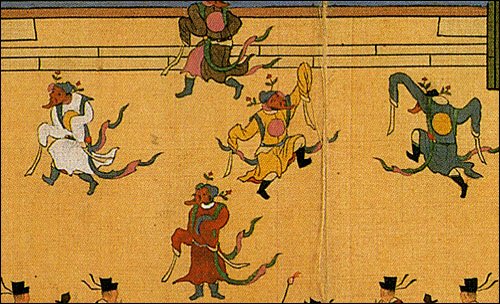
Cheoyongmu is a court dance today performed on stage but formerly used to dispel evil spirits and pray for tranquillity at royal banquets or during exorcism rites on New Year’s Eve to promote good fortune. Based on the Korean legend of Cheoyong, a son of the dragon king Yongwang, who took human form and saved his human wife from the smallpox spirit through singing and dancing, the dance is performed by five men clad in white, blue, black, red and yellow to represent the four cardinal directions and the centre. They wear the light wine-coloured mask of the man-god, with white teeth, tin earrings with a necklace of lead beads, and a black hat decorated with two peony blossoms and seven peaches to ward off evil and invite auspicious energy. The dancers move with stateliness and vigour through a variety of styles and tempos of music, punctuated by various lyrical song recitations. Part of a greater folk mythology surrounding Cheoyong, including the belief that his image carved on the gate of a house would repel smallpox and other ills, Cheoyongmu also embodies the philosophy of Confucianism, particularly the Theory of the Five Elements. The creation of the Cheoyong masks also provides a valuable opportunity for traditional craftsmanship.
Official description, UNESCO Intangible Cultural Heritage List — Cheoyongmu
At a glance
Cheoyongmu is a masked court dance performed by five men in costumes of white, blue, black, red and yellow. Based on the legend of Cheoyong, a son of the dragon king who saved his wife from the smallpox spirit through singing and dancing, the performance combines stately and vigorous movement with instrumental music and lyrical song recitations. The dancers wear distinctive masks with light wine-coloured faces, white teeth, tin earrings, lead bead necklaces, and black hats decorated with peonies and peaches.
Origins & history
Cheoyongmu originates from Korean legend: Cheoyong, a son of the dragon king Yongwang, took human form and saved his human wife from the smallpox spirit through singing and dancing. The dance grew from a broader folk mythology in which Cheoyong's image, carved on a house gate, was believed to repel smallpox and other ills. The tradition embodies Confucian philosophy, particularly the Theory of the Five Elements, which the five dancers represent—the four cardinal directions and the centre.
The practice
Five male performers dance in costumes representing the four cardinal directions and centre, each wearing the light wine-coloured mask with white teeth, tin earrings, lead bead necklaces, and a black hat adorned with two peony blossoms and seven peaches to ward off evil. The dancers move with stateliness and vigour through varied styles and tempos of music, accompanied by lyrical song recitations that punctuate the performance.
Cultural significance
Cheoyongmu was traditionally performed at royal banquets and on New Year's Eve during exorcism rites to dispel evil spirits and promote good fortune and tranquillity. Today it serves as a stage performance that keeps alive the knowledge of traditional mask-making craftsmanship, movement vocabularies, costuming, and music. The dance transmits the spiritual and courtly practices that shaped Korean cultural identity.
Key facts
- Country: Republic of Korea
- Inscribed: 2009
- UNESCO list: Representative List of the Intangible Cultural Heritage of Humanity
- UNESCO reference: 00189
- UNESCO vocabulary: Masks; Ritual dance; Theatre
- Map: not shown — UNESCO’s official description of this element names no locality, and a living tradition is practised across a community, not at one address.
Where to experience it
Cheoyongmu is performed on stages today by trained dancers and cultural institutions that maintain this ancient tradition. Visitors can encounter performances at cultural centers, museums, and official celebrations, particularly during festivals and special events dedicated to intangible heritage. The dance remains part of Korea's living cultural landscape, with performances offering opportunities to witness the elaborate costumes, masks, and movements that embody both legend and philosophy. Contact local cultural heritage organizations or national centers for current performance schedules and venues where this exorcism ritual has been transformed into a celebrated art form.
Sources & resources
- UNESCO — official element page: Cheoyongmu
- UNESCO — open data record: Intangible Heritage List, reference 00189
- UNESCO — official video: UNESCO film on this element — embedded on this page
- UNESCO — official photograph: Photograph of this element — Lee Sang-ueun — Cultural Heritage Administration, 2000
- Reference — Wikipedia (secondary): Cheoyongmu — consulted as a secondary reference, not as confirmation
- Cultural Heritage Online: Our archive and city guides

Sources
- S1 — van Zile, Judy. Perspectives on Korean Dance. Wesleyan University Press, 2001. ISBN 978-0-8195-6494-8.
- S2 — Howard, Keith. Preserving Korean Music: Intangible Cultural Properties as Finished Products. Ashgate, 2006. ISBN 978-0-7546-5792-7.
Spotted an error? Write to editorial@culturalheritageonline.com and we correct it the same day.