
An ancient Iranian system of martial arts, strength training and ritual movement performed in sacred domed spaces, blending pre-Islamic tradition with the spirituality of Persian Shia Islam.
In UNESCO’s words
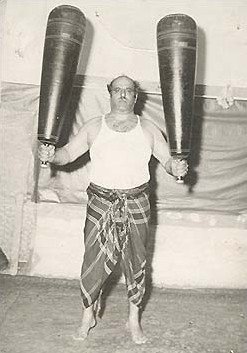
Pahlevani is an Iranian martial art that combines elements of Islam, Gnosticism and ancient Persian beliefs. It describes a ritual collection of gymnastic and callisthenic movements performed by ten to twenty men, each wielding instruments symbolizing ancient weapons. The ritual takes place in a ''Zoorkhane,'' a sacred domed structure with an octagonal sunken arena and audience seats. The ''Morshed'' (master) who leads the Pahlevani ritual performs epic and Gnostic poems and beats out time on a ''zarb'' goblet drum. The poems he recites transmit ethical and social teachings and constitute part of Zoorkhanei literature. Participants in the Pahlevani ritual may be drawn from any social strata or religious background, and each group has strong ties to its local community, working to assist those in need. During training, students are instructed in ethical and chivalrous values under the supervision of a ''Pīshkesvat'' (champion). Those who master the individual skills and arts, observe religious principles and pass ethical and moral stages of Gnosticism may acquire the prominent rank of ''Pahlevanī'' (hero), denoting rank and authority within the community. At present, there are 500 Zoorkhanes across Iran, each comprising practitioners, founders and a number of ''Pīshkesvats.''
Official description, UNESCO Intangible Cultural Heritage List — Pahlevani and Zoorkhanei rituals
At a glance
Pahlevani is an Iranian martial art combining Islamic, Gnostic and ancient Persian beliefs. Groups of ten to twenty men perform ritual gymnastic and calisthenic movements in a Zoorkhane, a sacred domed structure with an octagonal sunken arena. Each participant wields instruments that symbolize ancient weapons, while a master called the Morshed leads the ritual, reciting epic and Gnostic poems and beating time on a zarb goblet drum.
Origins & history
Pahlevani draws from both pre-Islamic Persian traditions and post-Islamic beliefs, integrating elements of Gnosticism with Islamic practice. The poems recited during rituals, known as Zoorkhanei literature, transmit ethical and social teachings that have been central to the tradition. Today, approximately 500 Zoorkhanes operate across Iran, each with its own practitioners, founders and champions.
The practice
A Zoorkhane is a sacred domed structure featuring an octagonal sunken arena surrounded by audience seats. During the ritual, ten to twenty men perform synchronized gymnastic and calisthenic movements while wielding symbolic weapons. The Morshed stands as leader, reciting poems and keeping rhythm on a zarb drum. Students train under a Pīshkesvat (champion) who instructs them in both individual skills and ethical values.
Cultural significance
Participants come from any social background or religious belief, and each Zoorkhane maintains strong ties to its local community, working to assist those in need. Those who master the skills, observe religious principles and progress through ethical and moral stages of Gnosticism may achieve the rank of Pahlevanī, denoting authority within their community. The tradition preserves knowledge of chivalrous values and community solidarity across generations.
Key facts
- Country: Iran (Islamic Republic of)
- Inscribed: 2010
- UNESCO list: Representative List of the Intangible Cultural Heritage of Humanity
- UNESCO reference: 00378
- UNESCO vocabulary: Martial arts; Rituals
- Map: not shown — UNESCO’s official description of this element names no locality, and a living tradition is practised across a community, not at one address.
Where to experience it
Pahlevani is practised across Iran in approximately 500 Zoorkhanes, each a sacred domed structure with an octagonal sunken arena where ten to twenty men perform ritualistic gymnastic movements. Visitors can witness these traditions by attending training sessions at active Zoorkhanes, where the master recites epic poems while beating time on a zarb drum, and participants move in synchronized sequences with symbolic weapons. These community spaces welcome observers to experience the full ritual of movement, music, and ethical teaching that has bound neighbourhoods together for generations.
Sources & resources
- UNESCO — official element page: Pahlevani and Zoorkhanei rituals
- UNESCO — open data record: Intangible Heritage List, reference 00378
- UNESCO — official photograph: Photograph of this element — Morteza Rezvanfar — 2009- By Iranian Cultural Heritage, Handicrafts and Tourism Organization
- Reference — Wikipedia (secondary): Pahlevani and zoorkhaneh rituals — consulted as a secondary reference, not as confirmation
- Cultural Heritage Online: Our archive and city guides
Sources
- S1 — Chehabi, H. E. The Juggernaut of Globalization: Sports and Modernity in Iran. International Journal of the History of Sport, 2002. / Foltz, Richard. Religions of Iran. Oneworld Publications, 2013. ISBN 978-1-78074-308-0.
- S2 — Luijendijk, D. H. Zoor Khane: Ancient Martial Art of Iran. Boulder, 2006. ISBN 978-1-4303-2545-1.
Spotted an error? Write to editorial@culturalheritageonline.com and we correct it the same day.