
An all-male itinerant troupe that has wandered Korea’s marketplaces and villages for centuries, performing a virtuosic blend of acrobatics, mask drama, puppet theater, and music.
In UNESCO’s words
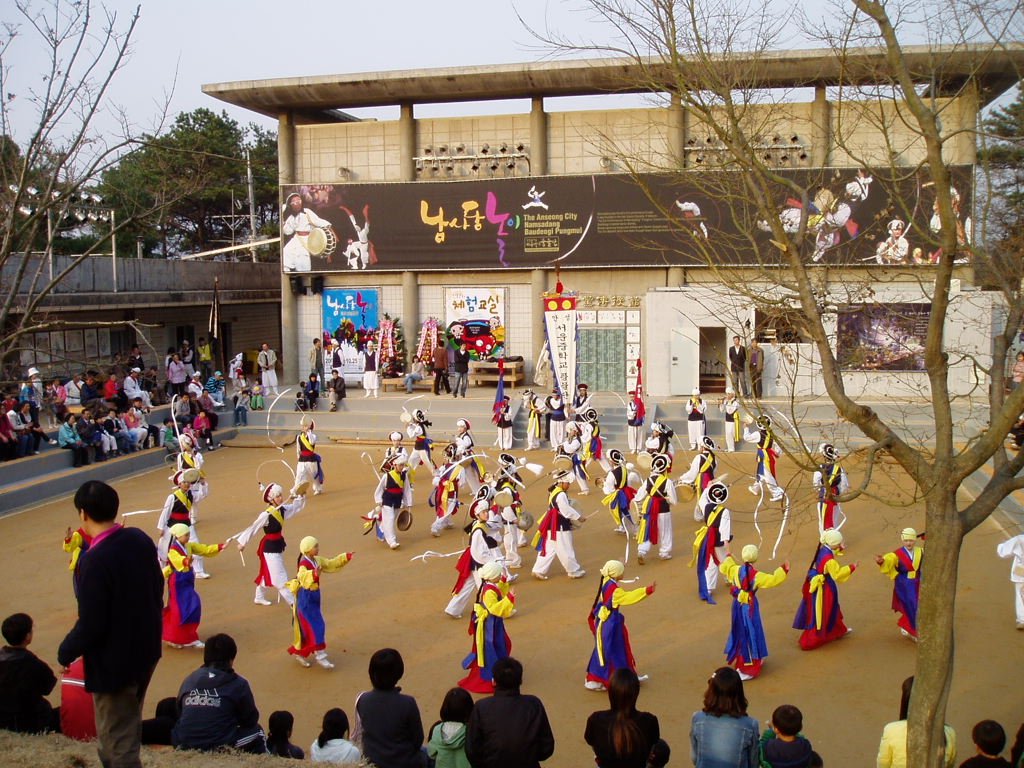
Namsadang Nori, literally the ‘all-male vagabond clown theatre’, is a multifaceted folk performance tradition originally practised widely by travelling entertainers and now kept alive by professional troupes in the Republic of Korea. The performance is made up of six components: a segment of ‘farmers’ music’ emphasizes the percussive sounds of metal gongs and animal-hide drums; a mask dance presents four comic scenes depicting people from different social classes; a tightrope walking act sees an acrobat on a high-wire engaged in witty exchanges with a clown below; in a puppet play, more than fifty puppets act out seven scenes together with a narrator and musicians; an acrobatic segment combines physical feats performed on the ground with comic dialogue and music; and an intricate display of hoop spinning with a wooden stick rounds out the performance. In addition to entertaining rural audiences that would surround the performers in outdoor arenas, Namsadang Nori carried an important social message. The mask dance and puppet plays in particular enacted the oppression of the lower classes as well as women in a male-dominated society. Through satire, these performances raised issues on behalf of those with no political voice and manifested ideals of equality and freedom, sustaining and inspiring the poor.
Official description, UNESCO Intangible Cultural Heritage List — Namsadang Nori
At a glance
Namsadang Nori is a multifaceted folk performance tradition that combines six distinct components into a single entertainment. The performance features farmers' music using metal gongs and drums, a mask dance with comic scenes of different social classes, tightrope walking with acrobatic and comic exchanges, a puppet play with more than fifty figures acting out scenes, acrobatic feats paired with dialogue and music, and hoop spinning displays. Originally practised by travelling entertainers, professional troupes in the Republic of Korea now maintain this tradition, performing in outdoor arenas for audiences.
Origins & history
Namsadang Nori developed among travelling entertainers and grew into a tradition kept alive by professional troupes. The performance tradition carried social significance beyond entertainment, as the mask dance and puppet plays enacted the oppression of lower classes and women in a male-dominated society. Through satire, these performances gave voice to those without political power and promoted ideals of equality and freedom, sustaining hope among the poor.
The practice
A Namsadang Nori performance unfolds as six integrated components, each requiring distinct skills. Farmers' music emphasizes percussive sounds of metal gongs and animal-hide drums. The mask dance presents four comic scenes depicting people from different social classes. A tightrope walker performs on a high-wire while exchanging witty remarks with a clown positioned below. The puppet play features more than fifty puppets acting out seven scenes alongside a narrator and musicians. Acrobatic segments combine physical feats performed on the ground with comic dialogue and music. The performance concludes with an intricate display of hoop spinning using a wooden stick.
Cultural significance
Beyond entertainment, Namsadang Nori carried an important social message for rural audiences. The mask dance and puppet plays in particular raised issues on behalf of the lower classes and women, who had no political voice. Through satire, the tradition manifested ideals of equality and freedom, sustaining and inspiring the poor by depicting their oppression in a male-dominated society.
Key facts
- Country: Republic of Korea
- Inscribed: 2009
- UNESCO list: Representative List of the Intangible Cultural Heritage of Humanity
- UNESCO reference: 00184
- UNESCO vocabulary: Acrobatics; Performing arts; Theatre
- Map: not shown — UNESCO’s official description of this element names no locality, and a living tradition is practised across a community, not at one address.
Where to experience it
Namsadang Nori is kept alive by professional troupes throughout the Republic of Korea, where performances can be encountered at cultural venues and festivals. Visitors seeking to experience this multifaceted tradition should contact local cultural centers or national intangible cultural heritage authorities for current performance schedules and information about where travelling entertainers and established companies present their six-part shows—from farmers' music and mask dances to tightrope walking, puppet plays, acrobatics, and hoop spinning—to audiences gathered in outdoor arenas and formal venues alike.
Sources & resources
- UNESCO — official element page: Namsadang Nori
- UNESCO — open data record: Intangible Heritage List, reference 00184
- UNESCO — official video: UNESCO film on this element — embedded on this page
- UNESCO — official photograph: Photograph of this element — Song Bong-wha — Cultural Heritage Administration, 2000
- Reference — Wikipedia (secondary): Namsadang — consulted as a secondary reference, not as confirmation
- Cultural Heritage Online: Our archive and city guides

Sources
- S1 — Kim, Uk-dong. The Art of Peasant Theatre in Korea. Seoul National University Press, 2001. ISBN 978-89-521-0260-7.
- S2 — Howard, Keith. Preserving Korean Music: Intangible Cultural Properties as Finished Products. Ashgate, 2006. ISBN 978-0-7546-5792-7.
Spotted an error? Write to editorial@culturalheritageonline.com and we correct it the same day.