
Armenian craftspeople carve memorial stelae bearing intricate crosses, rosettes, and botanical motifs in a tradition rooted in medieval Christian art.
In UNESCO’s words
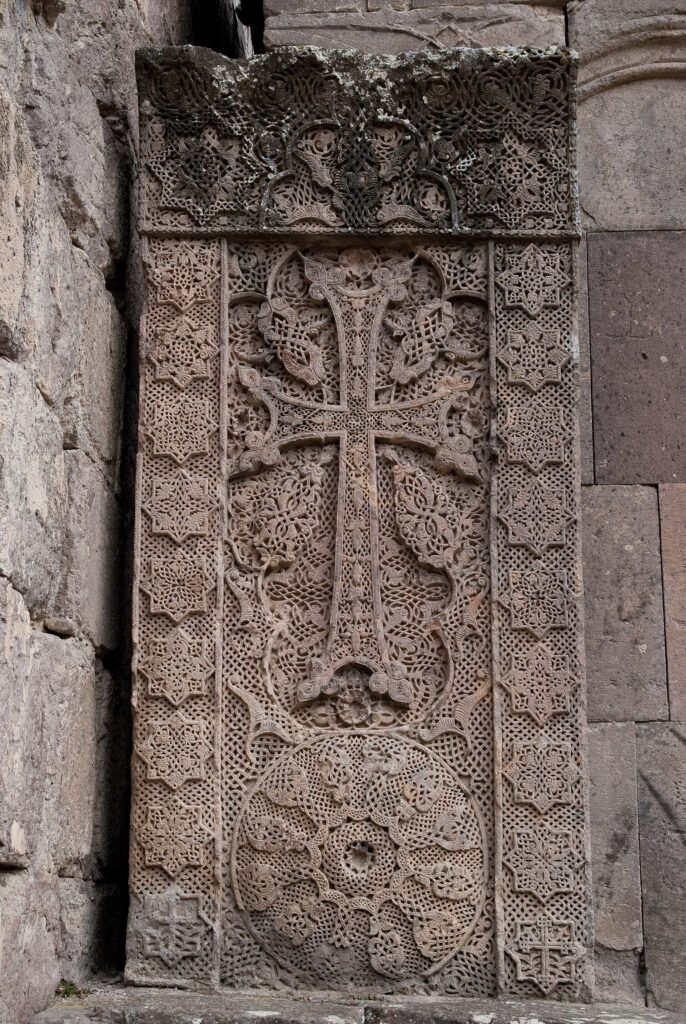
Khachkars are outdoor steles carved from stone by craftspeople in Armenia and communities in the Armenian diaspora. They act as a focal point for worship, as memorial stones and as relics facilitating communication between the secular and divine. Khachkars reach 1.5 metres in height, and have an ornamentally carved cross in the middle, resting on the symbol of a sun or wheel of eternity, accompanied by vegetative-geometric motifs, carvings of saints and animals. Khachkars are created usually using local stone and carved using chisel, die, sharp pens and hammers. The carvings are then ground using fine sand. Small breaks and rough surfaces are eliminated by plaster of clay or lime, and then painted. Once finished, the Khachkar is erected during a small religious ceremony. After being blessed and anointed, the Khachkar is believed to possess holy powers and can provide help, protection, victory, long life, remembrance and mediation towards salvation of the soul. Among more than 50,000 Khachkars in Armenia, each has its own pattern, and no two are alike. Khachkar craftsmanship is transmitted through families or from master to apprentice, teaching the traditional methods and patterns, while encouraging regional distinctiveness and individual improvisation.
Official description, UNESCO Intangible Cultural Heritage List — Armenian cross-stones art. Symbolism and craftsmanship of Khachkars
At a glance
Khachkars are carved stone steles created by Armenian craftspeople and communities in the Armenian diaspora. Each stele features an ornamentally carved cross at its center, resting on a sun or wheel symbol, accompanied by vegetative-geometric motifs, carvings of saints and animals. Typically reaching 1.5 metres in height, khachkars serve as focal points for worship, memorial stones, and relics that facilitate communication between the secular and divine.
Origins & history
Khachkars represent a long-established tradition within Armenian communities. Among more than 50,000 examples in Armenia, each possesses its own unique pattern—no two are alike. The craftsmanship is transmitted through families or from master to apprentice, with teaching methods that preserve traditional techniques and patterns while encouraging regional distinctiveness and individual improvisation.
The practice
Craftspeople carve khachkars from local stone using chisels, dies, sharp pens and hammers. Once carved, the surface is ground using fine sand, and small breaks or rough areas are smoothed with plaster of clay or lime before painting. The finished stele is then erected during a small religious ceremony, after which it is blessed and anointed.
Cultural significance
Once blessed and anointed, a khachkar is believed to possess holy powers, capable of providing help, protection, victory, long life, remembrance and mediation towards salvation of the soul. The tradition remains vital to Armenian communities as a means of honouring the dead and expressing spiritual devotion. Transmission of knowledge between generations ensures the survival of traditional carving methods.
Key facts
- Country: Armenia
- Inscribed: 2010
- UNESCO list: Representative List of the Intangible Cultural Heritage of Humanity
- UNESCO reference: 00434
- UNESCO vocabulary: Orthodox Churches; Sculpture
- Map: not shown — UNESCO’s official description of this element names no locality, and a living tradition is practised across a community, not at one address.
Where to experience it
Khachkars can be encountered throughout Armenia, where more than 50,000 of these carved stone steles stand as focal points for worship and remembrance. Visitors may observe the craft through stone artisans' workshops and witness newly commissioned khachkars being erected during religious ceremonies. The tradition also thrives among Armenian diaspora communities worldwide, each khachkar displaying its own unique pattern and regional distinctiveness. To experience the living practice, seek out memorial sites and craftspeople who continue transmitting these traditional methods and patterns through family lineages and apprenticeships.
Sources & resources
- UNESCO — official element page: Armenian cross-stones art. Symbolism and craftsmanship of Khachkars
- UNESCO — open data record: Intangible Heritage List, reference 00434
- UNESCO — official photograph: Photograph of this element — Z. Sargsyan — 2008, H.L Petrosyan
- Reference — Wikipedia (secondary): Khachkar — consulted as a secondary reference, not as confirmation
- Cultural Heritage Online: Our archive and city guides

Sources
- S1 — Donabédian, Patrick. The Armenian Khachkar. Somogy Art Publishers, 2008. ISBN 978-2-7572-0152-7.
- S2 — Maranci, Christina. The Art of Armenia: An Introduction. Oxford University Press, 2018. ISBN 978-0-19-067409-0.
Spotted an error? Write to editorial@culturalheritageonline.com and we correct it the same day.