
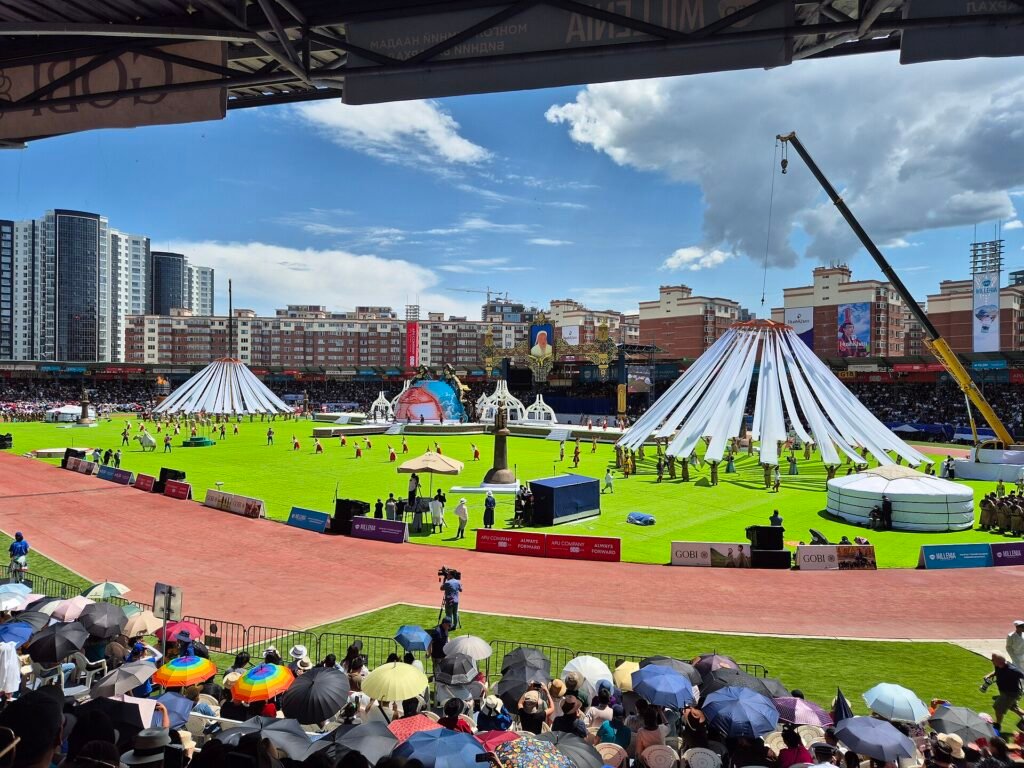
A midsummer festival of wrestling, horse racing and archery that draws together communities across Mongolia, Inner Mongolia and Tuva to celebrate the “three games of men.”
In UNESCO’s words
Naadam is a national festival celebrated every year from 11 to 13 July across Mongolia that focuses on three traditional games: horseracing, wrestling and archery. Mongolian Naadam is inseparably connected to the nomadic civilization of the Mongols, who have long practiced pastoralism on Central Asia’s vast steppe. Oral traditions, performing arts, national cuisine, craftsmanship, and cultural forms such as long song, Khöömei overtone singing, Bie biyelgee dance and Morin khuur fiddle also feature prominently during Naadam. Mongolians follow special rituals and practices during the festival, such as wearing unique costumes and using distinctive tools and sporting items. Festival participants revere the sportsmen, sportswomen, and children who compete, and winners are rewarded titles for their achievements. Ritual praise songs and poems are dedicated to the contestants in the events. Everyone is allowed and encouraged to participate in Naadam, thus nurturing community involvement and togetherness. The three types of sports are directly linked with the lifestyles and living conditions of the Mongols and their transmission is traditionally undertaken through home-schooling by family members, although formalized training regimens have recently developed for wrestling and archery. The rituals and customs of Naadam also accentuate respect for nature and the environment.
Official description, UNESCO Intangible Cultural Heritage List — Naadam, Mongolian traditional festival
At a glance
Naadam is Mongolia's annual national festival, celebrated from 11 to 13 July each year. It centres on three traditional games: horseracing, wrestling, and archery. The festival showcases not only these competitions but also oral traditions, performing arts, national cuisine, craftsmanship, and cultural forms including long song, Khöömei overtone singing, Bie biyelgee dance, and Morin khuur fiddle. Everyone is encouraged to participate, fostering community involvement and togetherness.
Origins & history
Naadam is inseparably connected to Mongolian nomadic civilization and the pastoralism long practised across Central Asia's steppe. The three sports are directly linked to the lifestyles and living conditions of the Mongols. Their transmission has traditionally been undertaken through home-schooling by family members, though formalized training regimens have recently developed for wrestling and archery.
The practice
Participants wear unique costumes and use distinctive tools and sporting items during Naadam. The three competitions involve specific practices: horseracing, wrestling, and archery. Ritual praise songs and poems are dedicated to contestants, and winners receive titles for their achievements. Mongolians follow special rituals and practices throughout the festival.
Cultural significance
Naadam strengthens community bonds and reflects deep respect for nature and the environment among Mongolian culture. Festival participants revere the sportsmen, sportswomen, and children who compete, emphasizing the cultural value placed on these athletes. The festival nurtures community participation and celebrates traditions central to Mongolian identity and heritage.
Key facts
- Country: Mongolia
- Inscribed: 2010
- UNESCO list: Representative List of the Intangible Cultural Heritage of Humanity
- UNESCO reference: 00395
- UNESCO vocabulary: Festivals; Rituals; Sports competitions
- Map: not shown — UNESCO’s official description of this element names no locality, and a living tradition is practised across a community, not at one address.
Where to experience it
Naadam takes place across Mongolia every year from 11 to 13 July, drawing thousands of spectators, athletes and families to witness the three traditional competitions of horseracing, wrestling and archery. Visitors can experience not only the sporting events held in stadiums and on open grounds, but also the wider cultural expressions that accompany the festival—long song, Khöömei overtone singing, Bie biyelgee dance and Morin khuur fiddle performances. The festival embodies nomadic pastoralist traditions and encourages community participation, allowing everyone to engage with these living customs. For specific dates and venues, consult local tourism information or UNESCO's Intangible Cultural Heritage platform.
Sources & resources
- UNESCO — official element page: Naadam, Mongolian traditional festival
- UNESCO — open data record: Intangible Heritage List, reference 00395
- UNESCO — official video: UNESCO film on this element — embedded on this page
- UNESCO — official photograph: Photograph of this element — Ch. Batbold — Ch. Batbold, 2009
- Reference — Wikipedia (secondary): Naadam — consulted as a secondary reference, not as confirmation
- Cultural Heritage Online: Our archive and city guides

Sources
- S1 — Pegg, Carole. Mongolian Music, Dance, & Oral Narrative. University of Washington Press, 2001. ISBN 978-0-295-98030-0.
- S2 — Humphrey, Caroline. The Unmaking of Soviet Life. Cornell University Press, 2002. ISBN 978-0-8014-8773-6.
Spotted an error? Write to editorial@culturalheritageonline.com and we correct it the same day.