
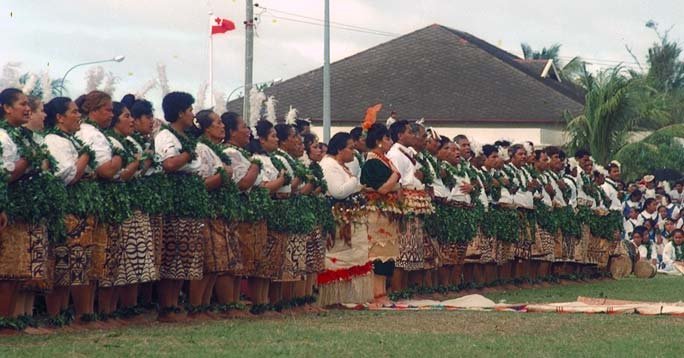
A standing group dance where performers gesture with their arms alone, Lakalaka is Tonga’s national dance and the formal expression of the kingdom’s ceremonial life.
In UNESCO’s words
The Tonga archipelago lies in the South Pacific approximately 2,000 kilometres north-east of New Zealand. It is the only constitutional monarchy in the Pacific region. Often considered Tonga’s national dance, Lakalaka is a blend of choreography, oratory, and vocal and instrumental polyphony. This cultural expression is practised by communities throughout the islands and features prominently at important celebrations such as the coronation of the monarch and anniversaries of the constitution.The term lakalaka means “to step briskly or carefully” in the Tongan language, and its origins can be traced to a dance known as the me’elaufola. The tradition developed in the nineteenth century and, thanks to the continuous transmission and the patronage of the royal family, it underwent a revival in the twentieth century. Performances last approximately thirty minutes and involve large groups of up to several hundred people. Participants are aligned in rows, men on the right and women on the left.The men dance in rapid and energetic movements, while the women execute graceful dance steps co-ordinated with elegant hand gestures. Both groups clap and sing as they move, and a chorus often provides vocal accompaniment.The polyphonic singing coupled with the synchronized movements of hundreds of dancers offers an impressive spectacle.The creative force behind the performance is the punake who is at the same time poet, composer, choreographer and performance director. Punakes are expected to continually renew the Lakalaka repertory, by exploring themes related to Tongan history, legends, values and social structure. However, over the past few decades, the number of performances has, diminished and young composers tend to recycle the existing repertory rather than create new compositions.
Official description, UNESCO Intangible Cultural Heritage List — Lakalaka, dances and sung speeches of Tonga
At a glance
Lakalaka is a group dance performed throughout the Tongan islands, blending choreography with poetry, singing, and instrumental music. The name means 'to step briskly or carefully' in Tongan. Considered the national dance, it features prominently at important celebrations including coronations and constitutional anniversaries. Performances typically last about thirty minutes and involve large groups of up to several hundred participants arranged in rows, with men on the right and women on the left.
Origins & history
Lakalaka traces its origins to an earlier dance called the me'elaufola. The tradition developed during the nineteenth century and experienced a significant revival in the twentieth century, supported by the patronage of the royal family. This continuous transmission across generations helped establish it as a central part of Tongan cultural expression.
The practice
Performances feature men executing rapid and energetic movements while women perform graceful steps coordinated with elegant hand gestures. Both groups clap and sing as they move, often accompanied by a chorus providing vocal support. The creative direction comes from the punake—a single individual who serves as poet, composer, choreographer, and performance director. Punakes traditionally renew the repertory by creating new compositions that explore themes from Tongan history, legends, values, and social structure.
Cultural significance
Lakalaka embodies the collective identity of Tongan communities and marks moments of national importance. The synchronized movements of hundreds of dancers combined with polyphonic singing create an impressive spectacle that reinforces cultural continuity. However, over recent decades the number of performances has diminished, and young composers increasingly recycle existing works rather than develop new ones, raising concerns about the tradition's creative vitality.
Key facts
- Country: Tonga
- Inscribed: 2008
- UNESCO list: Representative List of the Intangible Cultural Heritage of Humanity
- UNESCO reference: 00072
- UNESCO vocabulary: Dance; Instrumental music; Polyphonic singing; Vocal music
- Map: not shown — UNESCO’s official description of this element names no locality, and a living tradition is practised across a community, not at one address.
Where to experience it
Lakalaka is performed by communities throughout the Tonga archipelago, featuring prominently at important celebrations including the coronation of the monarch and anniversaries of the constitution. Visitors can experience this national dance at royal occasions and major festivals that showcase Tongan culture. Performances typically last around thirty minutes and involve large groups of dancers—sometimes several hundred—aligned in rows with men on the right and women on the left, accompanied by polyphonic singing and synchronized movements that create an impressive spectacle.
Sources & resources
- UNESCO — official element page: Lakalaka, dances and sung speeches of Tonga
- UNESCO — open data record: Intangible Heritage List, reference 00072
- UNESCO — official video: UNESCO film on this element — embedded on this page
- UNESCO — official photograph: A blend of dances, recitations, songs and music, the Lakalaka involves up to several hundred people aligned in rows dancing in rapid and energetic movements. Practised by communities throughout the islands, it features themes related to Tongan history, legends, values and social structures. — Pesi S. Fonua
- Reference — Wikipedia (secondary): Lakalaka — consulted as a secondary reference, not as confirmation
- Cultural Heritage Online: Our archive and city guides

Sources
- S1 — Kaeppler, Adrienne L. Poetry in Motion: Studies of Tongan Dance. Vava'u Press, 1993. ISBN 978-982-213-003-4.
- S2 — Campbell, I. C. Island Kingdom: Tonga Ancient and Modern. Canterbury University Press, 2001. ISBN 978-1-877257-14-8.
Spotted an error? Write to editorial@culturalheritageonline.com and we correct it the same day.