
A ritual theatre and folk dance drama performed in Kerala temples, Mudiyettu enacts the mythological battle between the goddess Kali and the demon Darika through elaborate movement, costume, and devotional practice.
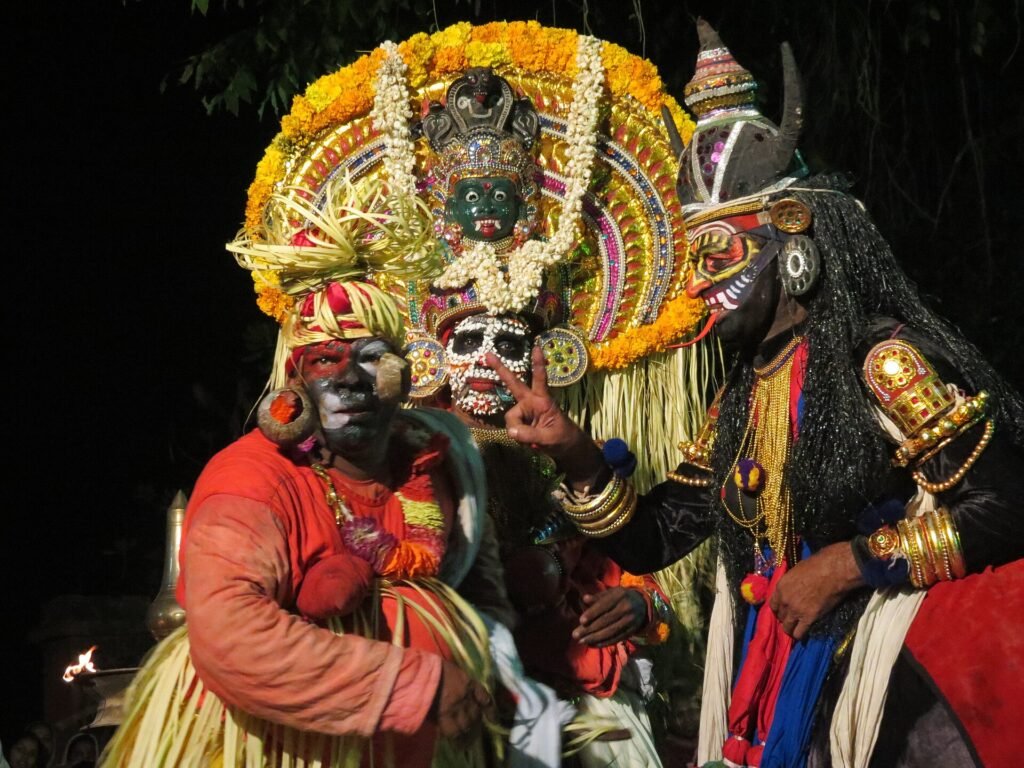
In UNESCO’s words
Mudiyettu is a ritual dance drama from Kerala based on the mythological tale of a battle between the goddess Kali and the demon Darika. It is a community ritual in which the entire village participates. After the summer crops have been harvested, the villagers reach the temple in the early morning on an appointed day. Mudiyettu performers purify themselves through fasting and prayer, then draw a huge image of goddess Kali, called as ''kalam'', on the temple floor with coloured powders, wherein the spirit of the goddess is invoked. This prepares the ground for the lively enactment to follow, in which the divine sage Narada importunes Shiva to contain the demon Darika, who is immune to defeat by mortals. Shiva instead commands that Darika will die at the hand of the goddess Kali. Mudiyettu is performed annually in ‘Bhagavati Kavus’, the temples of the goddess, in different villages along the rivers Chalakkudy Puzha, Periyar and Moovattupuzha. Mutual cooperation and collective participation of each caste in the ritual instils and strengthens common identity and mutual bonding in the community. Responsibility for its transmission lies with the elders and senior performers, who engage the younger generation as apprentices during the course of the performance. Mudiyettu serves as an important cultural site for transmission of traditional values, ethics, moral codes and aesthetic norms of the community to the next generation, thereby ensuring its continuity and relevance in present times.
Official description, UNESCO Intangible Cultural Heritage List — Mudiyettu, ritual theatre and dance drama of Kerala
At a glance
Mudiyettu is a ritual dance drama performed in Kerala that tells the mythological story of goddess Kali's battle against the demon Darika. The entire village participates in this community ritual, which takes place after the summer harvest. Performers begin by purifying themselves through fasting and prayer, then create a large image of the goddess called a kalam using coloured powders on the temple floor. This sacred drawing invokes the goddess's spirit and sets the stage for the dramatic performance that follows.
Origins & history
Mudiyettu originates from the temple worship practices of Kerala and is performed annually in Bhagavati Kavus—temples dedicated to the goddess—located in villages along three rivers. The ritual draws on local mythology and has been central to community life for generations. Knowledge of the tradition passes from elders and senior performers to younger apprentices, who learn by participating in the performance itself, ensuring the practice continues.
The practice
The performance unfolds as the divine sage Narada appeals to Shiva to stop the demon Darika, who cannot be defeated by mortals. Shiva then decrees that Kali alone will destroy him. Mudiyettu brings together people of all castes working cooperatively, demonstrating the mutual responsibilities that bind the community. The ritual serves as the occasion when elders actively teach younger generations the traditional values, ethics, moral codes, and aesthetic principles that define their culture.
Cultural significance
Mudiyettu strengthens the community by requiring each caste to participate together in a shared ritual responsibility. This collective act builds common identity and mutual bonds among villagers. The performance transmits traditional knowledge and cultural continuity to the next generation, keeping the community's values and practices alive and relevant in the present day.
Key facts
- Country: India
- Inscribed: 2010
- UNESCO list: Representative List of the Intangible Cultural Heritage of Humanity
- UNESCO reference: 00345
- UNESCO vocabulary: Dance; Religious practice; Theatre
- Map: not shown — UNESCO’s official description of this element names no locality, and a living tradition is practised across a community, not at one address.
- Related World Heritage site: Western Ghats (a different UNESCO designation, not the place of the tradition)
Where to experience it
Mudiyettu is performed annually in Bhagavati Kavus—temples dedicated to the goddess—in villages along the rivers Chalakkudy Puzha, Periyar and Moovattupuzha in Kerala. The ritual takes place after the summer harvest, when entire communities gather at dawn to witness performers purify themselves through fasting and prayer before creating the goddess's image in coloured powder on the temple floor. Visitors attending should approach these performances with deep respect for their sacred, community-centred nature and consult local temples about specific dates and participation protocols.
Sources & resources
- UNESCO — official element page: Mudiyettu, ritual theatre and dance drama of Kerala
- UNESCO — open data record: Intangible Heritage List, reference 00345
- UNESCO — official video: UNESCO film on this element — embedded on this page
- UNESCO — official photograph: Photograph of this element — P. S.Ali — IGNCA/Government of India, 2009
- Reference — Wikipedia (secondary): Mudiyettu — consulted as a secondary reference, not as confirmation
- Cultural Heritage Online: Our archive and city guides

Sources
- S1 — Richmond, Farley P., Darius L. Swann, and Phillip B. Zarrilli, eds. Indian Theatre: Traditions of Performance. University of Hawaii Press, 1990. ISBN 978-0-8248-1322-2.
- S2 — Tarabout, Gilles. Sacrifier et donner à voir en pays malabar. Éditions de l'EHESS, 1986. ISBN 978-2-7132-0857-7.
Spotted an error? Write to editorial@culturalheritageonline.com and we correct it the same day.