
A complete performance art uniting music, storytelling, and traditional dance rooted in the voices of enslaved people and Mauritian Creole communities. Sega remains a living expression of island identity across the Indian Ocean.
In UNESCO’s words
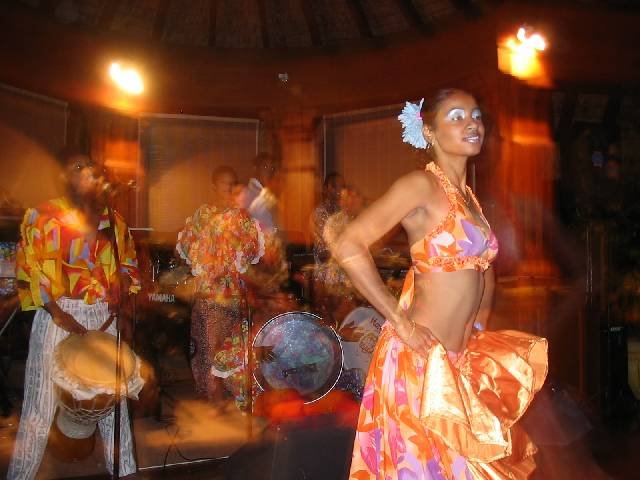
Traditional Mauritian Sega Tipik is a vibrant performing art, emblematic of the Creole community and performed at informal private family events or in public spaces. Songs sung in a minor key gradually increase in tempo, as dancers move their hips and hands to a percussive beat, using short steps to manoeuvre around each other in a variety of different formations. Each soloist improvises lyrics in the Creole language, sometimes blended with other languages, while a frame drum, box rattle and triangle keep time and produce the rhythmic beat. Sega songs can talk of love or address everyday challenges and concerns, with the meaning often enacted through the choreography. Traditionally, women dancers wear long skirts and petticoats while men wear rolled-up trousers, colourful shirts and straw hats, in memory of the dress of their ancestors. The main practitioners are the singers, dancers and musicians, who transmit their skills both formally and informally through participation and imitation. Some practitioners also make the instruments, and transmit their skills through informal apprenticeship. Representing the multiculturalism of Mauritian society, Sega breaks down cultural and class barriers, creates opportunities for intercultural encounters, and unifies various groups around a shared Mauritian heritage.
Official description, UNESCO Intangible Cultural Heritage List — Traditional Mauritian Sega
At a glance
Sega Tipik is a performing art central to Creole community identity, combining music, dance, and song. Performed at family gatherings and public events, it features dancers moving their hips and hands in short steps around each other while singers improvise lyrics in Creole, sometimes blended with other languages. A frame drum, box rattle, and triangle provide the rhythmic beat, with songs beginning in a minor key and gradually increasing in tempo. The choreography often enacts the meaning of lyrics that address love, daily challenges, and everyday concerns.
Origins & history
Sega has its roots in the music of enslaved people and their Mauritian Creole descendants. Historically, the tradition served as a vehicle for social critique; a form called Santé engagé used sega music to protest injustices within Mauritian society. Over time, the practice evolved into multiple regional and stylistic variants, each shaped by the cultural identity of its community and neighboring traditions.
The practice
Performance involves singers who improvise lyrics, dancers, and musicians working together. Performers traditionally wear specific clothing: women wear long skirts and petticoats while men wear rolled-up trousers, colourful shirts, and straw hats, reflecting ancestral dress. The main instruments are a frame drum, box rattle, and triangle. Practitioners learn through both formal and informal methods—participation, imitation, and apprenticeship. Some practitioners also craft the instruments themselves, passing these skills through informal apprenticeship.
Cultural significance
Sega Tipik represents the multiculturalism of Mauritian society, breaking down cultural and class barriers. It creates opportunities for intercultural encounters and unifies various groups around shared Mauritian heritage. The tradition embodies community identity and collective belonging across different social groups.
Key facts
- Country: Mauritius
- Inscribed: 2014
- UNESCO list: Representative List of the Intangible Cultural Heritage of Humanity
- UNESCO reference: 01003
- UNESCO vocabulary: Dance; Instrumental music
- Map: not shown — UNESCO’s official description of this element names no locality, and a living tradition is practised across a community, not at one address.
Where to experience it
Sega Tipik thrives across Mauritius, encountered at informal family gatherings and public celebrations where the Creole community brings the tradition to life. Performers—singers, dancers, and musicians—share their skills through participation and imitation, while some practitioners craft the frame drums, box rattles, and triangles that drive the rhythm. Visitors may encounter sega at community events and cultural festivals throughout the island, where the practice continues to break down social barriers and unite various groups around shared Mauritian heritage. The tradition also persists among Mauritian diaspora communities worldwide, keeping the ancestral art alive beyond the island's shores.
Sources & resources
- UNESCO — official element page: Traditional Mauritian Sega
- UNESCO — open data record: Intangible Heritage List, reference 01003
- UNESCO — official video: UNESCO film on this element — embedded on this page
- UNESCO — official photograph: Members of Lespri Ravann playing the instruments: (left to right) the maravann, the ravann and the triyang — Nipon Medhi — National Heritage Fund
- Reference — Wikipedia (secondary): Sega (genre) — consulted as a secondary reference, not as confirmation
- Cultural Heritage Online: Our archive and city guides

Sources
- S1 — Allen, Richard B. Slaves, Freedmen, and Indentured Laborers in Colonial Mauritius. Cambridge University Press, 1999. ISBN 978-0-521-64125-8.
- S2 — Boswell, Rosabelle. Le Malaise Créole: Ethnic Identity in Mauritius. Berghahn Books, 2006. ISBN 978-1-84545-075-5.
Spotted an error? Write to editorial@culturalheritageonline.com and we correct it the same day.